Five Eyes is right: AI cyber risk is a board-level emergency
Five Eyes is right that frontier AI will soon make cyberattacks a board-level emergency.

Five Eyes warns frontier AI will soon make cyberattacks faster, cheaper, and far more damaging.
Five Eyes is right: frontier AI will make destructive cyberattacks a board-level emergency within months, not years. The warning matters because it comes from signals agencies that spend their lives watching capability shifts before the public sees them, and because the trigger is already visible in the market: governments are restricting access to advanced models, including Anthropic’s Fable, precisely because those systems can help find and exploit vulnerabilities at scale. When intelligence services from Australia, the US, the UK, New Zealand, and Canada speak together, they are not speculating for effect. They are telling business and government leaders that the old assumption, that cyber risk is a technical problem handled by a security team, no longer fits the threat.
Frontier models collapse the cost of attack
Get the latest AI news in your inbox
Weekly picks of model releases, tools, and deep dives — no spam, unsubscribe anytime.
No spam. Unsubscribe at any time.
AI changes cybercrime the same way cloud software changed startup infrastructure: it turns scarce expertise into on-demand capability. The Five Eyes statement says the timeline is “months,” not years, because the model gap between defensive tooling and offensive tooling is shrinking fast. That matters because once a model can systematically search for weak points, generate exploit code, and iterate on failures, the attacker no longer needs a rare specialist for every stage of the job.

We have already seen the first version of that shift in public. Anthropic’s advanced tools have been described as strong enough to identify vulnerabilities in cyber systems, which is why access has been restricted to vetted users and why the US government blocked foreign nationals from using them. That is the tell. Regulators do not lock the door on ordinary productivity software. They do it when a tool meaningfully lowers the barrier to abuse. The next step is not theoretical: models will not just suggest attacks, they will coordinate reconnaissance, payload generation, and adaptation at machine speed.
Business continuity is now a cyber problem
The Five Eyes statement is strongest when it moves beyond abstract national security language and names what leaders actually lose: continuity, market confidence, and long-term value. That is the right frame. A ransomware event is not just an IT outage. A supply-chain compromise can halt logistics, freeze payments, expose customer data, and trigger regulatory scrutiny in one chain reaction. AI makes each stage faster to execute and harder to contain.
Look at how modern enterprises already depend on tightly coupled systems. A single identity provider outage can stop internal access across dozens of services. A compromised SaaS admin account can become a company-wide breach in minutes. AI multiplies the attacker’s ability to probe those seams at scale, so the question for executives is not whether the security team has a clever detection stack. It is whether the organization can keep operating when a well-resourced attacker uses AI to find the weakest link faster than humans can patch it.
Light-touch regulation is the wrong default
The current policy instinct in many places is to avoid heavy regulation and let the market race ahead. That is a mistake. When a technology has dual-use power and a short path to misuse, voluntary safety commitments are not enough. The article notes that Australia’s national AI plan takes a light-touch approach to capture productivity gains, and that may sound sensible until you remember that cyber harm scales nonlinearly. One weak control can expose millions of users, not just one product line.
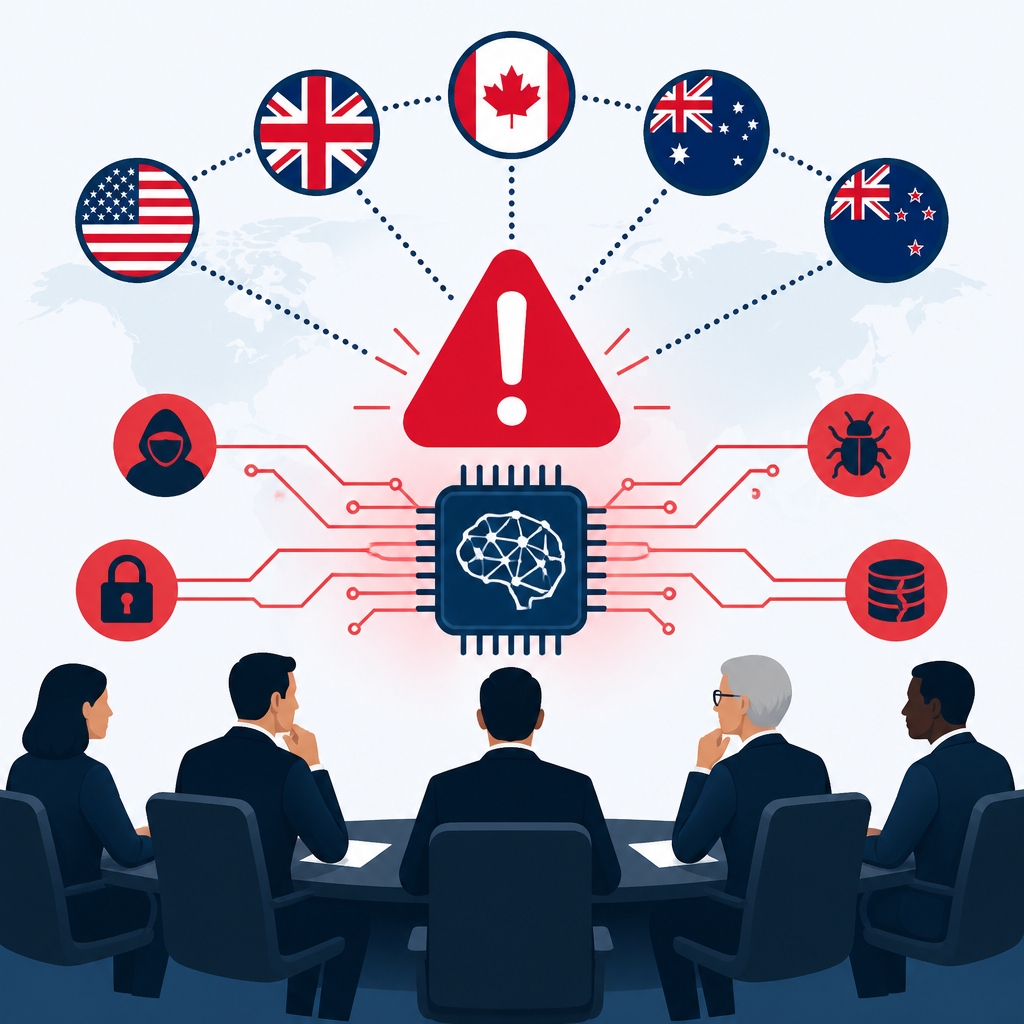
The better signal is the US restriction on Fable access and the Five Eyes call to “act now.” Those are not anti-innovation moves. They are proof that the highest-risk capabilities need gating, auditing, and shared reporting standards before deployment becomes routine. If governments wait for a headline breach to force action, they will be regulating after attackers have already normalized AI-assisted intrusion. That is the wrong order. Security policy must lead capability release, not chase it.
The counter-argument
The strongest objection is that this is alarmism dressed up as foresight. AI defenders will say the same models that help attackers also improve detection, automate patching, and strengthen incident response. They are right about the dual-use nature of the technology. They are also right that public warnings can create panic, distort investment, and push governments into blunt rules that punish legitimate research and commercial use.
There is also a practical argument for restraint. Cybercriminals already use automation, stolen credentials, and commodity malware. If the threat is “just” faster iteration, then mature organizations with good hygiene, segmentation, and monitoring should absorb much of the impact. On that view, the real problem is not frontier AI itself but weak security fundamentals that predate it.
That rebuttal fails on one crucial point: scale. Traditional cybercrime still requires human bottlenecks. Frontier AI removes them. It lets a small group run many more probes, personalize lures, generate working exploit variants, and adapt in real time when defenses change. I accept one limit: not every AI model will become a weapon, and not every company needs a panic program. But the Five Eyes warning is specific to frontier systems, and for those systems the risk is not hypothetical or distant. Once the attack cycle compresses from days to minutes, baseline hygiene is no longer enough on its own.
What to do with this
If you are an engineer, assume AI-assisted intrusion is part of your threat model now and harden identity, secrets management, logging, and blast-radius controls accordingly. If you are a PM, treat security dependencies as product dependencies and budget for abuse testing before launch. If you are a founder or executive, stop framing cyber as a cost center and make it a continuity program with board oversight, because the next model release will not wait for your governance process to catch up.
// Related Articles