OpenAI and Anthropic take 80% of AI 50 funding
OpenAI and Anthropic now hold $242.6 billion of the $305.6 billion raised by Forbes AI 50 startups.

Why do OpenAI and Anthropic hold so much of Forbes’ AI 50 funding?
OpenAI and Anthropic hold $242.6 billion of the $305.6 billion raised by Forbes AI 50 startups.
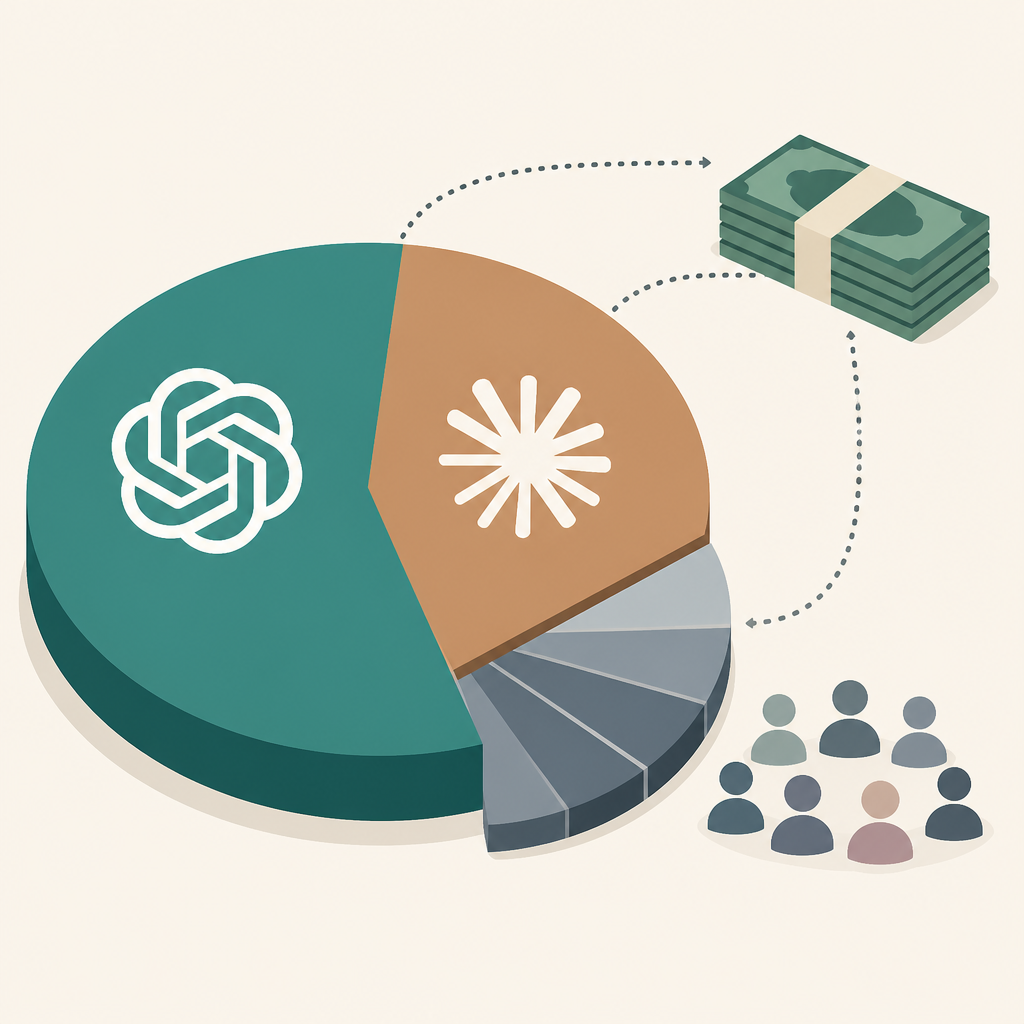
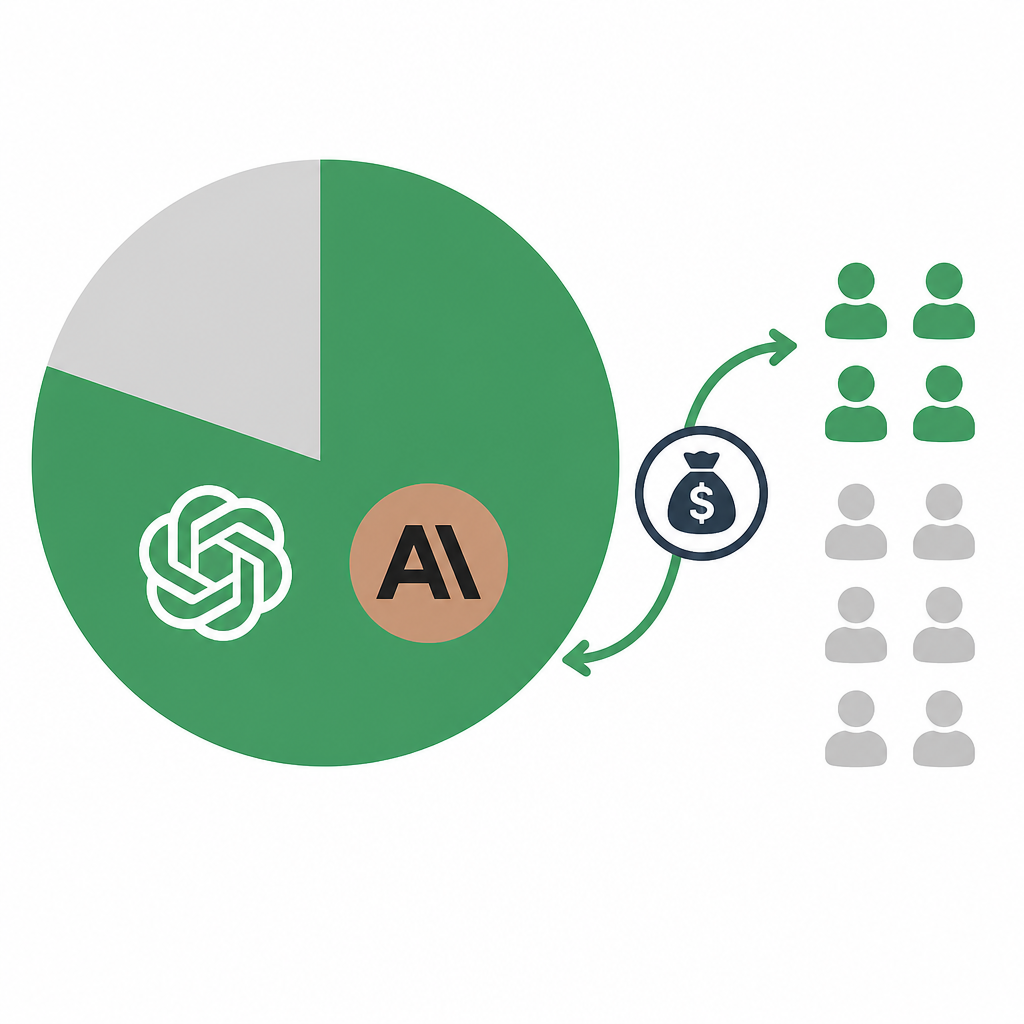
The answer is in the numbers: the 50 private AI companies on Forbes’ 2026 AI 50 list have raised $305.6 billion in venture funding, and OpenAI plus Anthropic account for $242.6 billion of it. That means two companies control about 80% of the capital in a ranking that is supposed to show the shape of the market, not just the size of its checkbooks.
That concentration matters because it changes how buyers, investors, and competitors think about AI. The money at the top is flowing into foundation models and coding tools, while the companies below are proving something more operational: vertical AI products can still build real businesses without raising anywhere near the same amounts of capital.
| Metric | Value | What it means |
|---|---|---|
| Total AI 50 venture funding | $305.6 billion | Capital raised by 50 private AI companies |
| OpenAI + Anthropic funding | $242.6 billion | About 80% of the list’s total funding |
| OpenAI annualized revenue | $25 billion+ | Reported by late February 2026 |
| Anthropic revenue run rate | $30 billion+ | Disclosed in early April 2026 |
The money is concentrating at the top
Get the latest AI news in your inbox
Weekly picks of model releases, tools, and deep dives — no spam, unsubscribe anytime.
No spam. Unsubscribe at any time.
OpenAI and Anthropic are no longer just the two best-known names in AI. They are the gravitational center of venture funding, product attention, and developer tooling. Forbes says OpenAI had passed $25 billion in annualized revenue by late February 2026, while Anthropic said its revenue run rate crossed $30 billion in early April 2026.
Those figures help explain why both companies are pushing hard into coding assistants. Claude Code and Codex are now competing for the same developer workflows, and that is where the real enterprise money sits. When engineering teams choose a coding assistant, they are deciding how code gets written, reviewed, and shipped.
That fight also puts pressure on independent startups. Cursor, valued at $29.3 billion and also on the AI 50 list, has to compete with labs that can spend far more on model training, distribution, and product iteration. The funding gap is so wide that the market is starting to split into two very different classes of companies.
- Frontier labs own the base models and the biggest budgets.
- Application startups build on top of those models and sell to specific buyers.
- Enterprise procurement teams now care as much about vendor stability as model quality.
- Coding tools have become the sharpest battleground because they touch daily workflow.
Vertical AI is where revenue shows up
The more interesting part of the Forbes list is what the smaller companies are doing with far less capital. Gamma, a two-year-old AI presentation builder valued at $2.1 billion, has crossed $100 million in annualized revenue with just 50 employees, according to Forbes. That is a tidy signal that AI software can still be capital efficient when it solves a narrow, repeated job.
“The age of AI is here, and the future is being built by the companies that are using it to solve real problems.” — Fei-Fei Li
That quote from Fei-Fei Li fits the rest of the list. Her company, World Labs, has raised more than $1 billion to work on spatial intelligence. Rogo says roughly 25,000 bankers and investors use its finance-focused AI tools for numerical analysis. Chai Discovery has reached a $1.3 billion valuation while applying AI to drug discovery.
Then there is Physical Intelligence, which has raised $1 billion to train robot foundation models from real-world teleoperation data. That is a different bet entirely: instead of selling software into a browser tab, it is trying to teach machines to act in kitchens, factories, and warehouses.
- Fireworks AI gives developers access to frontier models without hosting the infrastructure themselves.
- Mistral is selling open-weight models to European governments and large companies such as Cisco.
- Reflection is building open-source models for buyers worried about supply-chain origin and data governance.
- Cognition bought the remaining assets of Windsurf after Google hired its cofounders and licensed its tech for $2.4 billion.
Consolidation is changing what buyers should watch
The AI 50 is also showing how quickly the market is consolidating. xAI was acquired by SpaceX, creating a combined entity Forbes values at $1.25 trillion. Google paid $2.4 billion to hire the cofounders of Windsurf and license its technology, and Meta brought on Scale AI cofounder Alexandr Wang to lead its superintelligence lab.
That does two things at once. It removes some independent vendors from the market, and it raises the bar for the ones that remain. Enterprise buyers now have to ask whether a startup can survive long enough to support a multi-year deployment, or whether it will end up inside a larger platform before the contract is even renewed.
For companies buying AI tools, the practical question is no longer “Which model is smartest?” It is “Who controls the model, who controls the roadmap, and what happens if this vendor gets bought?” Those are procurement questions, but they are also architecture questions.
Forbes says the main list received hundreds of applications and used a mix of quantitative scoring and qualitative review. It also launched a first AI 50 Brink list this year, which highlights early-stage startups that may show up in enterprise buying conversations within the next 12 to 24 months.
What the next buying cycle will look like
The 2026 AI 50 list says the market is maturing in a very specific way. The biggest checks keep flowing to a small number of general-purpose labs, while the most useful enterprise products are coming from narrower companies with sharper use cases. That split is likely to get wider before it gets smaller.
If you are building or buying AI software, the takeaway is simple: track the frontier labs for capability, but track the vertical startups for actual deployment. The next vendor shortlists in finance, robotics, drug discovery, and developer tooling will probably come from the companies that can show revenue, retention, and trust, not just model size.
The real question now is whether the next wave of enterprise AI budgets goes to the model owners or to the specialists building on top of them. The answer will decide who gets paid when AI moves from pilot projects to permanent infrastructure.
// Related Articles
- [IND]
Crypto’s infrastructure era arrives with AI agents
- [IND]
AI Weekly: 2026-08-03 ~ 2026-08-10
- [IND]
Kimi K3 Needs About 1.5 TB of Memory
- [IND]
Cursor should not copy VS Code’s new design
- [IND]
Institutional Crypto Tops $30B in Tokenization
- [IND]
Icon’s Claude deal shows clinical trials need AI, not pilots