Fruitfly-Inspired Regression Without Heavy Models
A fruitfly-inspired method turns regression into pattern matching to cut compute, memory, and inference cost.

A fruitfly-inspired method turns regression into pattern matching to cut compute, memory, and inference cost.
- Research org: Unspecified in arXiv abstract
- Core data: No benchmark numbers in abstract
- Breakthrough: Replace global surrogate models with a finite library of local patterns
This paper, From Classification to Regression: Using a Fruitfly to Solve Equations, is trying to solve a familiar engineering problem: how do you make regression and scientific prediction cheaper without losing too much accuracy? The authors argue that many scientific datasets do not fill the whole input space evenly. Instead, they tend to live in limited, recurring regions. That makes them a good fit for a method that looks less like a giant end-to-end regressor and more like a fast retrieval system.
For developers, the appeal is straightforward. If you can answer new queries by matching them against stored patterns, you may not need a large global model for every prediction. That means a smaller memory footprint, lower inference cost, and a design where you can explicitly tune the trade-off between accuracy and efficiency. The paper does not give benchmark numbers in the abstract, so the practical upside is framed as a method-level claim rather than a measured win.
What problem this paper is trying to fix
Get the latest AI news in your inbox
Weekly picks of model releases, tools, and deep dives — no spam, unsubscribe anytime.
No spam. Unsubscribe at any time.
The paper starts from the observation that regression on scientific data is often hard to scale with conventional surrogate models. Global models try to learn one smooth mapping from inputs to outputs across the entire domain, but that can be wasteful when the real data only occupy a few recurring regions. In those cases, a big model may spend capacity learning parts of the space that are rarely or never used.

That is the gap this work targets. Instead of building a single complex model, the authors propose learning from a finite library of representative local patterns. The idea is to exploit structure in the data itself: if similar inputs tend to produce similar outputs, then prediction can be reduced to finding the closest stored patterns and combining their responses.
This is why the method is described as being motivated by fruitflies. The biological analogy is not about copying an organism for its own sake; it is about using a sensing-and-matching style of computation. In other words, the system does not need to understand the whole world at once. It only needs to recognize enough relevant patterns to make a useful prediction.
How the method works in plain English
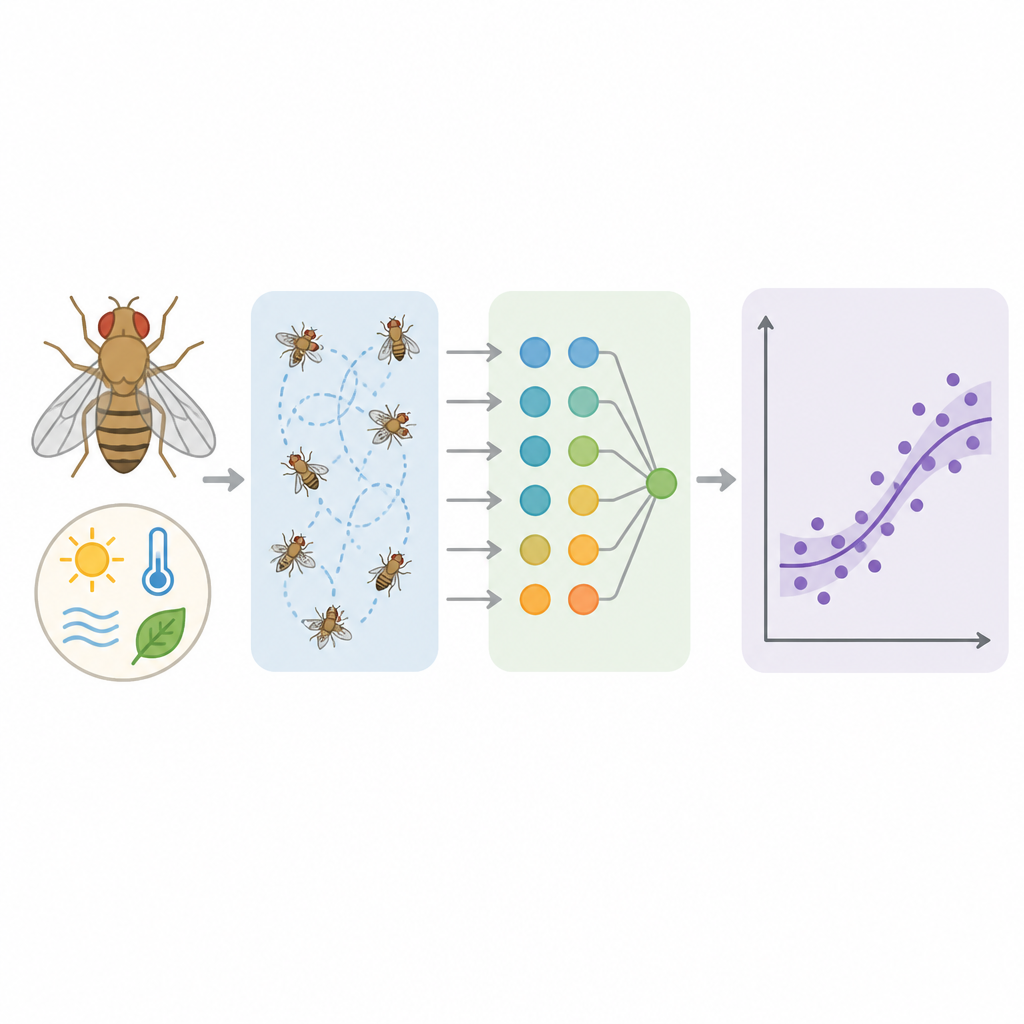
The core move is to recast regression as a classification-like problem. Rather than directly predicting a continuous value from a monolithic model, the method first stores representative local patterns. When a query arrives, the system measures similarity between the query and those stored patterns.
Once it has those similarity scores, it does not stop at a nearest-neighbor vote. The paper says the associated responses are combined through weighted reconstruction. That means the final prediction is built from multiple matched patterns, with more similar patterns contributing more strongly. The result is a reconstruction step that turns a set of local examples into a continuous output.
The authors describe this as a general framework for learning nonlinear input-output relationships. That matters because nonlinear systems are where simple interpolation often breaks down. By anchoring prediction in local patterns, the method is meant to stay useful even when the underlying mapping is complicated, as long as the data can be represented through suitable embeddings and similarity measures.
For dynamical systems, the paper also describes an offline-online workflow. In the offline phase, patterns are extracted from data or governing equations. In the online phase, prediction only requires similarity evaluation and response aggregation. That separation is important because it pushes the expensive work out of the runtime path.
What the paper actually shows
The abstract says the approach is applied in three settings: nonlinear dynamical systems, data-driven regression, and physics-informed learning. It also says the method uses suitable embeddings and similarity measures in those cases. That suggests the framework is meant to be flexible rather than tied to one narrow task.
What the abstract does not provide is equally important. There are no benchmark tables, no accuracy percentages, no speedup numbers, and no memory savings figures in the text provided here. So while the paper clearly claims lower computational and memory demands, the abstract alone does not let us quantify how large those gains are.
Still, the design goal is clear enough to be useful. The authors want explicit control over the trade-off among accuracy, storage, and inference cost. That is a practical engineering target, especially for scientific workloads where you may care more about predictable runtime and compact storage than about squeezing out the last bit of model flexibility.
- The method replaces a global surrogate with a library of local patterns.
- Prediction is done by similarity matching plus weighted reconstruction.
- An offline-online split moves pattern extraction away from runtime inference.
Why developers should care
If you build systems for scientific computing, simulation, or data-driven modeling, this paper points toward a different design pattern for regression. Instead of treating every prediction as a fresh pass through a large model, you can treat it as a retrieval-and-reconstruction problem. That can be easier to reason about, easier to compress, and potentially cheaper to run.
The offline-online structure is especially relevant for production settings. Offline, you can spend time extracting and organizing representative patterns from data or equations. Online, you only need similarity computations and response aggregation. That makes the runtime path simpler, which is attractive when latency, memory, or deployment constraints matter.
There is also a conceptual benefit. Because the framework is built around explicit patterns, it may be easier to inspect than a black-box surrogate. The abstract does not claim interpretability directly, so that should not be overstated, but the stored-pattern design does give engineers a more concrete handle on what the model is using to make decisions.
Limits and open questions
The biggest limitation in the source material is that the abstract stays high level. It does not specify the size of the pattern library, the exact similarity functions, the embeddings used, or the datasets and metrics in enough detail to evaluate the method rigorously from the abstract alone. That means the real engineering cost and performance envelope are still open questions here.
Another practical question is how the approach behaves as problems get larger or less repetitive. The method is motivated by scientific data that occupy limited and recurring regions of input space. If the input distribution becomes broader or more irregular, the pattern library could grow, and the storage-efficiency advantage might shrink. The abstract does not answer that directly.
Even so, the paper is interesting because it proposes a concrete alternative to heavyweight regression: use classification-style similarity over local patterns, then reconstruct the output. For teams working on physics-informed learning or nonlinear dynamical systems, that is a design worth watching, especially if you need a controllable balance between accuracy and resource use.
The bottom line
This paper argues that regression does not always need a full global model. If your data are structured around recurring local regions, a finite library of patterns plus similarity-based reconstruction may be enough to make useful predictions while reducing compute and memory pressure.
For practitioners, the main takeaway is not that this has already beaten standard methods on a published benchmark in the abstract provided here. It is that the authors offer a framework for rethinking regression as pattern matching, with an offline-online workflow that could fit scientific and physics-informed workloads where efficiency matters.
// Related Articles
- [RSCH]
Mental World Modeling: Simulating minds, not just scenes
- [RSCH]
Do You Need to Pretrain Q-Functions?
- [RSCH]
OpenAI’s agent hack forces tighter eval controls
- [RSCH]
CARE routes LoRA experts by confidence
- [RSCH]
πR² makes flow policies react in real time
- [RSCH]
Relay-OPD fixes prefix failure in distillation