Relay-OPD fixes prefix failure in distillation
Relay-OPD lets a teacher briefly take over failed prefixes, improving on-policy distillation and cutting training trajectories by over 50%.
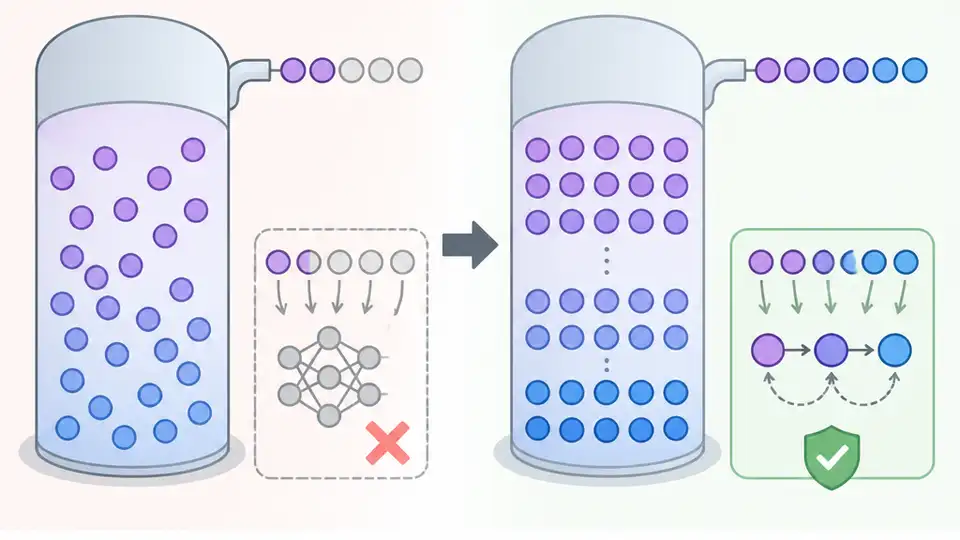
Relay-OPD lets a teacher briefly take over failed prefixes, improving on-policy distillation and cutting training trajectories by over 50%.
- Research org: Unspecified in arXiv abstract
- Core data: Training trajectory length reduced by over 50%
- Breakthrough: Label-free handoff trigger relays teacher control on failed prefixes
On-policy distillation is supposed to make student supervision more realistic by grounding token-level training in the student’s own trajectory. But the paper argues that this setup has a sharp failure mode: once the student heads down the wrong reasoning path, everything that follows is built on that mistake, so the supervision becomes noisy and the compute gets wasted.
Pass the Baton: Trajectory-Relayed On-Policy Distillation proposes a simple fix for that problem: let the teacher step in only when the student’s prefix has clearly gone off course, then hand control back to the student. In other words, the method keeps the training on-policy in spirit, but adds a controlled relay so bad prefixes do not dominate the rest of the rollout.
What problem this paper is trying to fix
Get the latest AI news in your inbox
Weekly picks of model releases, tools, and deep dives — no spam, unsubscribe anytime.
No spam. Unsubscribe at any time.
The core issue is prefix failure. In reasoning-heavy generation, especially math, one early wrong turn can poison the rest of the trajectory. Standard on-policy distillation still optimizes the student on the trajectory it actually produced, but if that trajectory is already misdirected, the teacher’s later supervision is less useful.
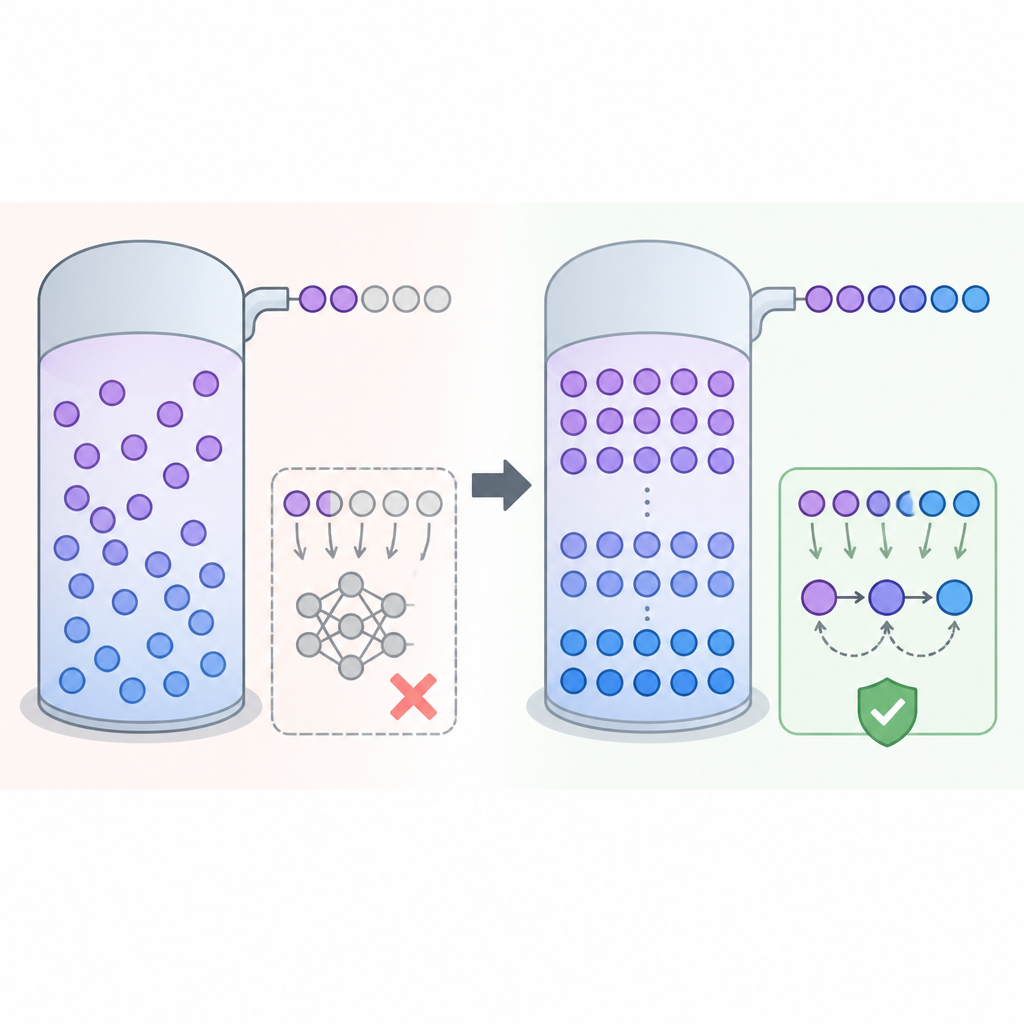
The authors point to a continuation asymmetry on failed prefixes: after a mistake, the teacher tends to redirect, while the student tends to keep going in the same wrong direction. That mismatch is the signal Relay-OPD uses to decide when to hand off control. The key idea is not to supervise every token with the teacher, but to intervene only at the moments that matter most.
This matters because a lot of distillation systems face the same tradeoff: either stay close to the student and risk learning from bad rollouts, or lean too hard on the teacher and drift away from the student policy. Relay-OPD is trying to sit in the middle of that spectrum.
How the method works in plain English
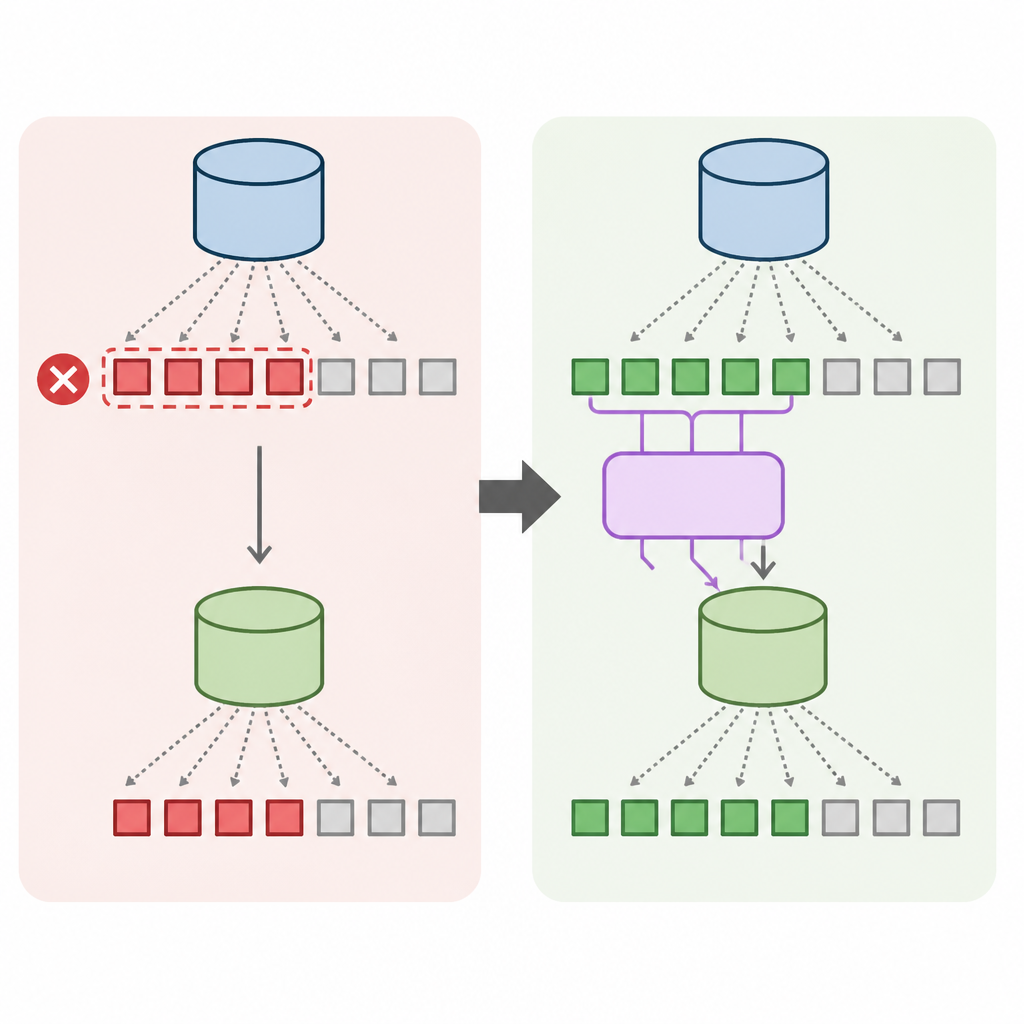
Relay-OPD builds what the paper calls relay trajectories. During training, the student starts generating as usual. When the system detects a trigger point, the teacher briefly takes over and writes a short teacher leg. After that, the student resumes and is optimized on the resulting mixed trajectory.
The paper describes the trigger as label-free, which is important: it is not relying on extra human annotations to decide when the student has gone wrong. Instead, it converts the teacher-student continuation asymmetry into a handoff rule. That makes the intervention mechanism feel more like a training control policy than a separate supervision pipeline.
There is also a limited relay budget. That means the teacher does not keep interrupting the student everywhere. The intervention is concentrated on critical early positions, which is where the paper suggests the biggest payoff comes from, while also limiting how far the trajectory departs from the student’s own policy.
For engineers, the practical shape of the method is easy to understand: detect a bad prefix, let the stronger model repair the path, then continue training the weaker model on that repaired rollout. The novelty is in making that relay selective and automatic rather than turning every rollout into a full teacher-led generation.
What the paper actually shows
The evaluation uses a Qwen3-4B-Instruct-2507 teacher with Qwen3-0.6B and Qwen3-1.7B-Non-Thinking students across eight mathematical reasoning benchmarks. The abstract does not list the benchmark names, so the exact suite is not provided in the source text here.
What the abstract does give is the aggregate result: for the 1.7B student, Relay-OPD achieves the best or second-best result on every benchmark, beats standard OPD by 5.73% on average, and beats the strongest baseline FastOPD by 1.49% on average. It also reports consistent gains for the 0.6B student.
Another concrete result is efficiency: training trajectory length is reduced by over 50%. That is a meaningful signal for anyone thinking about distillation cost, because shorter trajectories mean less compute spent propagating obviously bad reasoning paths.
What the abstract does not provide is enough detail to judge everything you would want as a practitioner. It does not include per-benchmark numbers, runtime breakdowns, ablations in the summary text, or a description of failure cases. So the safest reading is that the method looks strong on the reported math benchmarks, but the source excerpt does not let us inspect where it helps most or where it might break down.
Why developers should care
If you build or train small reasoning models, this paper is about a very real pain point: once a model starts drifting, standard token-level training can end up reinforcing the drift instead of correcting it. Relay-OPD is a concrete attempt to make distillation more robust without abandoning the student’s own trajectory entirely.
That makes it relevant for anyone working on reasoning distillation, math tutors, or compact assistants that need to preserve a strong teacher’s behavior while still learning to generate in the student’s own style. The relay idea also suggests a broader design pattern: use the teacher as a selective repair mechanism, not just a blanket supervisor.
There is still an open question around how general this is beyond the reported math reasoning setting. The abstract only mentions eight mathematical reasoning benchmarks, so it is not yet clear from this source whether the same relay logic transfers cleanly to open-ended generation, code, or other domains with different failure modes.
Even with that limitation, the paper’s contribution is easy to appreciate. It reframes a common distillation weakness as a controllable training signal, then turns that signal into a selective teacher handoff. For teams trying to squeeze more reasoning quality out of smaller models, that is the kind of idea worth testing.
Bottom line
Relay-OPD is a teacher-student training scheme that patches bad reasoning prefixes instead of blindly training through them. The reported gains are strong, the compute savings are real, and the method is simple enough to understand as a training-time relay rather than a new model architecture.
- It targets prefix failure, where one wrong early step contaminates the rest of the rollout.
- It uses a label-free trigger to let the teacher briefly repair failed prefixes.
- It reports better math reasoning results and over 50% shorter training trajectories.
// Related Articles
- [RSCH]
CARE routes LoRA experts by confidence
- [RSCH]
πR² makes flow policies react in real time
- [RSCH]
Learning from Multiple Data Providers
- [RSCH]
Certified parallel Sinkhorn speeds up dynamic OT
- [RSCH]
ClinFusion tackles medical MLLMs from the vision side
- [RSCH]
Explainable RL for Air Traffic Control