CARE routes LoRA experts by confidence
CARE routes more LoRA experts to uncertain tokens and fewer to easy ones, using router confidence as the trigger.
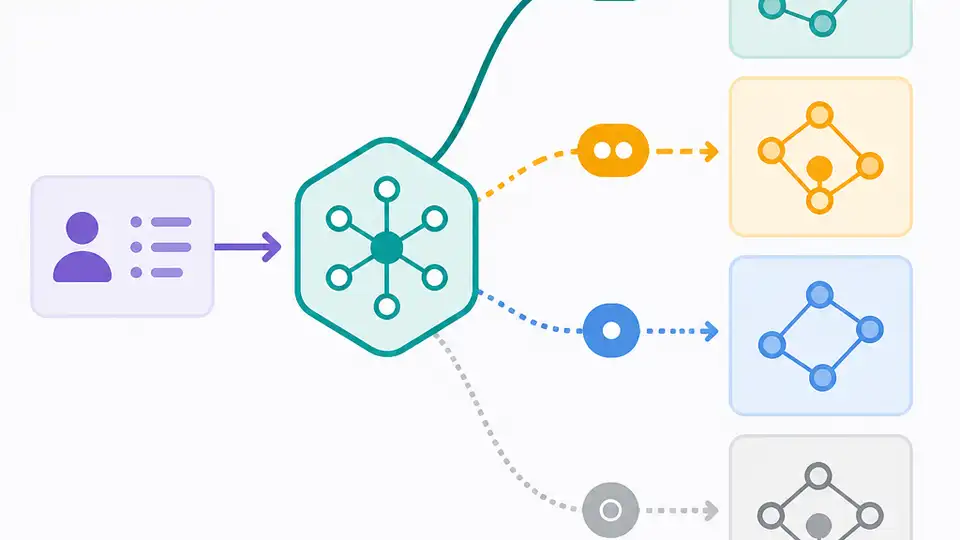
When a model treats every token the same, it can waste expert capacity on easy cases and underserve the hard ones.
CARE routes more LoRA experts to uncertain tokens and fewer to easy ones, using router confidence as the trigger.
- Research org: Unspecified in arXiv abstract
- Core data: Eight commonsense benchmarks
- Breakthrough: Nucleus-style expert admission driven by router confidence
Spend Experts Where You Are Unsure: Confidence-Adaptive Routing for Mixture-of-Experts LoRA tackles a simple but important mismatch: fixed-k MoE-LoRA routing spends the same expert budget on every token, even though some tokens are clearly easier than others. The paper argues that the router already exposes a useful signal — the shape of its output distribution — and CARE turns that signal into a per-token routing rule.
For engineers, the appeal is straightforward. If you are already using MoE-LoRA, you do not want a routing scheme that burns compute uniformly just because the token count is the same. You want a router that can spend more where the model is uncertain and back off where it is confident, without adding a second pass or extra parameters.
What problem this paper is trying to fix
Get the latest AI news in your inbox
Weekly picks of model releases, tools, and deep dives — no spam, unsubscribe anytime.
No spam. Unsubscribe at any time.
Standard MoE variants of LoRA route each token to a fixed number of experts, usually described as top-k routing. That is easy to implement, but it assumes every token deserves the same amount of expert capacity. The abstract says that is a poor fit because tokens vary in uncertainty: some are already well handled by the base model, while others need more help.
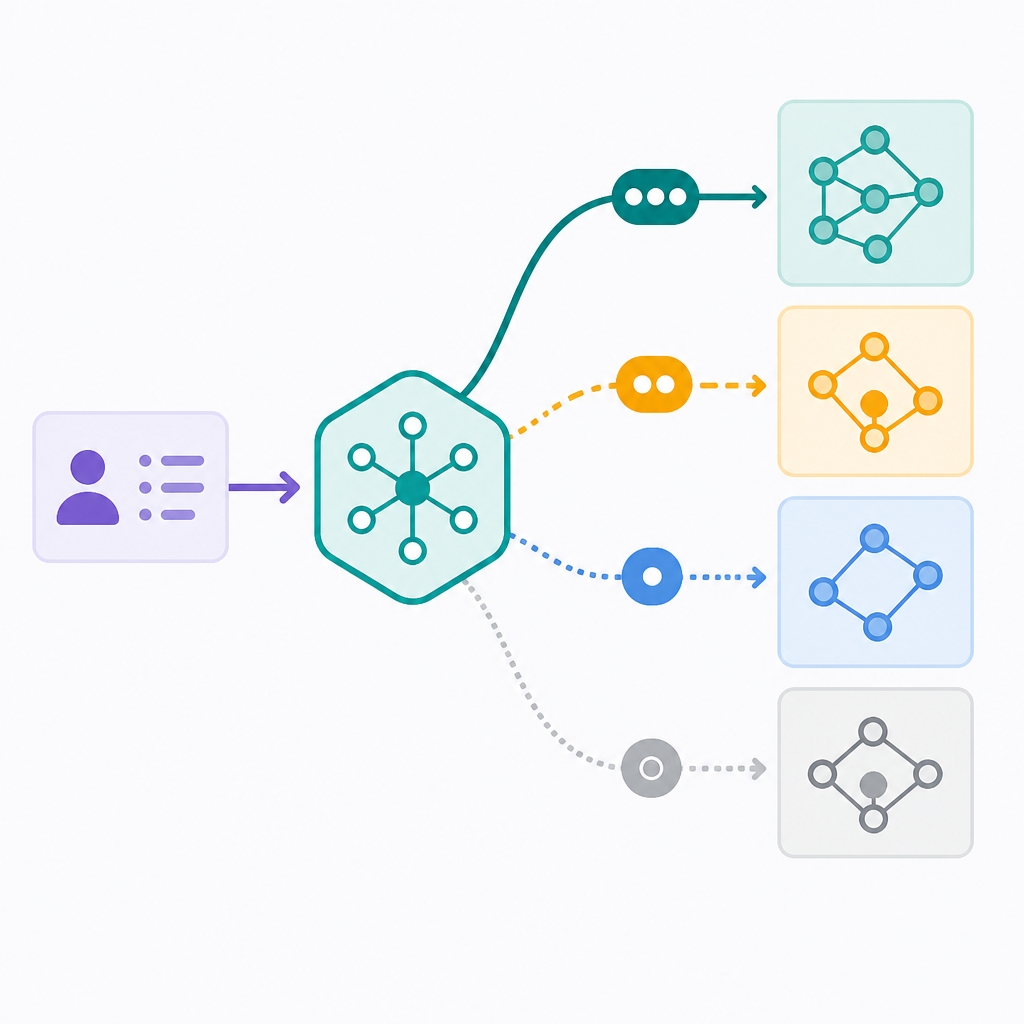
The paper’s core observation is that the router’s output distribution itself already encodes uncertainty. A peaked distribution suggests the router is confident about which experts matter. A flatter distribution suggests ambiguity. CARE uses that signal directly instead of forcing a universal k.
This matters because a routing policy is not just an efficiency detail. In an MoE system, routing decides where the model spends its limited expert budget. A bad policy can waste compute on easy tokens and still fail on difficult ones. CARE is trying to make that budget more selective.
How CARE works in plain English
CARE stands for Confidence-Adaptive Routing of Experts, and the mechanism is deliberately simple. Instead of selecting exactly k experts, it admits experts in descending router-weight order until the cumulative probability mass reaches a threshold. In other words, it behaves a bit like nucleus sampling, but for experts rather than tokens.
There is one extra twist: if the admitted experts disagree, CARE allows a small extension. The abstract frames that disagreement as a useful epistemic signal, meaning it can indicate that the model is less settled and may benefit from more expert capacity.
To keep the system usable in practice, CARE includes a “budget thermostat.” That component calibrates the threshold so the average number of active experts matches a target budget. This is important because a confidence-based rule could otherwise drift too high or too low in average compute.
Two implementation details make the method attractive for real systems. First, it is a drop-in rule, so it fits into existing MoE-LoRA setups. Second, it is single-pass and adds no extra parameters, which means it avoids the complexity of multi-stage routing or retraining a separate controller.
What the paper actually shows
The abstract reports results across eight commonsense benchmarks on LLaMA-3.1-8B and Qwen2.5-7B, plus math, code, and knowledge tasks. That is a broad spread of task types, which is useful because a routing policy that only helps on one narrow workload would be much less convincing.
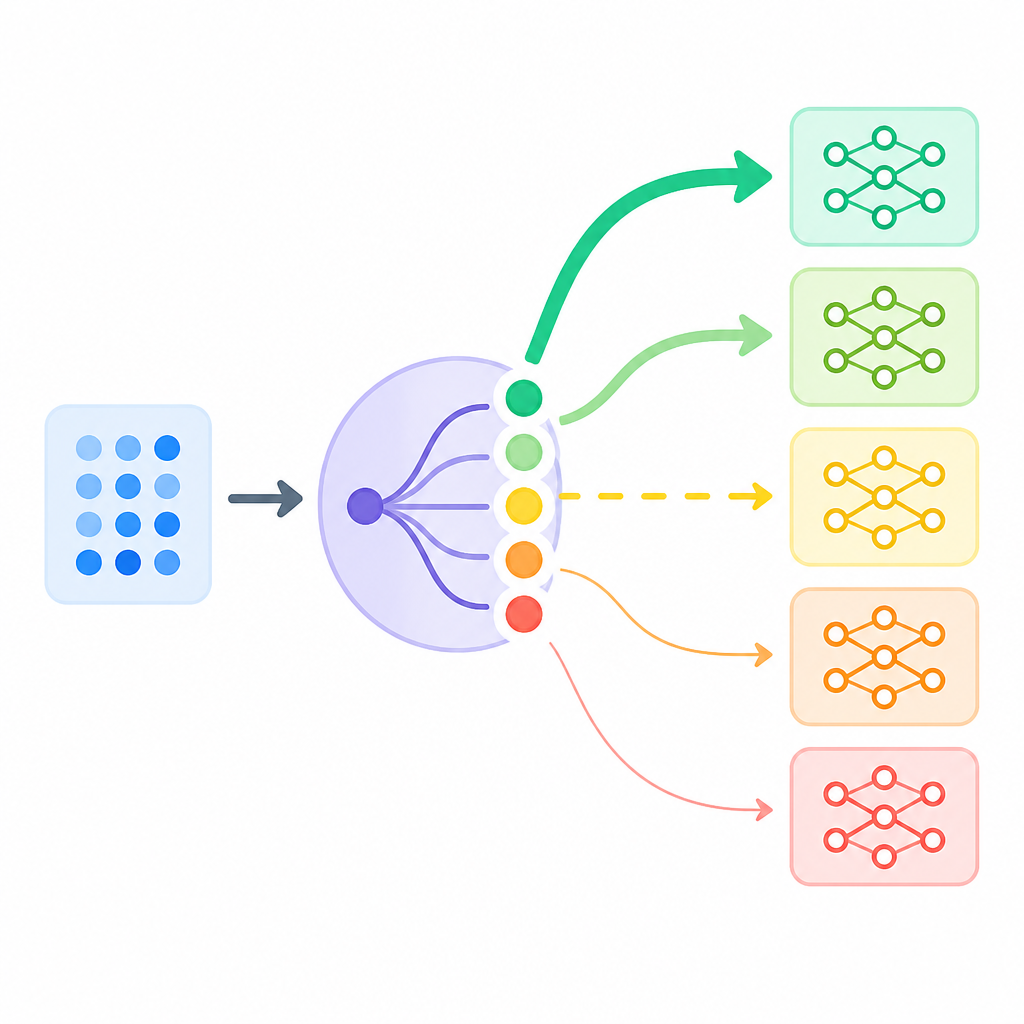
At matched compute, CARE improves over fixed top-k MoE-LoRA. It also matches the fixed-k=4 baseline while activating fewer experts. The abstract does not give the exact benchmark scores, so there are no numeric gains to quote here, but the direction of the result is clear: more selective routing without losing performance.
The paper also claims the same confidence and disagreement signals improve out-of-distribution detection compared with MSP, entropy, and multi-pass proxies. That is a potentially useful side effect for practitioners, because routing uncertainty and OOD detection often come from the same underlying question: how sure is the model about this input?
Beyond the headline results, the authors say they support the design with nucleus fidelity, budget optimality, and an epistemic reading of disagreement. The abstract does not unpack those analyses in detail, but the framing suggests they are trying to justify CARE both empirically and conceptually, not just by showing it works once.
Why developers should care
If you are building or fine-tuning MoE-LoRA systems, CARE points to a practical way to make routing more adaptive without changing the rest of the stack. The method is especially relevant when compute budget matters, because it tries to preserve quality while reducing unnecessary expert activations on easy tokens.
It also gives teams a more interpretable routing story. Fixed-k routing is simple, but it does not tell you why one token gets the same expert budget as another. CARE’s confidence-based threshold makes the policy easier to reason about: more uncertainty means more experts, and disagreement can justify a small extra expansion.
That said, the abstract leaves some open questions. It does not provide the exact benchmark numbers, so readers cannot judge effect size from the summary alone. It also does not spell out how sensitive the thermostat is to different target budgets, or how the threshold behaves across architectures and datasets beyond the listed models and tasks.
There is also a broader systems question: routing policies that depend on confidence can be useful, but they need to stay stable under distribution shift. The paper’s OOD detection result is encouraging, but the abstract does not tell us whether routing quality itself remains robust in harder real-world deployments.
What to take away
CARE is not a new MoE architecture so much as a smarter routing rule for MoE-LoRA. It replaces a fixed expert count with a confidence-adaptive threshold, keeps the system single-pass, and uses disagreement as a cue to spend a little more compute when the model looks uncertain.
For developers, the main lesson is that router outputs are more than just selection scores. In this paper, they become a per-token uncertainty signal that can guide compute allocation, improve matched-compute performance, and even help with OOD detection. If you work on efficient adaptation layers, that is a useful design pattern to keep in mind.
- CARE replaces fixed-k expert routing with confidence-based expert admission.
- It keeps MoE-LoRA single-pass, parameter-free, and budget-controlled.
- The abstract reports better matched-compute performance and improved OOD detection, but no exact scores.
// Related Articles
- [RSCH]
πR² makes flow policies react in real time
- [RSCH]
Relay-OPD fixes prefix failure in distillation
- [RSCH]
Learning from Multiple Data Providers
- [RSCH]
Certified parallel Sinkhorn speeds up dynamic OT
- [RSCH]
ClinFusion tackles medical MLLMs from the vision side
- [RSCH]
Explainable RL for Air Traffic Control