Gemini 3.5 Live Translate rolls out in 70+ languages
Google launched Gemini 3.5 Live Translate for near real-time speech translation in 70+ languages across Translate, Meet and the Gemini Live API.

Google has launched Gemini 3.5 Live Translate for near real-time speech translation in 70+ languages.
Google has released Gemini 3.5 Live Translate, its latest audio model for live speech-to-speech translation, on Jun. 9, 2026. The model starts rolling out today across developer tools, enterprise products, and consumer apps, with support for more than 70 languages and translated speech that keeps pace with the speaker.
| 項目 | 數值 |
|---|---|
| Languages supported | 70+ |
| Language combinations in Meet | 2,000+ |
| Developer access | Public preview |
| Google Meet access | Private preview this month |
| Translation delay | Just a few seconds behind speaker |
What changed
Get the latest AI news in your inbox
Weekly picks of model releases, tools, and deep dives — no spam, unsubscribe anytime.
No spam. Unsubscribe at any time.
Gemini 3.5 Live Translate is built to translate speech continuously instead of waiting for a full turn. Google says the model detects 70+ languages automatically, preserves intonation, pacing, and pitch, and keeps the translated audio only a few seconds behind the original speaker.

The rollout spans three surfaces:
- Developers can try it in public preview through the Gemini Live API and Google AI Studio.
- Enterprise users will get it in private preview in Google Meet starting this month.
- Consumers can use it in the Google Translate app on Android and iOS.
- Google is also adding an Android listening mode that routes translations through the phone earpiece.
Google says the model can handle multilingual input without manual settings and is tuned for noisy, unpredictable environments. That makes it a fit for live interpretation in meetings, lessons, broadcasts, and other voice-heavy workflows.
Why it matters
For developers, the biggest change is lower friction for building voice translation apps. Google points to partners such as Agora, Fishjam, LiveKit, Pipecat, and Vision Agents, which can now focus more on product UX than real-time media plumbing.
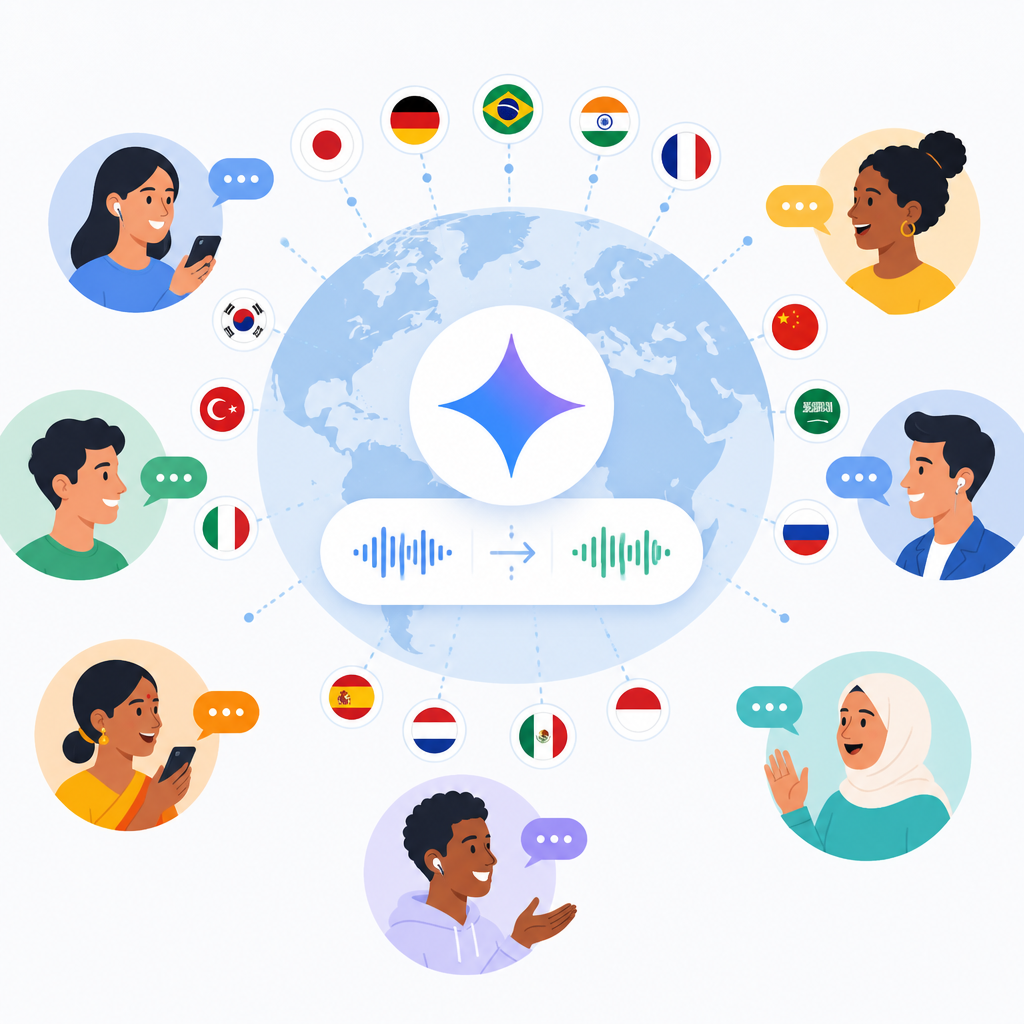
For the market, the Meet update is the clearest signal. Google says speech translation will expand from five languages to 70+, and from English-only translation pairs to more than 2,000 language combinations in a single meeting. That widens the addressable use case for global teams, customer support, and cross-border collaboration.
Google also says all generated audio is watermarked with SynthID, making AI output detectable. The company frames that as a guardrail against misuse, especially as live translation becomes easier to deploy inside calls and broadcasts.
The key question now is not whether live speech translation works, but how quickly it becomes a default layer in meetings, calls, and mobile translation apps.
// Related Articles
- [MODEL]
OpenAI Cuts GPT-5.6 Prices as AI Bills Climb
- [MODEL]
Opus 5 proves premium AI is becoming a commodity
- [MODEL]
OpenAI Gives Scientists Free GPT-5.6 Access
- [MODEL]
Google ships Gemini 3.6 Flash and 3.5 Lite
- [MODEL]
Kimi K3 Is Forcing Silicon Valley to Pick Sides
- [MODEL]
Opus 5 lets you ship with fewer refusals