Google Gemini outage hits users with error 1076
Google Gemini suffered a hours-long outage with error 1076 and error 1099 messages before Google said systems were recovering.

Google Gemini suffered a hours-long outage that triggered error 1076 and error 1099 messages.
Google Gemini spent part of June 10, 2026 throwing error messages at users instead of answering prompts. The outage began around 6:11am ET and 11:11am BST, then spread across both web and mobile versions before Google said it was seeing signs of recovery.
| Metric | Detail |
|---|---|
| Outage start | About 6:11am ET / 11:11am BST |
| Main errors | Error 1076 and error 1099 |
| Google status update | “We are seeing signs of recovery” |
| Follow-up deadline | Wednesday, 2026-06-10 14:30 PDT |
What broke, and how users noticed it
Get the latest AI news in your inbox
Weekly picks of model releases, tools, and deep dives — no spam, unsubscribe anytime.
No spam. Unsubscribe at any time.
The first sign of trouble was a spike in reports on Downdetector, where complaints climbed in both the US and UK at the same time. Users trying to start new chats were greeted by error 1076, error 1099, or a plain “something went wrong” message.
TechRadar’s own team saw the same behavior, which matters because it rules out a single-account glitch. The issue hit different devices, different browsers, and both the app and the web client, so this was a service-side problem rather than a local setup bug.
Google’s own wording was cautious. On its Workspace Status Dashboard, the company said its engineering team had applied mitigations, was investigating the root cause, and was seeing signs of recovery. That is the kind of update you get when the fix is in motion, but the diagnosis is still unfinished.
- Reports started rising at 6:11am ET / 11:11am BST
- Errors appeared on desktop and mobile
- Google said it had applied mitigations
- A follow-up update was promised by 14:30 PDT
Why error 1076 became the headline
Error 1076 got the most attention because Gemini itself appears to describe it as a handshake or initial connection timeout error. In plain English, that means the app is failing before a conversation even begins. If the service cannot finish the first connection step, the user never reaches the point where the model can answer.
That detail also explains why refreshing sometimes helped. Some users found that typing the same prompt again immediately would get a response on the second try. That is a useful short-term trick, but it is not a real fix. It just gives the service another shot at completing the connection.
“We are seeing signs of recovery and will continue to monitor progress.” — Google Workspace Status Dashboard
Google also said, “We will provide an update by Wednesday, 2026-06-10 14:30 PDT with current details.” That tells us the company had enough signal to believe the outage was easing, but not enough confidence to close the incident yet.
There was a second wrinkle here: Claude also had a rough patch on the same day. Its status page reported “Elevated errors on Claude Haiku 4.5,” then later said a fix had been implemented and results were being monitored. That does not mean the two incidents were connected, but it does show how dependent AI tools are on a thin layer of infrastructure that can fail in multiple places at once.
How Gemini compared across platforms and services
The outage did not look limited to one interface. Reports on Gemini showed up on the web and in the mobile app, with Downdetector’s US split showing 57% of reports from the app and 36% from the web. That mix suggests a backend issue affecting the shared service rather than a broken release on one platform.
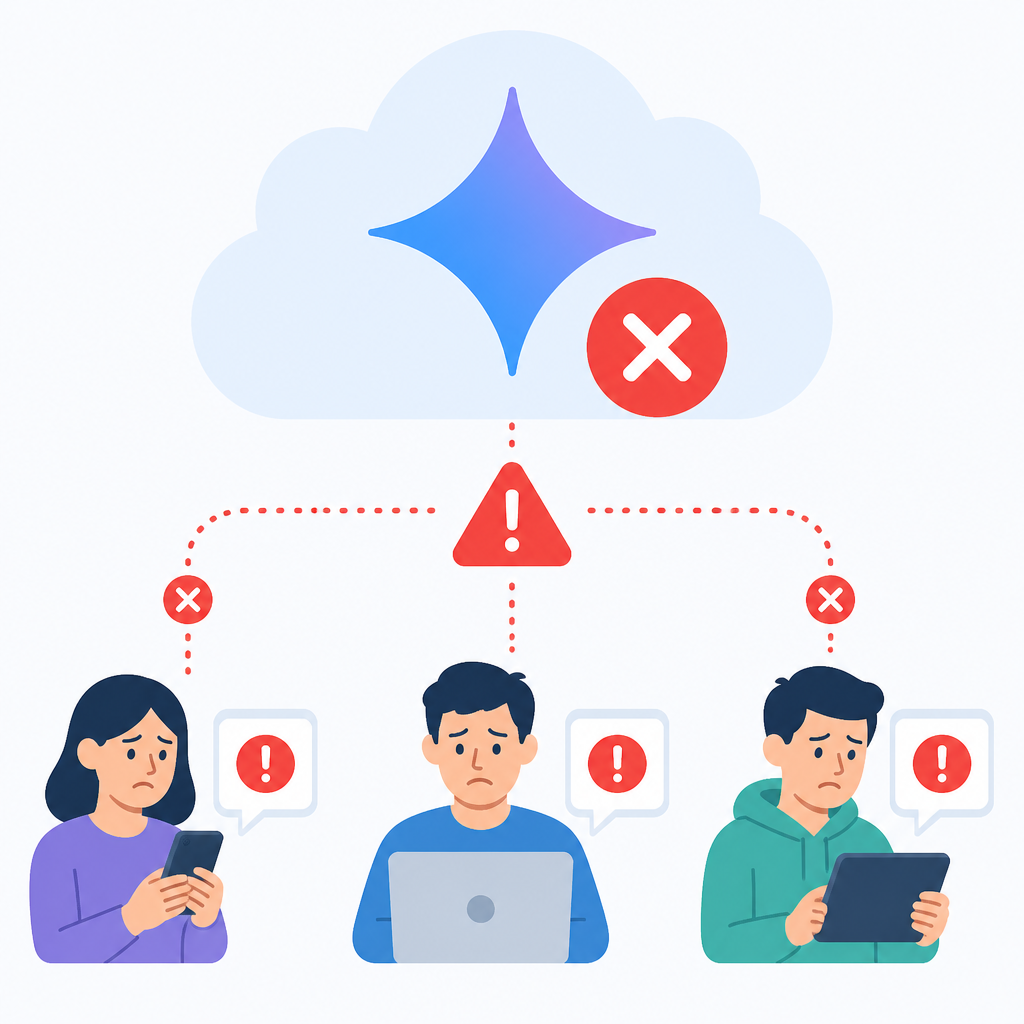
Google’s status page also created a strange contrast: users were seeing failures while the dashboard still said “all systems are operational.” That kind of mismatch happens during active incidents, especially before internal monitoring and public status pages catch up to what users are already experiencing.
- 57% of US reports came from the app
- 36% came from the web
- Users tried switching accounts and phones without success
- Some prompts worked after immediate re-entry
For developers and product teams, the practical lesson is simple: AI chat apps fail like any other internet service. The model may be healthy, but the connection layer, auth flow, or request routing can still break user access. That is why status pages, telemetry, and public reports often tell different parts of the same story.
If you rely on Gemini for work, the best move during incidents like this is to keep a backup workflow ready. A second model, a local note, or even a plain text retry loop can save time when the chat layer starts acting up. If you want more context on how model outages affect day-to-day use, see our coverage of AI outages and user workflows.
What this outage says about AI reliability
This outage is a reminder that AI products are still software products, and software products fail in ordinary ways. The model may be the headline feature, but users experience the whole stack: login, routing, rate limits, chat state, and the model itself. When any one of those pieces stumbles, the experience feels like the AI is down.
Google’s recovery update suggests the worst may be over, but the more interesting question is how often these incidents happen once Gemini is under heavier daily use. If error 1076 keeps showing up, Google will need to make the failure mode clearer and the recovery faster. For now, the immediate takeaway is practical: if Gemini returns an error, retry the prompt once, then switch tools if the problem persists.
That is the standard users will likely keep adopting until AI assistants become as boringly dependable as email. And if the next incident looks anything like this one, the first clue will probably be the same: a sudden spike on a public outage tracker before the status page catches up.
// Related Articles
- [IND]
Black Duck’s Coverity gets better at AI-era triage
- [IND]
Anthropic’s Opus 5 makes the AI race cheaper
- [IND]
OpenAI’s distillation playbook explains the Kimi panic
- [IND]
Gemini 3.5 Flash lets you buy speed
- [IND]
RISC-V is past the hobby phase and should be treated as a real platfo…
- [IND]
Nvidia and OpenAI discuss a $250B AI backstop