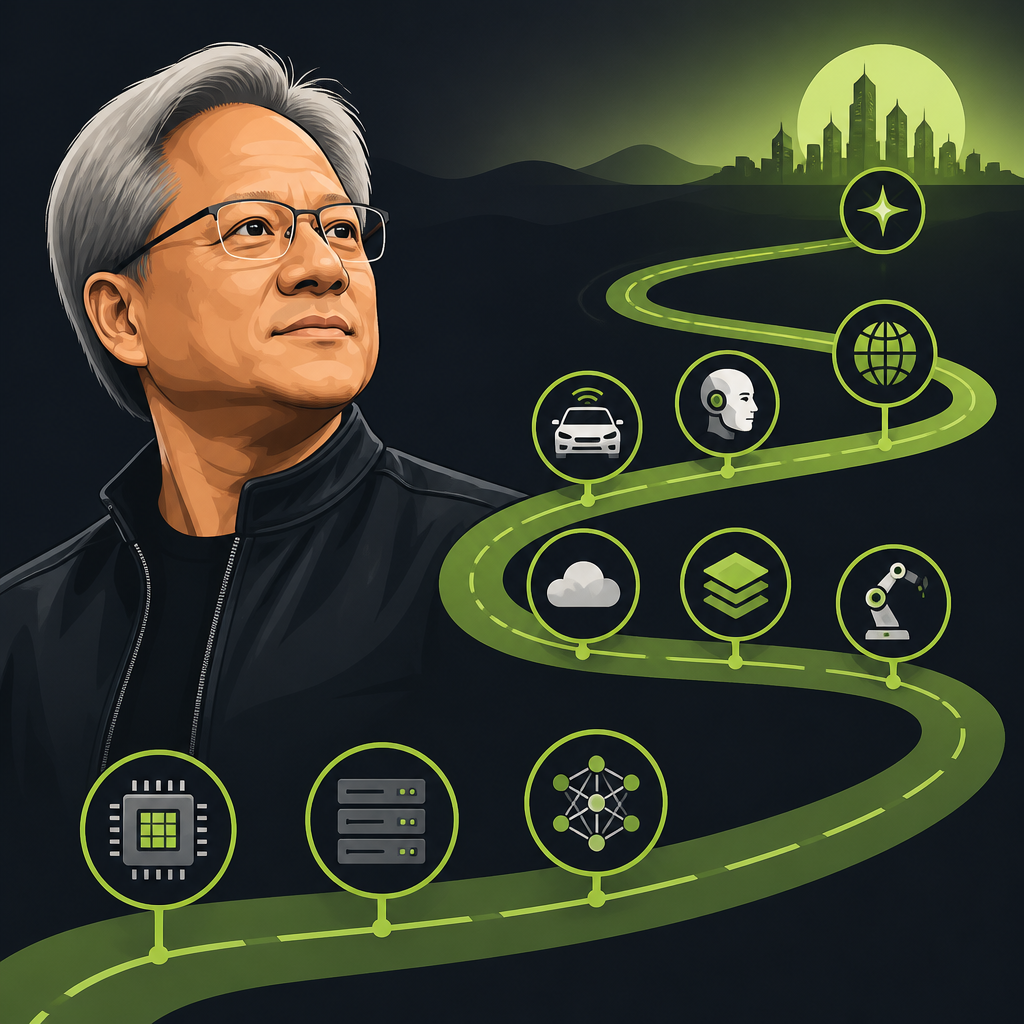
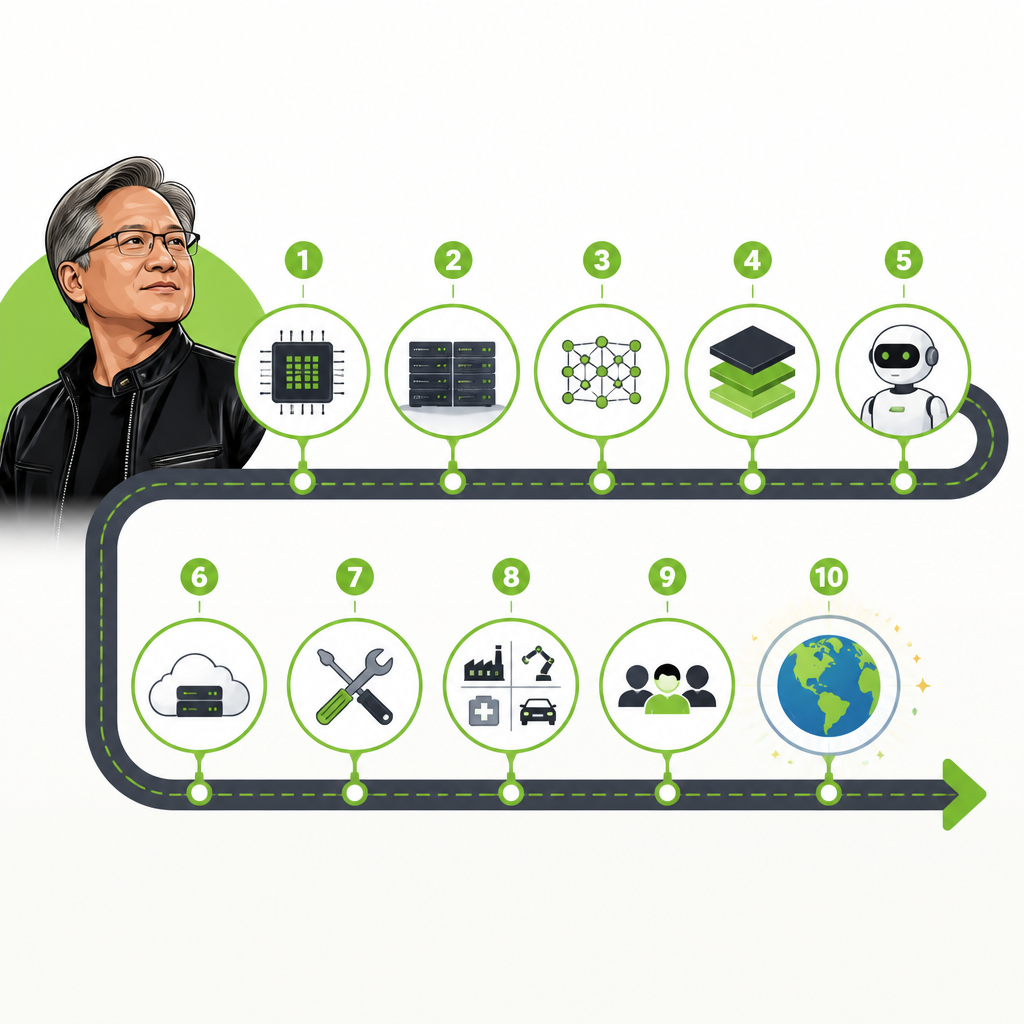
I break down Jensen Huang’s 10 AI moves into a copyable playbook.
I've been watching AI advice get noisier and, honestly, dumber. Everybody wants to talk about prompts, model rankings, and whatever shiny demo just got clipped on X. But when I sat with Jensen Huang’s long talk, the thing that kept bothering me was simpler: the real shift wasn’t in the chatbot. It was in the stack underneath it, the hiring signal above it, and the constraint hiding in plain sight. That’s the part most people miss because it’s less fun than a product launch and harder than writing “AI-first” on a slide.
What finally clicked for me was that Jensen wasn’t really giving a product roadmap. He was handing out a mental model for where value moves when AI stops being a toy and starts becoming infrastructure. I’ve seen this before in smaller forms. A tool gets good enough, the task gets cheaper, and then the job expands instead of disappearing. The people who keep staring at the old task get blindsided. The people who re-map the constraint move first. That’s what I pulled out of The AI Corner’s write-up of Jensen Huang’s 2026 roadmap.
So I’m going to decompose the thing the way I would for my own team: what Jensen actually said, what it means in plain English, where it shows up in real work, and how to use it without turning your company into a buzzword museum.
1. The inflection point already happened, and most teams are late
Get the latest AI news in your inbox
Weekly picks of model releases, tools, and deep dives — no spam, unsubscribe anytime.
No spam. Unsubscribe at any time.
“AI in the last several months became useful. That’s the big idea.”
What this actually means is that we are past the era where AI is only a demo machine. Jensen is saying agentic systems can now understand, reason, plan, and use tools well enough to finish real work. That matters because once AI becomes useful, the question stops being “Can it answer?” and becomes “Can it complete?”
I’ve run into this in product work. A model that can draft a nice response is cute. A model that can look at a repo, inspect a ticket, call tools, and finish a task is a different animal. That’s when the workflow changes. The old habit of wrapping a chat UI around a model starts feeling embarrassingly thin.
The AI Corner article points to Claude Code as the first system Jensen called productive for this style of work. Whether you agree with that specific pick or not, the point is solid: a usable agent benchmark has been set, and everything else gets measured against it now.
How to apply it:
Audit every AI use case in your org and label it as chat, assist, or agent.
If the workflow ends with a human copying output into another system, it is still mostly chat.
Pick one repetitive internal process and rebuild it as a tool-using loop, not a prompt.
That last step matters more than people want to admit. A lot of teams think they are “doing agentic AI” because they added a button. No. If the system can’t take action, it’s not the shift Jensen is talking about.
2. The value is two layers below the headline
“AI is not just an application. AI actually reinvented the computer industry.”
Jensen’s stack view is the part I’d pin to the wall: energy, chips, infrastructure, models, applications. Most of the public conversation lives at the model layer because that’s where the demos are. But capital, and eventually durable companies, often move below that. The article says NVIDIA is putting money into infrastructure names like CoreWeave, Nebius, and Nscale.
What this actually means is that if everyone is crowded into the obvious layer, the interesting companies are often one or two layers underneath. That’s where the bottlenecks live. That’s where the scarcity is. And scarcity is where pricing power shows up before the market gets bored and moves on to the next demo.
I’ve seen founders waste a year building “the best model wrapper” when the real opportunity was in deployment, orchestration, data movement, or power delivery. They were fishing where the water was already full of hooks.
How to apply it:
Draw your stack in five layers: energy, compute, infrastructure, model, application.
Circle the layer where customers are annoyed, blocked, or overpaying.
Ask yourself whether your company is solving a visible problem or a hidden bottleneck.
If you want a practical map of open ground, the Y Combinator Requests for Startups page is a decent place to scan for unmet needs. Not because YC is magic, but because it tends to expose where people are still looking for solutions instead of bragging about existing ones.
3. Jensen’s capital rule is not about returns, it’s about unlocking the next layer
“We invest at $1, it activates AI maybe by $100. If we can make that kind of amplification for the entire ecosystem, it would be tremendous.”
This is the bit people flatten into “strategic investment,” which is too vague to be useful. What Jensen is really saying is that capital should remove the constraint that blocks much larger value creation. He is not trying to squeeze every last basis point out of the check itself. He is trying to unlock the next $100 of activity that can’t happen until the constraint is removed.
The article gives the example of CoreWeave, where one dollar from NVIDIA reportedly helped unlock nine more from institutional investors. That’s the shape of the move: anchor capital, confidence, then follow-on capital. The check is the signal, but the real product is reduced uncertainty.
I like this framing because it’s brutally practical. Most investors look for upside. Jensen is looking for leverage, but not in the lazy “synergy” sense. He’s asking, “What is the thing that, if we remove it, lets the whole system breathe?”
How to apply it:
In your market, identify the one constraint that makes everything else expensive or slow.
Build the company that removes that constraint first.
Don’t confuse the enabling layer with the end-user layer. The enabler often has the better business.
I’ve seen this in developer tooling too. The company that makes deployment less painful can be more valuable than the app that sits on top of the deployment pipeline. People love the app. The money often goes to the thing that made the app possible.
4. Gross margins flipped, which means the unit economics argument got weaker
“Both of these companies and most of the AI native companies have turned. Their gross margins have gone extremely positive.”
That sentence matters because it undercuts the old lazy argument that AI businesses can’t make money. Jensen is saying the economics have improved fast enough that the conversation is no longer theoretical. The article points to OpenAI, Anthropic, and Cursor as examples of AI-native companies whose margins have moved in the right direction over the last few months.
What this actually means is that the market is still mentally lagging the operational reality. A lot of people are still talking as if AI products are doomed to be margin sinks forever. Meanwhile, usage is up, capacity demand is up, and the systems are getting better at monetizing the work they do.
I’ve had this exact argument with teams that were too early to see it. They assumed “AI = expensive forever,” then designed their roadmap around caution instead of demand. That’s how you miss a wave while congratulating yourself for being disciplined.
How to apply it:
Watch where serious companies are buying capacity, not just where they are posting demos.
Track gross margin movement in AI-native businesses as a signal, not a footnote.
Revisit any pricing model you froze in 2024. It may already be stale.
The article also notes that software engineering job openings are rising, not falling. That’s a useful reminder that demand expands when the cost of building drops. Cheaper creation does not always mean fewer builders. Sometimes it means more ambitious builders.
5. Radiology was the warning shot, not the exception
“100% of radiology is now infiltrated by AI. It is completely integrated. And yet, the radiologist job was not wiped out.”
This is one of the cleanest examples in the whole piece. The task got compressed, but the job did not disappear. Instead, the role expanded. More patients were read, more cases were handled, and radiologists became more valuable in a broader operational sense.
What this actually means is that AI usually attacks the task first, not the purpose. That distinction matters a lot. If you confuse the two, you end up predicting layoffs where the real outcome is role expansion. The machine handles more of the repetitive work, and the human gets pushed upward into judgment, coordination, and throughput management.
I’ve watched teams make the same mistake internally. They automate one slice of a workflow and then assume the whole role is gone. It usually isn’t. The role just changes shape. The output expectations rise because the bottleneck moved.
How to apply it:
List the tasks AI can already do in your field.
Then list the outcomes your role is actually paid to achieve.
Build around the gap between those two lists, because that gap is where the new job lives.
This is the part that should make managers rethink their org design. If a task gets cheaper, don’t just cut headcount and call it strategy. Ask what new level of throughput becomes possible, then staff for that.
6. Your task list is not your job description
“The purpose of a job and the task of the job are related, not the same.”
I think this is the most useful line in the whole roadmap because it breaks a really common mental trap. People keep equating what they do with why they are hired. Jensen’s own example is perfect: his tasks are typing and talking, both of which AI can now do at superhuman speed, but his purpose has only expanded because the company expects more from him, not less.
What this actually means is that automation doesn’t just erase work. It reallocates attention. If a system takes over the lower-value part of a role, the human role gets pulled toward judgment, strategy, and higher-volume decision-making. That’s not a philosophical point. It’s an operational one.
I’ve had to explain this to teams that were terrified of “being replaced.” Usually what they really meant was “our current workflow is about to be exposed as low-value.” That’s a different problem. And it’s fixable if you stop worshipping the task list.
How to apply it:
Write your task list and your purpose list separately.
Delete any identity language from the task list. Keep it mechanical.
Use AI to shrink the task list, then deliberately expand the purpose list.
For engineers, this means the job is less “write code” and more “solve problems and build things that did not exist yet.” For founders, it means the job is less “ship features” and more “remove the bottleneck that keeps the company from compounding.” Same pattern, different nouns.
7. AI fluency is now a hiring filter, not a bonus skill
“If you graduate and you’re not an expert AI user, you’re not going to take a job from another kid who is. That’s a dislocation.”
This is where the talk gets uncomfortably specific. Jensen is not saying everyone needs to become an ML researcher. He is saying that people who can direct AI systems toward outcomes will beat people who still treat AI like a side toy. That’s a hiring shift, not a vibes shift.
What this actually means is that the resume is getting less informative. A candidate can claim they are adaptable all day long. I care more about whether they can show me an AI-assisted workflow they built in the last month. That tells me how they think, how they work, and whether they can use the tools that are now sitting on the desk in front of them.
I’ve started asking for this kind of proof because the difference is immediate. Some people use AI to draft a sentence. Others use it to compress research, generate options, test assumptions, and keep work moving while they sleep. Those are not the same candidate.
How to apply it:
Change your interview loop to include a live AI-assisted workflow walkthrough.
Ask candidates what they built with AI in the last 30 days.
Look for process design, not just prompt fluency.
If you want a practical benchmark for what fluency looks like, Anthropic’s Claude docs and workflow examples are a decent reference point, and so is any serious internal playbook you build around tools, connectors, and repeatable output. The point is not the brand. The point is whether the person can make the system do useful work.
8. Fear is a national strategy failure
“My greatest concern is that we scare United States people to the point where AI is so unpopular they don’t actually engage it. That we lose our lead as a nation.”
Jensen’s concern here is not about a single product or model. It’s about disengagement. If people get scared enough to avoid the technology, the country loses the habit of using it well. And once that habit is gone, catching up gets ugly.
What this actually means is that culture matters. A lot. If your organization talks about AI like it is radioactive, people will use it timidly or not at all. If you treat it as a normal tool that needs judgment and guardrails, people will experiment, learn, and improve faster.
I’ve seen both environments. In the fearful one, every AI use case needs a committee. In the engaged one, people test tools, share workflows, and learn from mistakes without turning every experiment into a policy crisis.
How to apply it:
Audit the language your team uses around AI.
Replace fear-based messaging with usage-based guidance.
Make safe experimentation normal, not exceptional.
Jensen’s point is not “ignore risks.” It’s “don’t let fear become your operating system.” That’s a very different thing.
9. Defense in AI is about abundance, not one super-weapon
“The way you defend against a super force is not with another super force. It’s with an abundance of cheap force.”
This is one of those lines that sounds simple until you actually apply it. Jensen is describing a defense model where you don’t rely on one giant AI to protect everything. Instead, you deploy many smaller, cheaper systems across different threat surfaces. Authentication, APIs, dependency chains, credential handling, endpoint exposure. Different problems, different agents.
What this actually means is that defense becomes distributed. A single attacker with a strong offensive model can scan faster than a human team can reason. So the answer is not to hope one bigger defender wins. The answer is to cover more surface area with many focused defenders.
I like this because it maps cleanly to real security work. Security teams already know that one control never catches everything. Jensen’s version just updates the math for AI-era attack speed.
How to apply it:
Break your threat surface into categories, not just severity buckets.
Assign a small model or agent to each category.
Prefer broad coverage over one fancy defensive system that looks good in a demo.
If you want to see how teams are thinking about this in practice, look at defensive tooling from companies like Wiz or the broader application-security ecosystem. The exact vendor matters less than the pattern: distributed coverage beats heroic centralization.
10. Ambition is now the bottleneck
“Whatever level of ambition you have, it’s just not high enough. Whatever expectations I have for the company, you’ve got to increase it by about 100x.”
This is the point where the roadmap stops being technical and turns into a demand shock. Jensen is saying the pace of AI has shortened research cycles so much that the old planning horizon is already too timid. He described going from months of research to a day in some contexts. That changes what you should even consider possible.
What this actually means is that the constraint is no longer just compute, models, or talent. It’s ambition. If you keep planning as if research takes forever and engineers move slowly, your roadmap will undershoot the world you’re actually building in.
I’ve had to do this exercise myself: take a normal three-year plan and rerun it with research 30 times faster and engineers 10 times more productive. The result is usually uncomfortable. Good. That discomfort is the signal that your plan was too small.
How to apply it:
Rewrite your roadmap with a 10x or 100x throughput assumption.
Kill any plan that only works if the old pace stays intact.
Set one target that feels a little ridiculous, then work backward from it.
That doesn’t mean be reckless. It means stop using stale constraints to justify stale goals. Jensen’s whole talk is basically one long warning against that habit.
The template you can copy
# Jensen-style AI roadmap template

## 1. What changed
AI is no longer just a chat interface. It can now understand, reason, plan, and use tools to complete real work.

## 2. What layer matters
Map the stack in five layers:
- Energy
- Chips / compute
- Infrastructure
- Models
- Applications

Circle the layer where the bottleneck is real and the competition is still thin.

## 3. What constraint blocks the next 100x
Name the single constraint that prevents much larger value creation.

Examples:
- Compute shortage
- Power shortage
- Data access
- Workflow fragmentation
- Security exposure
- Talent mismatch

## 4. What to build
Build the thing that removes the constraint first.

Do not start with the flashy app if the bottleneck lives below it.

## 5. What to automate
Split your work into two lists:

### Task list
The mechanical things AI can already do.

### Purpose list
The outcomes you are actually paid to achieve.

Use AI to shrink the task list and expand the purpose list.

## 6. Hiring filter
Ask every candidate:
- What AI-assisted workflow did you build in the last 30 days?
- What did it replace?
- What did it improve?
- How do you know it worked?

## 7. Defense model
If you are defending against AI-accelerated threats, do not rely on one giant control.

Use many cheap, focused agents across specific threat surfaces:
- Auth
- APIs
- Dependencies
- Credentials
- Endpoints

## 8. Roadmap reset
Rewrite the roadmap with faster assumptions:
- Research 30x faster
- Engineering 10x more productive
- Decision cycles shortened

Then ask:
What would I build if those assumptions were already true?

## 9. Operating rule
Do not confuse the task with the job.
Do not confuse the demo with the product.
Do not confuse the check with the unlock.
Do not confuse fear with strategy.

## 10. Weekly review
Every week, answer these four questions:
- What constraint did we remove?
- What workflow got shorter?
- What did AI do that a human no longer had to do manually?
- What got bigger because the task got cheaper?
I built this template to be used, not admired. If you’re a founder, use it to find the layer below the obvious one. If you’re a manager, use it to redraw roles around purpose instead of tasks. If you’re an investor, use it to find the constraint-remover instead of the prettiest wrapper. And if you’re hiring, use it to separate AI fluency from AI theater.
The nice thing about Jensen’s roadmap is that it is not mystical. It is a sequence of plain, hard calls: the useful inflection already happened, the stack is deeper than the headlines, capital should unlock constraints, margins are improving, jobs are changing shape, fluency is becoming mandatory, fear is a drag, defense needs distribution, and ambition has to rise with the tooling.
That is a real playbook. Not a slogan. Not a keynote mood board. A playbook.
Source attribution: the original write-up is by Ruben Dominguez at The AI Corner, and this article is my derivative breakdown of that source plus my own implementation notes. For the underlying company and product references, I linked to the official sites where possible.