Jensen Huang’s LG deal spans five AI bets
5 cooperation areas now link Nvidia and LG across robotics, data centers, mobility, AI models and power systems.

Nvidia and LG are widening their partnership across robotics, AI data centers, mobility and AI models.
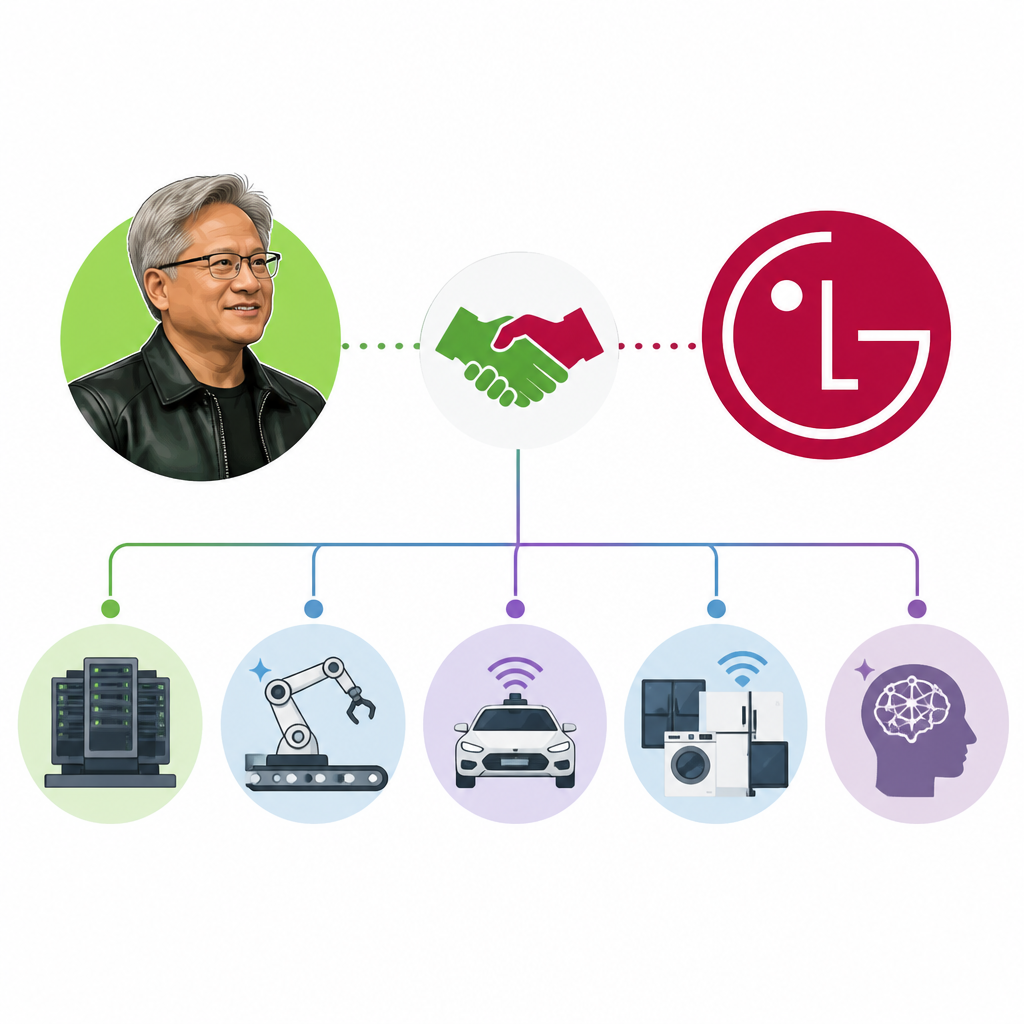
Jensen Huang and Koo Kwang-mo used a second meeting in three days to map out five cooperation areas, from humanoid robots to 800-volt power for GPU servers. The talks show how a chip deal can widen into a full-stack industrial AI plan.
| Item | Main focus | LG units involved |
|---|---|---|
| Robotics | Isaac, GR00T, Cosmos | LG Electronics, LG Innotek, LG CNS |
| AI data centers | Cooling, modular buildout, DSX reference design | LG Electronics, LG Uplus, LG CNS, LG Energy Solution |
| Mobility | Drive Hyperion, ADAS, SDVs | LG Electronics, LG Innotek |
| AI model tuning | Exaone training and inference | LG AI Research |
| Power systems | 800V DC, BESS links | LG Energy Solution |
1. Robotics
Get the latest AI news in your inbox
Weekly picks of model releases, tools, and deep dives — no spam, unsubscribe anytime.
No spam. Unsubscribe at any time.
The strongest near-term theme is physical AI, where software, sensors and machines meet in real tasks. LG Electronics plans to expand work on humanoid and logistics robots using Nvidia’s Isaac robotics platform, GR00T humanoid model and Cosmos world model tools.
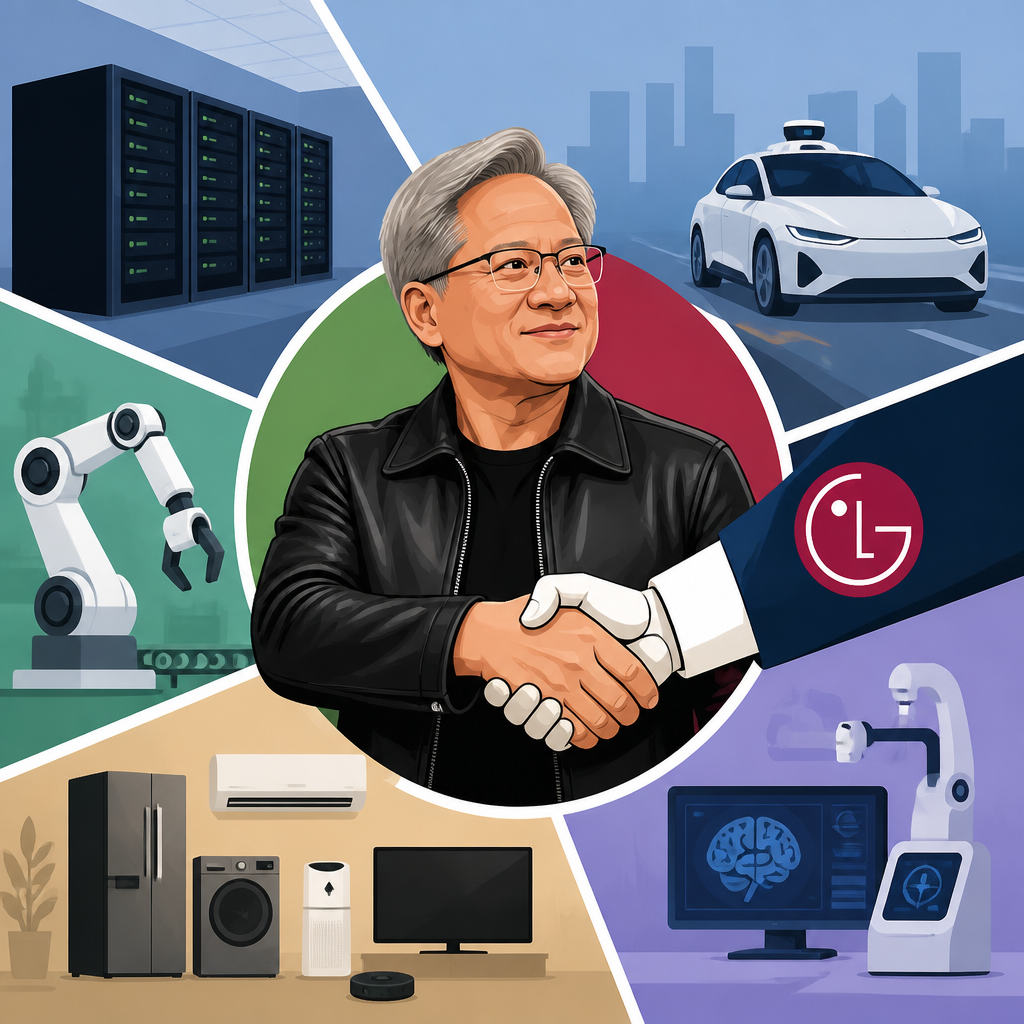
That scope runs from data creation to simulation, training and deployment. In practical terms, the two companies want a robotics stack that can be designed, tested and refined with the same AI tools before it reaches factories or warehouses.
- Isaac for robotics development
- GR00T for humanoid AI
- Cosmos for world models and simulation
- LG Innotek components for sensing and communication
2. AI data centers
LG and Nvidia are also treating AI infrastructure as a shared business line, not a side project. Because GPU servers draw more power and produce more heat than standard data centers, the companies are focusing on liquid cooling, modular design and power delivery.
LG Electronics is working on certification for coolant distribution units, cold plates and immersion cooling systems for Nvidia’s DSX AI factory architecture. LG Uplus and LG CNS will use the DSX reference design, while LG Energy Solution is discussing 800-volt direct-current power systems and battery energy storage links.
- CDUs, cold plates and immersion cooling
- Prefabricated modular data center concepts
- DSX AI factory reference design
- 800V DC power for future GPU servers
3. Autonomous driving
The mobility piece ties Nvidia’s Drive Hyperion platform to LG’s in-car systems. LG Electronics wants to integrate infotainment with Nvidia’s autonomous driving stack, then push ahead on advanced driver assistance systems and software-defined vehicles.
LG Innotek is part of that work too, with plans for communication modules, sensing solutions and automotive lighting tuned for Nvidia Drive architecture. The goal is a vehicle electronics package that can support more software content over time, not just one model cycle.
Drive Hyperion + infotainment + ADAS + SDV electronics
4. Exaone model improvement
LG’s own AI model, Exaone, is getting Nvidia help on both training and inference. LG AI Research plans to use Blackwell GPUs, the NeMo framework, TensorRT-LLM and Nemotron open datasets to improve model efficiency and response speed.
This is the part of the deal that shows the partnership is not only about hardware deployment. LG wants better model performance inside its own AI systems, while Nvidia gains another enterprise user for its software and accelerator stack.
- Blackwell GPUs for training
- NeMo for model development
- TensorRT-LLM for inference optimization
- Nemotron datasets for model work
5. Power infrastructure
The last pillar is less visible than robots or cars, but it may matter just as much. Nvidia’s AI factories need stable electrical systems, and LG Energy Solution is discussing 800-volt DC power solutions built for future GPU clusters.
That work may also connect to battery energy storage systems, which would help smooth demand spikes and support more resilient AI sites. In other words, the partnership is moving from chips and software into the physical plumbing that keeps large AI installations running.
How to decide
If you care most about factory automation and service robots, the robotics track is the clearest bet. If your focus is infrastructure, the data center and power sections are where the partnership could turn into real orders and long-term integration.
For readers tracking vehicles or model development, the mobility and Exaone efforts show how Nvidia’s stack can spread across LG’s businesses. The broad takeaway is simple: this is no longer a single product partnership, but a multi-unit AI plan with several places to grow.
// Related Articles
- [IND]
OpenAI’s distillation playbook explains the Kimi panic
- [IND]
Gemini 3.5 Flash lets you buy speed
- [IND]
RISC-V is past the hobby phase and should be treated as a real platfo…
- [IND]
Nvidia and OpenAI discuss a $250B AI backstop
- [IND]
Claude Opus 5 posts the lowest safety audit score
- [IND]
Anthropic expands Claude partnership with Cognizant