Label-free real-bogus classification with calibrated uncertainty
This paper shows injection-driven training can classify real vs bogus transients without human labels and still produce calibrated uncertainty.

This paper shows injection-driven training can classify real vs bogus transients without human labels and still produce calibrated uncertainty.
- Research org: Unspecified in arXiv abstract
- Core data: No benchmark numbers in abstract
- Breakthrough: Dual-network training with asymmetric co-teaching on injected and contaminated data
Time-domain surveys are flooding pipelines with transient candidates, and the Real-Bogus step decides what gets promoted for further analysis. The catch is that reliable labels are expensive, while community labels can be noisy and vary from survey to survey. This paper tackles that bottleneck with a training setup that does not depend on human-labeled data.
For engineers working on survey pipelines, the practical question is simple: can you build a classifier that stays useful when labels are weak, contaminated, or inconsistent? The authors say yes, at least in this setting, by combining simulated transient injections with survey data dominated by bogus examples and then training a model to separate the two under noisy supervision.
What problem this paper is trying to fix
Get the latest AI news in your inbox
Weekly picks of model releases, tools, and deep dives — no spam, unsubscribe anytime.
No spam. Unsubscribe at any time.
Real-Bogus classification is a gatekeeper task in automated discovery systems. If the model is too brittle, real transients get missed. If it is too permissive, pipelines get buried under false positives. The paper argues that the usual dependency on human labels makes this step hard to scale, especially for future surveys where the data volume keeps rising.
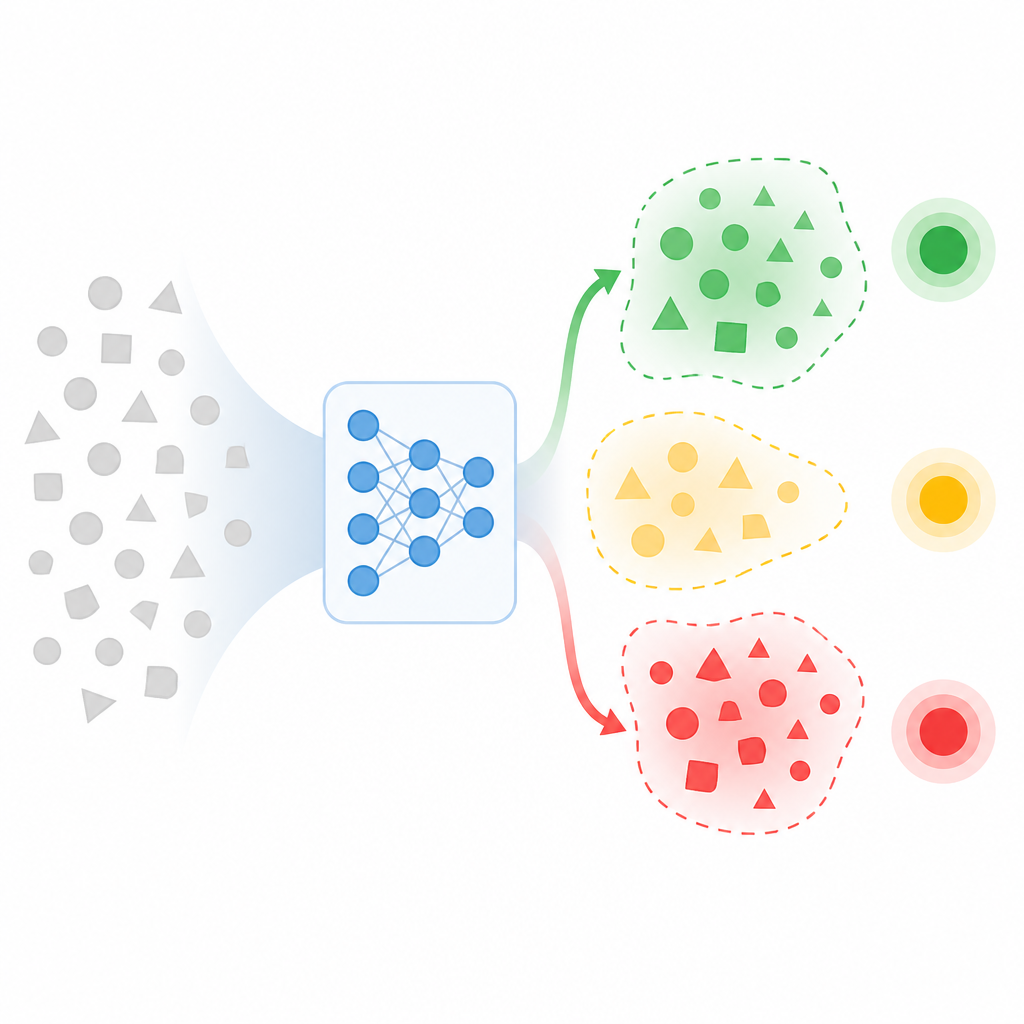
The specific pain point here is label quality. Human labels are costly, and even community labels may be survey-dependent and noisy. That creates a mismatch between what a model wants during training and what astronomy teams can realistically provide at scale. The paper is trying to remove that dependency without giving up robustness.
How the method works in plain English
The core idea is to train on two kinds of data: simulated transient injections and a survey class that is mostly bogus. Instead of treating the labels as clean, the authors assume different classes have different levels of label noise and use a dual-network model with asymmetric co-teaching to handle that imbalance.
In practice, co-teaching means the two networks can help filter noisy examples for each other, rather than trusting every label equally. The asymmetric part matters because the classes are not equally noisy. That is a sensible fit for this problem, where one class is intentionally built from injections and the other comes from contaminated survey data.
The paper also looks at uncertainty quantification. It compares MC dropout and deep ensembles, then proposes a lower-cost hybrid strategy that takes advantage of the dual-network setup to improve calibration. In other words, the model is not only trying to say “real” or “bogus,” but also to express how confident that decision should be.
That uncertainty piece is important for production pipelines. A classifier that can rank its own confidence is easier to integrate into downstream triage, alerting, and human review workflows. The paper also extends the evaluation into the light-curve domain to see whether the learned system can recover light-curve classes as well.
What the paper actually shows
The abstract does not provide benchmark numbers, so there are no accuracy, AUC, or calibration figures to quote here. What it does claim is that the method achieves strong Real-Bogus performance on a labeled subset and remains stable even under severe class contamination.
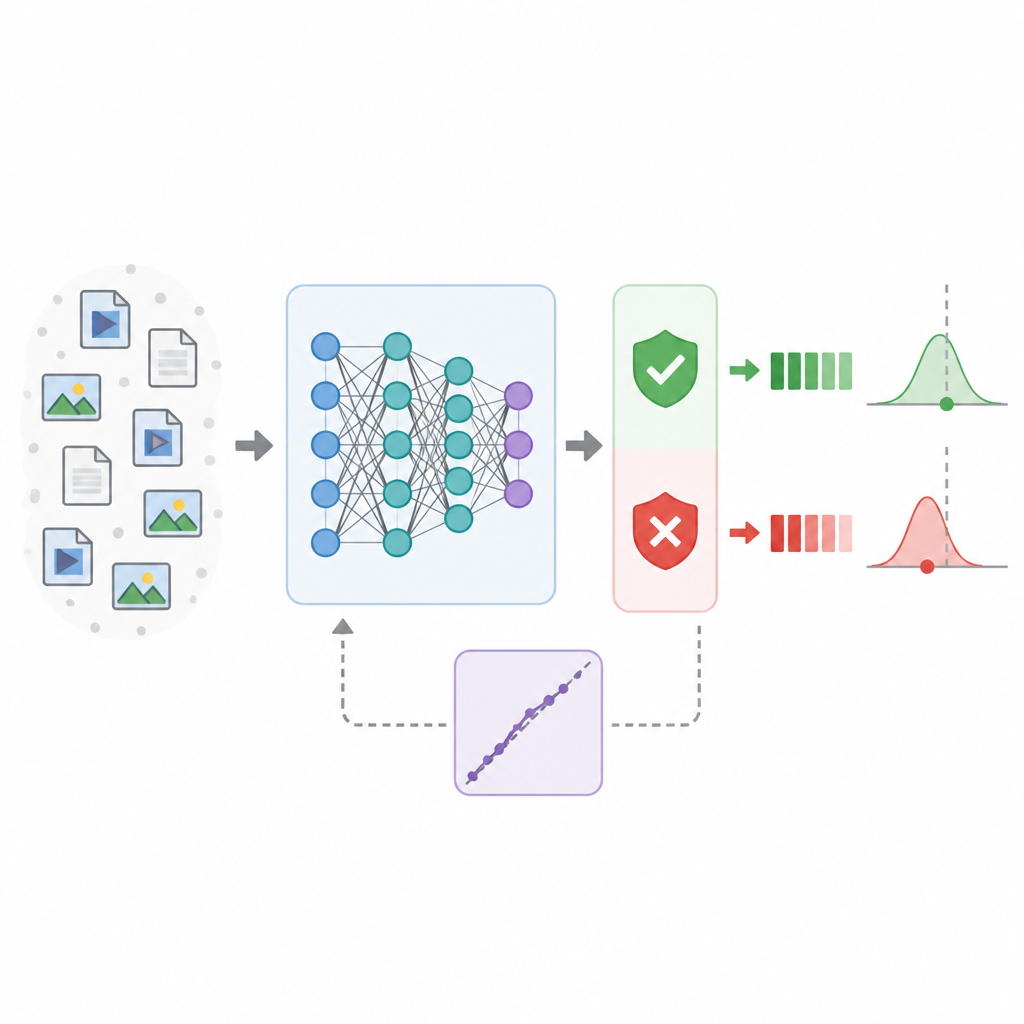
That stability claim is the headline result. The model is presented as robust to noisy supervision, which is exactly what you want if you are trying to train from weak signals instead of curated labels. The authors also say the method recovers transient light-curve classes with high fidelity.
There is one important caveat in the light-curve results: single-source identification is limited by ambiguity in light-curve-derived labels. That means the system can recover broader transient classes well, but finer-grained identification still runs into label ambiguity rather than just model weakness.
On uncertainty, the hybrid UQ strategy is described as competitive with more expensive ensemble baselines. The paper also reports that latent-space analyses show uncertainty aligning with the decision boundary and reveal subclasses within the bogus population. That is useful because it suggests the representation is not just separating classes, but also organizing the ambiguous region in a way that can be inspected.
Why developers should care
If you build ML systems for scientific pipelines, this is a useful pattern: use synthetic or injected data to bootstrap training when clean labels are scarce, then explicitly model label noise instead of pretending it is absent. The paper is a concrete example of weak supervision being used as an engineering strategy, not just a research curiosity.
The uncertainty angle matters too. Deep ensembles are often strong but costly, and MC dropout is cheaper but not always enough. A hybrid approach that leverages a dual-network structure could be a practical middle ground when you need calibrated outputs without paying full ensemble cost.
The paper also hints at a deployment workflow. The authors say the method is suited for transfer to forthcoming surveys by re-running the injection-based training pipeline. That is not the same as a one-click portable model, but it is a plausible recipe for adapting to new survey conditions without rebuilding a labeled dataset from scratch.
Limitations and open questions
The biggest limitation is also the most obvious one: the abstract gives no benchmark numbers, so you cannot yet judge the size of the gain from the summary alone. It also does not spell out the exact dataset scale, the evaluation subset composition, or how the contamination was distributed across classes.
There is also a broader question about generalization. The paper says the method is suited for transfer by re-running the injection-based pipeline, but that still implies survey-specific retraining rather than a universally pretrained detector. For teams planning to adopt this approach, the real work will be in making the injection process and contamination assumptions match the next survey.
Even so, the direction is clear: if you can train Real-Bogus classifiers without expensive human labels and still get calibrated uncertainty, you reduce a major operational bottleneck in transient discovery. That is the kind of improvement that matters when the data stream gets bigger than the labeling budget.
- Injection-based weak supervision can replace expensive human labels for Real-Bogus training.
- Dual-network asymmetric co-teaching is used to handle different noise levels across classes.
- Hybrid uncertainty estimation aims to deliver calibration at lower cost than full ensembles.
// Related Articles
- [RSCH]
Direct-OPD reuses weak-model RL gains for stronger models
- [RSCH]
CamVLA makes robot policies view-robust
- [RSCH]
Data link layer: OSI layer 2 explained
- [RSCH]
The OSI model still explains networking well
- [RSCH]
Evaluation Protocols for Fine-Tuned LLMs in 2026
- [RSCH]
DeepSpec should be treated as a data-regeneration pipeline, not a tra…