Mastercard’s AI Payments Move Is A Solana Bull Case, Not A Hype Story
Mastercard’s Agent Pay integration gives Solana a real utility case beyond speculation.

Mastercard’s Agent Pay integration gives Solana a real utility case beyond speculation.
Solana’s inclusion in Mastercard’s Agent Pay system matters because it turns SOL from a trading narrative into part of a payment rail built for autonomous software.
First, this is real utility, not branding
Get the latest AI news in your inbox
Weekly picks of model releases, tools, and deep dives — no spam, unsubscribe anytime.
No spam. Unsubscribe at any time.
Mastercard’s Agent Pay for Machines is designed for AI-driven payments, and the key detail is not the press release gloss but the function: autonomous agents can execute transactions using cards and stablecoins. When a major payments network adds a blockchain to that workflow, it is not treating the chain as a meme asset. It is choosing settlement infrastructure.
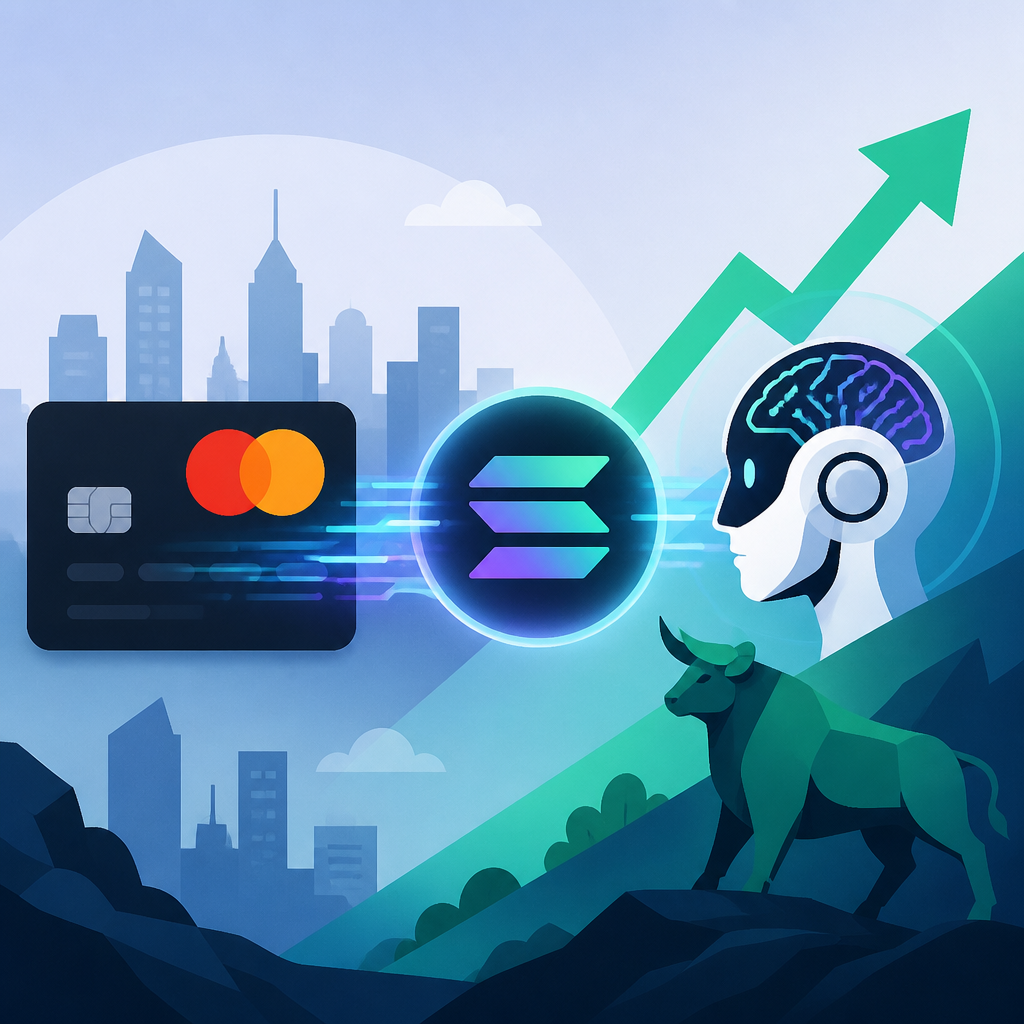
Solana fits that role because its core value proposition is fast execution with low fees, which is exactly what machine-to-machine commerce needs. In a system where software agents may issue frequent, low-value transactions, expensive or slow settlement destroys the use case. Solana being supported inside that ecosystem gives it a practical job, and practical jobs are what create durable demand.
Second, the market already knows the token needs a catalyst
SOL is trading near the low $60s after a sharp selloff, with daily RSI around 28 and price sitting well below its 20-day, 50-day, and 200-day moving averages. That is the profile of an asset under pressure, not one priced for perfection. The Mastercard integration arrives into weakness, which matters because good news often has the most impact when sentiment is exhausted.
The technical setup also gives the story more than headline value. Support near $60.52 has held as a short-term floor, and analysts are watching a possible rebound toward $77 if momentum improves. A payment integration does not erase macro fear or ETF outflows, but it does add a fundamental reason for buyers to care beyond a reflex bounce. That combination is stronger than a pure chart trade.
Third, Solana is being pulled into the right kind of ecosystem
AI commerce is going to reward blockchains that can process many small transactions without friction. That is not a theoretical preference; it is a design requirement. If autonomous agents are to buy data, pay APIs, settle services, or move stablecoins across systems, the chain underneath has to behave like infrastructure, not like a congested experiment. Solana has spent years arguing that it can be that infrastructure, and Mastercard’s integration gives that claim external validation.

This is also how adoption narratives become credible. Crypto markets have been flooded with partnerships that amount to logo swaps and little else. Here, the integration connects a global payments brand, stablecoins, and blockchain settlement in a way that maps to a real workflow. That is the kind of bridge that can outlast a single market cycle because it ties token utility to a commercial process, not just to investor sentiment.
The counter-argument
The strongest bear case is straightforward: one integration does not fix weak price action, and it does not guarantee that merchants, developers, or agents will actually route meaningful volume through Solana. ETF outflows and broader risk-off conditions still dominate crypto pricing. If capital is leaving the market, a utility headline can be drowned out by macro pressure.
That objection is valid, and it sets a real limit on the near-term thesis. Solana is not suddenly repriced because Mastercard added it to a payment system. But the counter-argument fails on the long view because adoption catalysts do not need to move price immediately to matter. They need to establish a credible path to usage. Mastercard has done that here, and once a blockchain becomes part of payment architecture, the burden shifts to competitors to prove they belong there too.
What to do with this
If you are an engineer, PM, or founder building in crypto or fintech, treat this as a signal to optimize for settlement speed, stablecoin compatibility, and agent-friendly payment flows. If you are evaluating Solana, focus less on the next candle and more on whether its ecosystem can capture machine-driven transaction volume. The right question is not whether this headline pumps SOL today. The right question is whether Solana is becoming the default chain for automated commerce. On that question, the answer is yes.
// Related Articles
- [IND]
Black Duck’s Coverity gets better at AI-era triage
- [IND]
Anthropic’s Opus 5 makes the AI race cheaper
- [IND]
OpenAI’s distillation playbook explains the Kimi panic
- [IND]
Gemini 3.5 Flash lets you buy speed
- [IND]
RISC-V is past the hobby phase and should be treated as a real platfo…
- [IND]
Nvidia and OpenAI discuss a $250B AI backstop