ML helps trace Seiberg dualities
The paper uses ML to identify Seiberg dualities in quiver gauge theories and beats deterministic methods on modest-size graphs.
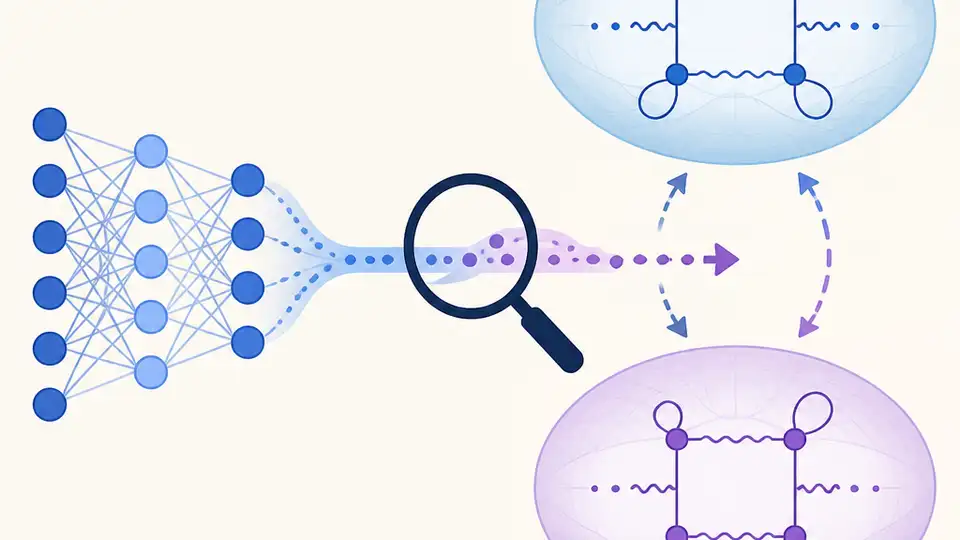
Machine learning can trace Seiberg dualities in quiver gauge theories better than deterministic methods on modest graphs.
- Research org: Unspecified in arXiv abstract
- Core data: Quivers with about 10 nodes
- Breakthrough: Transformers and MLPs search quiver mutations, aided by pathfinder algorithms
This paper asks a practical question that shows up whenever dualities matter: given two systems, how do you efficiently tell whether they are actually dual? The authors study that problem for Seiberg dualities in supersymmetric quiver gauge theories, and they frame it as a machine-learning task rather than a purely symbolic one.
For developers, the interesting part is not just the physics. It is the setup: a hard search problem with known rules, a structured graph-like input, and a comparison between learned models and deterministic algorithms. That makes the paper relevant as a benchmark-style case study for how frontier AI systems handle combinatorial reasoning under explicit constraints.
What problem this paper is trying to fix
Get the latest AI news in your inbox
Weekly picks of model releases, tools, and deep dives — no spam, unsubscribe anytime.
No spam. Unsubscribe at any time.
Dualities are a way of saying that two different-looking systems are actually describing the same underlying physics. The abstract says these relationships are important for both microscopic and emergent phenomena, but verifying them can be computationally difficult even when the governing rules are already known.
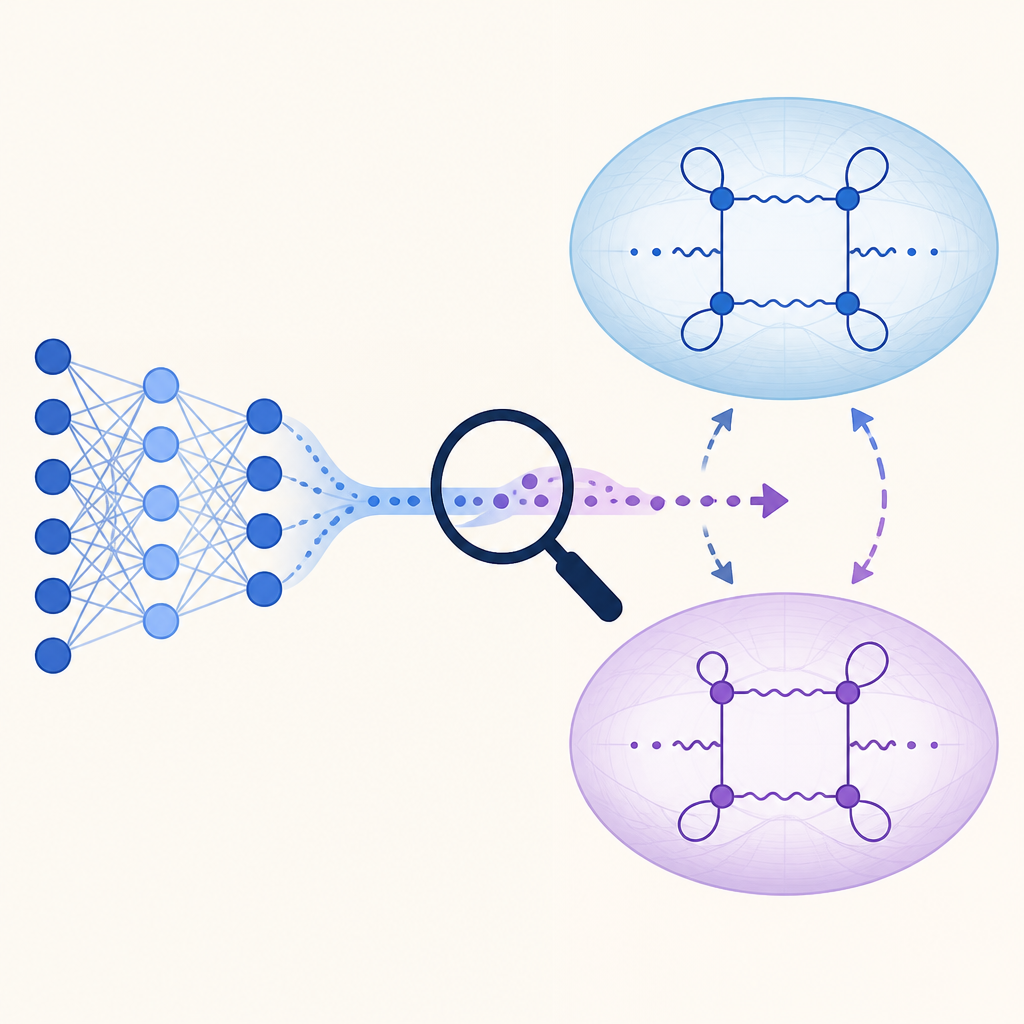
That difficulty is the core bottleneck. The question is not whether dualities exist in theory; it is how to efficiently establish that two given systems are dual in practice. In this paper, the target is Seiberg duality, expressed through supersymmetric quiver gauge theories.
The authors describe the mathematical problem as establishing mutations of quivers. They also connect it to the broader theme of “learning to unknot,” which signals that the task has the flavor of structured search over transformations rather than simple classification.
How the method works in plain English
The paper uses machine learning to learn how to trace the transformations that connect one quiver to another. In practical terms, the model is trying to navigate a search space of mutations and identify whether a duality path exists.
The abstract names two main model families: transformers and multi-layer perceptrons. Those architectures are tested on quivers with a modest number of nodes, on the order of 10. The point is to see how different network designs behave on the same duality-tracing task.
The authors also add well-established pathfinder algorithms to the network. They compare this to “Google Maps for quivers,” which is a useful intuition: the learned model proposes or evaluates routes, while the pathfinder component improves the search strategy by helping it navigate the graph more effectively.
That hybrid setup matters because it suggests the task is not just about raw pattern recognition. It is about combining learned heuristics with classical search machinery, which is a familiar and often effective pattern in applied AI systems.
What the paper actually shows
The abstract does give one concrete result: for quivers with about 10 nodes, transformers and MLPs tend to outperform deterministic algorithms. That is the clearest performance claim available in the source.
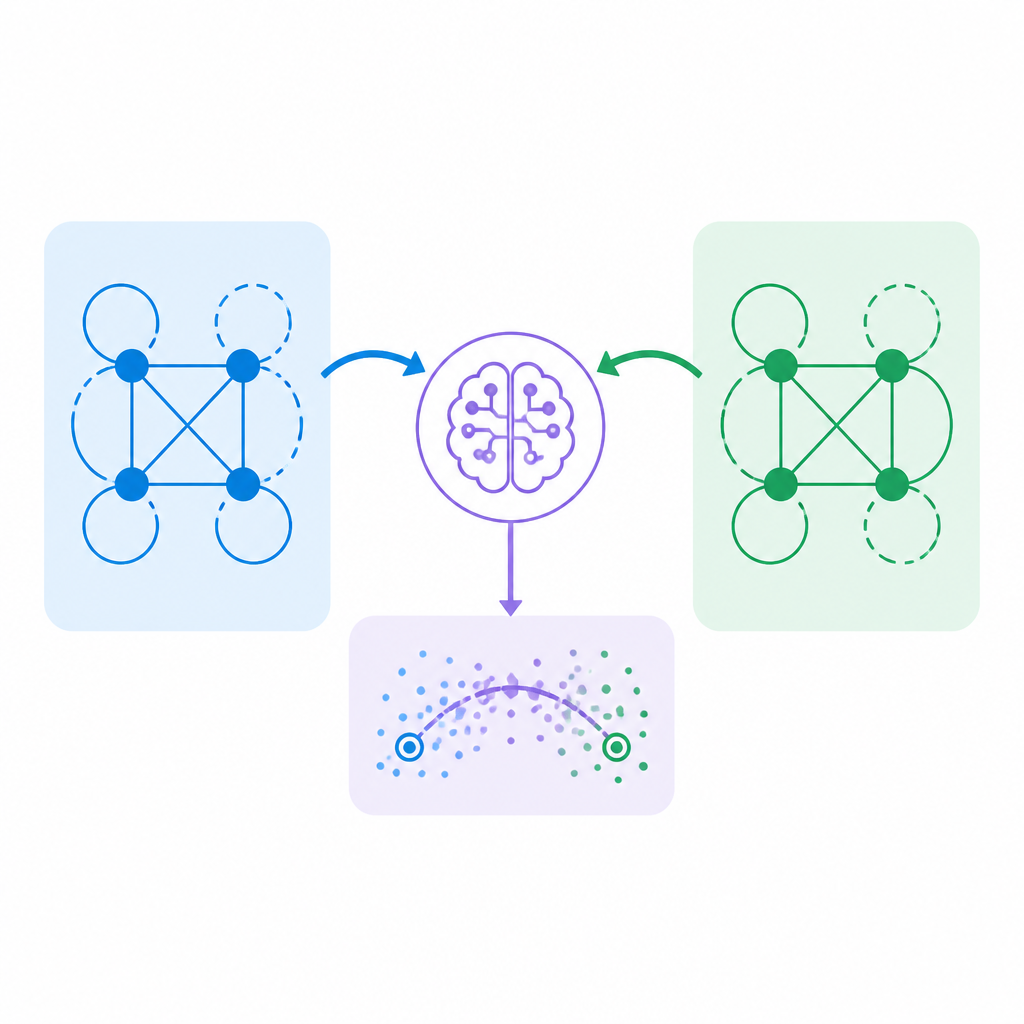
It also says that adding pathfinder algorithms improves both the efficiency and the accuracy of the search strategy. So the paper’s takeaway is not simply “deep learning wins,” but rather that a hybrid approach can do better on this particular duality-tracing problem.
At the same time, the abstract does not provide benchmark numbers, dataset sizes, exact accuracy values, runtime measurements, or ablation details. So while the qualitative result is clear, the source material does not let us quantify the size of the gain.
The authors position the work as a way to study computational complexity across different dualities. That is an important framing: the machine-learning system is not only solving instances, it is also being used to probe how hard the underlying problem is.
Why engineers and AI practitioners should care
This is a useful example of AI on a structured scientific search task. The input is highly constrained, the rules are known, and success depends on navigating a combinatorial space efficiently. Those are exactly the kinds of conditions where hybrid systems can shine.
For ML practitioners, the paper is interesting because it compares architectures on a task that is not a standard benchmark like image classification or language modeling. Instead, it tests whether models can learn to reason over graph mutations and duality paths. That makes it a potentially useful benchmark for frontier models applied to theoretical physics.
For developers building AI systems, the lesson is more general: when a problem has a known formal structure, it may be worth pairing learned components with classical algorithms instead of choosing one or the other. The paper suggests that transformers and MLPs can help, but also that search utilities still add value.
Limitations and open questions
The biggest limitation is scope. The abstract only claims success on quivers with a modest number of nodes, around 10. It does not tell us how the method scales as the graphs get larger or the mutation space becomes more complex.
Another limitation is the lack of detailed metrics in the abstract. We do not get benchmark tables, exact speedups, or error rates, so the practical performance gap remains qualitative in the source material.
There is also an open question around generalization. The paper focuses on Seiberg dualities for supersymmetric quiver gauge theories, so it is not yet clear from the abstract how broadly the approach transfers to other duality problems or other kinds of structured scientific reasoning.
Still, the direction is compelling: use machine learning to assist with a hard, rule-based search problem, then augment it with classical pathfinding. That combination is often where real-world systems end up being most useful, and this paper gives a physics-flavored example of that pattern.
The bigger picture
The abstract ends by suggesting that this class of questions could be a useful benchmark for frontier AI models in theoretical physics. That is a strong hint about where the authors think the field should go next.
In other words, the paper is not just about one duality problem. It is about whether AI can become a serious tool for tracing mathematically defined equivalences in physics, especially when the search space is too large for brute-force reasoning to be convenient.
For OraCore readers, the key takeaway is simple: this is a proof-of-concept for using ML plus search to solve a structured scientific reasoning task. The physics is specialized, but the systems lesson is broadly applicable.
- ML models can help trace dualities in structured graph problems.
- Hybrid search improves both efficiency and accuracy over pure learning or pure rules.
- The paper is promising, but the abstract does not provide hard benchmark numbers.
// Related Articles
- [RSCH]
PAC-MAN makes humanoid dodgeball safer
- [RSCH]
ReToken uses one learned token to fetch visual context
- [RSCH]
Fruitfly-Inspired Regression Without Heavy Models
- [RSCH]
Mental World Modeling: Simulating minds, not just scenes
- [RSCH]
Do You Need to Pretrain Q-Functions?
- [RSCH]
OpenAI’s agent hack forces tighter eval controls