ReToken uses one learned token to fetch visual context
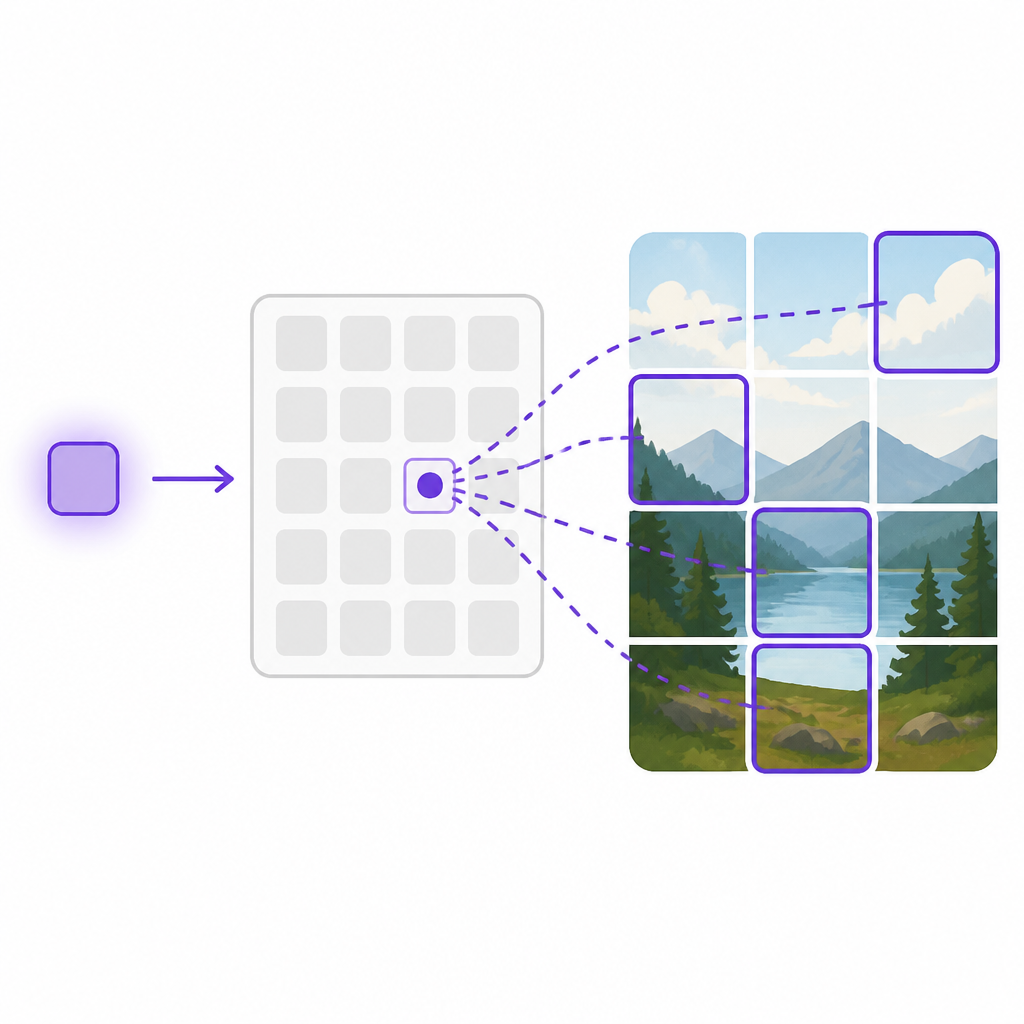
ReToken uses one learned token to retrieve relevant visual tokens and improve long-context vision-language retrieval.

13.4 points is how much ReToken improves Qwen3VL-8B on Visual Haystacks.
- Research org: Unspecified in arXiv abstract
- Core data: 13.4-point gain on Visual Haystacks
- Breakthrough: A single learnable embedding retrieves sparse query-relevant visual tokens
ReToken: One Token to Improve Vision-Language Models for Visual Retrieval tackles a very practical bottleneck in vision-language systems: once the visual context gets long, models start to miss relevant details, and feeding every token into the model becomes too expensive for GPU memory. The paper’s pitch is simple: instead of processing everything, learn one token that can act like a retrieval query over a pre-filled visual KV cache.
That matters for anyone building image or video assistants that need to answer questions over crowded scenes, long documents, or long videos. The paper is not claiming a new base model or a new multimodal architecture from scratch. It is proposing a lightweight retrieval mechanism that sits on top of existing vision-language models and helps them focus on the right visual evidence.
What problem ReToken is trying to fix
Get the latest AI news in your inbox
Weekly picks of model releases, tools, and deep dives — no spam, unsubscribe anytime.
No spam. Unsubscribe at any time.
Vision-language models struggle in the exact situations developers care about most: many distractors, long contexts, and limited memory. As the number of irrelevant visual tokens grows, performance degrades. At the same time, sending all tokens through the model at once is computationally infeasible under GPU memory constraints.

That creates a familiar engineering tradeoff. You can keep more context and pay more compute, or you can prune aggressively and risk losing the one detail the user asked about. ReToken is designed to move that tradeoff in a better direction by retrieving only the visual tokens that matter for the current query.
How the method works in plain English
ReToken is described as a single learnable embedding trained as an explicit retrieval target. In practical terms, think of it as one small learned query vector whose job is to pull back the most relevant visual tokens from a pre-filled visual KV cache.
The key idea is sparsity. Rather than letting the model attend over everything, ReToken selects a sparse set of query-relevant visual tokens. That makes the system lighter during inference and gives the model a more focused slice of the visual context to reason over.
The paper emphasizes that this is a lightweight design, not a heavyweight retriever stack. It is trained on only a small image-QA dataset, which is important because it suggests the method does not require massive additional supervision just to learn how to retrieve useful visual evidence.
What the paper actually shows
The abstract reports gains across both image and video benchmarks, which is the strongest signal that the method transfers beyond a single toy setup. On Visual Haystacks, ReToken improves Qwen3VL-8B by 13.4 points and InternVL3.5 by 12.4 points, which the abstract says is more than 20% relative improvement.
It also reports zero-shot transfer to long video on LVBench, where ReToken gives an 8.0-point gain with Qwen3VL-8B. That zero-shot result matters because it suggests the retrieval token is not just overfitting to one benchmark format; it can help in a different long-context setting without additional task-specific training.
The paper also makes a deployment-relevant claim: both training and long-video inference fit on a single H100. For engineers, that is often the difference between a research idea and something that can actually be tried in a real pipeline.
One thing the abstract does not provide is a full benchmark table with all metrics, latency numbers, or memory numbers. So while the gains are clear, the public summary does not let us compare ReToken against every possible retrieval or compression baseline in detail.
Why developers should care
If you are building multimodal search, visual QA, or video assistants, the core problem is not just accuracy. It is how to keep the model focused when the input is noisy, long, and expensive to process. ReToken is interesting because it attacks that problem with a very small learned component instead of a large architectural overhaul.
That makes it appealing as a systems idea. A single retrieval token over a KV cache could be easier to slot into existing vision-language stacks than a more invasive redesign, especially when you are already constrained by memory and want to avoid processing every frame or patch.
It is also a reminder that retrieval is becoming just as important in multimodal systems as it is in text-only LLMs. When context gets too large, the model needs a way to fetch evidence, not just ingest it.
Limitations and open questions
The abstract gives us a strong headline result, but not enough detail to know where the method breaks. We do not get the exact training recipe, the retrieval thresholding strategy, the cost of the retrieval step itself, or how sensitive the method is to different kinds of distractors.
We also do not know from the abstract how ReToken behaves across broader model families, beyond the two named systems in the summary. The reported gains are promising, but the public note does not establish whether the same token works equally well for other backbones, other datasets, or much longer contexts than those tested.
Still, the direction is clear: if long visual context is the bottleneck, a small learned retrieval token may be a practical way to make vision-language models more usable without blowing up memory. For teams shipping multimodal products, that is the kind of idea worth prototyping.
- ReToken learns one embedding to retrieve sparse visual tokens from a KV cache.
- It improves long-context visual retrieval on both image and video benchmarks.
- The abstract reports strong gains but does not include full benchmark tables or latency breakdowns.
// Related Articles
- [RSCH]
PAC-MAN makes humanoid dodgeball safer
- [RSCH]
ML helps trace Seiberg dualities
- [RSCH]
Fruitfly-Inspired Regression Without Heavy Models
- [RSCH]
Mental World Modeling: Simulating minds, not just scenes
- [RSCH]
Do You Need to Pretrain Q-Functions?
- [RSCH]
OpenAI’s agent hack forces tighter eval controls