MLOps Roadmap 2026 Turns Learning Into Delivery
A practical MLOps roadmap you can copy to go from basics to production-ready workflows in 2026.

A copyable MLOps roadmap for moving from basics to production-ready delivery in 2026.
I’ve been using MLOps roadmaps for a while now, and most of them feel weirdly academic. They list the right words, sure. Reproducibility, automation, scalability, collaboration. Great. But when I hand that kind of roadmap to a junior engineer, they still don’t know what to do on Monday morning. Do I learn Python packaging first? Do I build a model? Do I wire CI/CD? Do I touch Kubernetes before I’ve even shipped a toy pipeline? That’s the part that keeps bothering me.
The IABAC post, “MLOps Roadmap 2026: A Complete Beginner-to-Professional Guide”, is the trigger here. It lays out the usual progression from MLOps basics to cloud, orchestration, monitoring, edge AI, and explainability. I’m not treating it like gospel. I’m treating it like a useful scaffold that needs a real developer’s translation. The source doesn’t give view or star counts, so I’m not inventing any. What it does give is a clean sequence, and that’s enough to turn into something you can actually follow.
Stop treating MLOps like a buzzword bucket
Get the latest AI news in your inbox
Weekly picks of model releases, tools, and deep dives — no spam, unsubscribe anytime.
No spam. Unsubscribe at any time.
“MLOps stands for Machine Learning Operations. It is a set of practices that combines several important fields, including: Machine Learning, DevOps, Data Engineering, Cloud Computing, Software Engineering.”
What this actually means is: MLOps is not a single tool, and it’s not a certification badge you slap on your LinkedIn headline. It’s the boring connective tissue between model work and real software delivery. If your model can’t be reproduced, deployed, monitored, and updated, then it’s still a notebook experiment with a confidence problem.

I ran into this the hard way when I first tried to “productionize” a model by just wrapping it in a Flask app and calling it done. It worked once. Then the environment drifted, dependencies changed, and the model output stopped matching what we tested locally. That’s when the MLOps part stopped being theory and started being annoying reality.
The IABAC guide frames MLOps as the lifecycle around data collection, preparation, training, testing, deployment, monitoring, maintenance, and continuous improvement. That’s the right mental model. If you only learn model training, you’ve learned maybe 20 percent of the job.
How to apply it: when you start any MLOps project, write the lifecycle out before you write code. I mean literally list the stages. Then ask, “What breaks here?” That question matters more than “Which framework should I use?”
- Define the input data source and ownership.
- Define the training trigger and retraining cadence.
- Define the deployment target and rollback path.
- Define the metrics that decide whether the model stays live.
If you do only one thing from this article, do that. It keeps the roadmap from becoming decorative.
Learn the principles before you touch the stack
“Reproducibility means that experiments can be repeated and produce the same or very similar results. Automation reduces the need for manual work. Scalability means that the system can handle more data, more users, and more traffic without breaking down. Collaboration improves teamwork.”
This is the part people skip because it sounds obvious. Then they spend three months debugging a pipeline that fails only on the second Tuesday of the month because the training job depends on a hidden local file and somebody’s laptop timezone. I wish I was exaggerating.
The source names four core principles: reproducibility, automation, scalability, and collaboration. I’d add one more, which is observability. If you can’t see what happened, you can’t improve what happened.
What this actually means is that your first MLOps skill is not Kubernetes. It’s discipline. Version your data. Version your code. Record your parameters. Track your environment. Make every run explainable after the fact. That’s the difference between “I think it worked” and “I can prove it worked.”
How to apply it: set up a tiny experiment log for every model you touch. It can be a markdown file at first. Track the dataset hash, code commit, metric, and deployment status. That simple habit saves you from the classic MLOps trap where nobody knows which model is actually in production.
- Reproducibility: same inputs, same outputs, or close enough to explain variance.
- Automation: no manual clicking through repeatable steps.
- Scalability: don’t design for your laptop, design for the ugly future.
- Collaboration: make it possible for someone else to rerun your work without a scavenger hunt.
If you want a concrete reference for versioning practices, I’d start with Git and then move toward experiment tracking tools like MLflow. The point is not the brand. The point is traceability.
Programming fundamentals are the floor, not the finish line
“Step 3: Master Programming Fundamentals”
The guide keeps programming fundamentals high on the roadmap, and that’s correct. I’ve seen too many people try to jump straight from “I took an AI course” to “I’m building MLOps pipelines” without being able to structure code cleanly. That almost always turns into a pile of scripts that only one person can run.
What this actually means is that MLOps expects you to be comfortable with Python, basic software structure, package management, testing, and scripting. You do not need to become a language nerd. You do need to write code that other systems can call without complaint.
I ran into this when I tried to automate a training job that depended on a notebook export. The notebook had hidden state, import order issues, and a couple of helper cells nobody remembered. Turning that into a packageable module was the real work. The model was the easy part.
How to apply it: build one tiny project with a clean entry point, config file, and test suite. Use Python, because that’s the language most MLOps workflows still expect. Keep the code boring. Boring code is easier to deploy.
If you want to sharpen this layer, I’d use Python, pytest, and a packaging tool such as the Python Packaging User Guide. You’re not learning these for fun. You’re learning them because production systems punish sloppy structure.
Version control is where MLOps starts acting like software
“Learn Version Control Systems”
This step matters more than beginners think. Without version control, MLOps turns into a guessing game. Which model file was trained on which data? Which config produced the better metric? Which branch got deployed? If the answer is “some file in a shared folder,” you’re already in trouble.
What this actually means is that Git is not optional. It is the memory of your project. It gives you a way to track code, experiment branches, review changes, and recover when somebody breaks the pipeline at 5:40 p.m. on a Friday. Which, yes, happens.
I’ve watched teams keep model artifacts in random cloud folders and then spend hours trying to reconstruct the deployment history. That kind of chaos is avoidable. Use Git for code, use artifact storage for built outputs, and never mix the two just because it feels convenient.
How to apply it: create a repo structure that separates source code, configs, tests, and pipeline definitions. Then use tags or release branches to mark production-ready states. If you need a reference, start with Git documentation and pair it with a basic branching strategy that your team can actually remember.
- Keep model training code in source control.
- Track config changes separately from code changes.
- Use tags for deployed versions.
- Never treat notebook outputs as your only record.
This is one of those habits that feels tedious until it saves your weekend.
CI/CD is the bridge between model work and shipping
“Learn CI/CD for MLOps”
People hear CI/CD and think “web app stuff.” That’s lazy. In MLOps, CI/CD is what keeps model delivery from becoming a manual ritual. If every change requires someone to run a script, validate the output, package the model, upload it, and poke production by hand, then you don’t have a pipeline. You have a chore list.
What this actually means is that model code, tests, packaging, and deployment should be automated as much as possible. CI catches broken code early. CD moves approved artifacts into the right environment. In MLOps, that often includes extra checks for data quality, model drift, and performance regressions.
I ran into this when a team I worked with had a “deployment pipeline” that was really a Slack message saying “new model is ready.” That’s not deployment. That’s hope with a timestamp.
How to apply it: start with a simple pipeline that runs tests on every commit, trains on a scheduled trigger or sample dataset, and packages the model artifact. Once that works, add deployment to staging. Only then think about production automation. If you want tooling, look at GitHub Actions, Jenkins, or GitLab CI/CD.
The goal is not to automate everything on day one. The goal is to remove the highest-friction manual steps first.
Cloud, infrastructure as code, and orchestration are the real production layer
“Learn Cloud Computing” and “Learn Infrastructure as Code” and “Learn Orchestration and Deployment”
This is where the roadmap finally starts looking like production instead of a classroom exercise. Cloud computing gives you elastic infrastructure. Infrastructure as code gives you repeatability. Orchestration gives you control over multi-step workflows. Together, they stop your MLOps setup from living as a pile of one-off commands in somebody’s shell history.
What this actually means is that you should learn enough cloud to deploy, scale, and observe workloads without begging for manual server access every time. Then learn infrastructure as code so your environments are defined in files, not tribal knowledge. Then learn orchestration so training, validation, deployment, and retraining can run as a coordinated workflow.
I’ve seen teams do all of this with hand-built scripts, and it always turns into a maintenance tax. The first time a node dies or a cluster gets recreated, the whole “works on my machine” story collapses. Terraform, Docker, and a workflow engine exist specifically to keep that mess from spreading.
How to apply it: build one end-to-end project using Docker for packaging, Terraform for infrastructure, and a workflow tool like Apache Airflow or Prefect for orchestration. You do not need all the bells and whistles. You need a repeatable path from code to running service.
A practical stack might look like this:
- Docker for containerizing training and inference jobs.
- Terraform for declaring cloud resources.
- Airflow or Prefect for scheduling and dependencies.
- Cloud storage for datasets and artifacts.
That’s enough to teach you the moving parts without drowning in platform sprawl.
Monitoring is where the model earns its keep
“Learn Monitoring and Observability”
The source includes monitoring, and I’m glad it does, because this is where most beginner MLOps plans get hand-wavy. People obsess over training accuracy and then forget that once the model is live, the world keeps changing. Data drifts. User behavior shifts. The business changes the definition of success. Your beautiful offline metric can become a lie fast.
What this actually means is that production models need health checks, performance tracking, latency monitoring, and drift detection. You are not done when the model deploys. That’s when the job starts.
I ran into this with a recommendation model that looked strong in validation but slowly degraded after launch because the input distribution shifted. Nobody noticed until the business team complained. That’s exactly the kind of failure good monitoring is supposed to catch early.
How to apply it: track both system metrics and model metrics. System metrics include latency, error rate, CPU, memory, and throughput. Model metrics include prediction quality, drift, calibration, and business outcome proxies. Use dashboards, alerts, and logs together. If you only watch one layer, you’re blind in the other.
For tooling, I’d look at Prometheus, Grafana, and model-specific logging in MLflow. You want enough signal to know when a model is healthy and enough history to explain when it isn’t.
Edge AI and XAI are the “professional” layer, not the starting line
“Explore Edge AI” and “Learn Explainable AI (XAI)”
The guide ends with edge AI and explainable AI, and that’s a sensible move. These are not first-week topics. They matter when you already understand deployment constraints and need to make models work in constrained environments or justify decisions to humans who are going to ask hard questions.
What this actually means is that edge AI is about running inference near the device or user, often with limited compute, bandwidth, or latency budgets. XAI is about making model behavior understandable enough for debugging, compliance, trust, or internal review. Both are production concerns, not hobby projects.
I’ve seen teams rush into explainability because it sounds responsible, then realize they don’t have clean feature lineage or stable model versions. You can’t explain a mess you didn’t instrument. Same with edge deployment: if your model is huge and your runtime assumptions are fuzzy, the edge will punish you immediately.
How to apply it: only add edge or explainability work after your core pipeline is stable. For edge, test model size, latency, and hardware constraints early. For XAI, define the audience first. Engineers need different explanations than compliance teams or business stakeholders.
If you want tools, start with ONNX for portability and libraries like SHAP or LIME for explanation workflows. Again, tools are secondary. Clear questions come first.
Follow a path, not a mood
“Recommended Learning Path”
The phrase sounds simple, but it’s the part that saves people from random-walk learning. I’ve watched too many engineers bounce between courses, cloud tutorials, and model demos without ever building a coherent skill stack. They end up with fragments. Fragments are frustrating because they feel productive while producing very little.
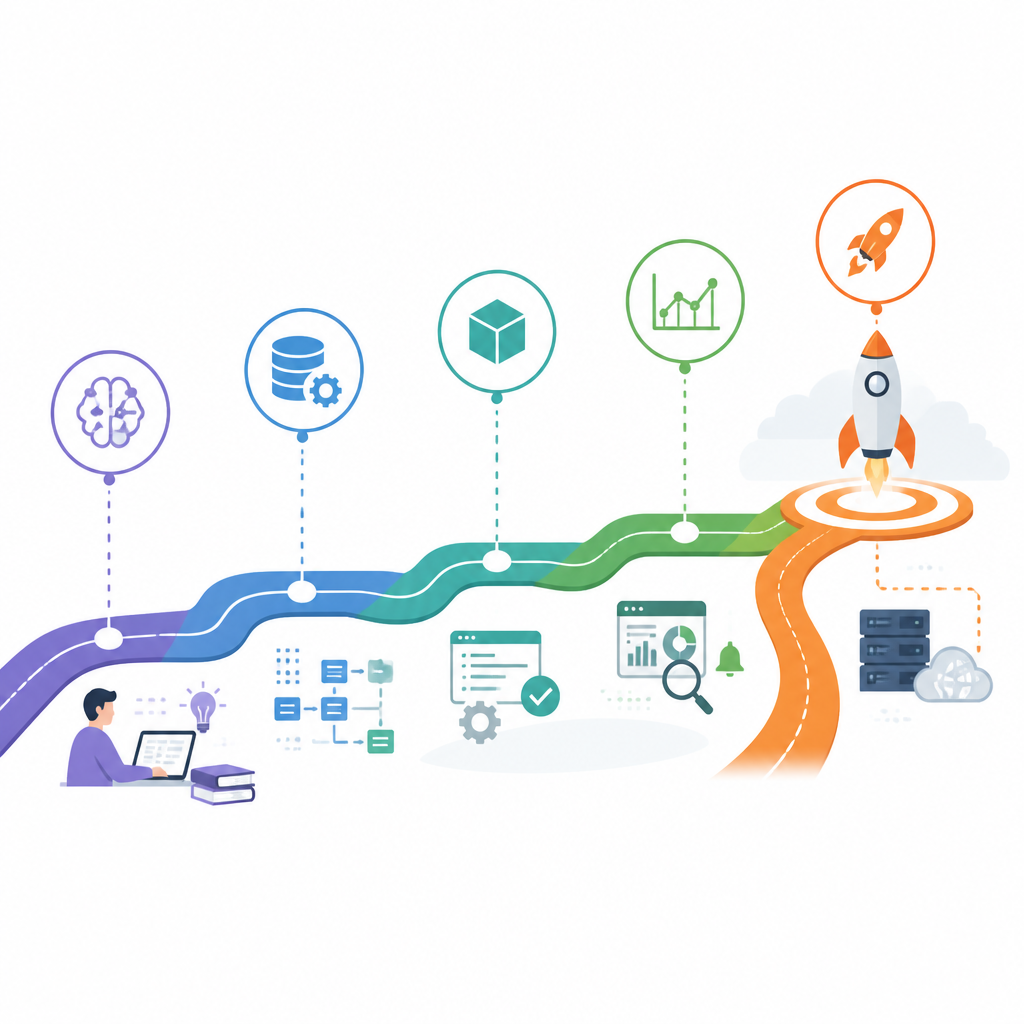
What this actually means is that your learning path should move from fundamentals to systems in a deliberate order. First understand the lifecycle. Then learn code structure and version control. Then add CI/CD. Then add cloud and infrastructure. Then add orchestration, monitoring, and advanced topics like edge and XAI.
How to apply it: set milestones by output, not by hours studied. For example, “I can package a model in Docker,” “I can deploy a training pipeline with GitHub Actions,” or “I can detect drift and trigger retraining.” Those are real milestones. “I watched six hours of MLOps videos” is not.
Here’s the order I’d use if I were mentoring someone from scratch:
- Learn Python, Git, and basic testing.
- Build and track a simple ML experiment.
- Automate training and validation with CI.
- Package the workflow in Docker.
- Deploy to a cloud environment.
- Add monitoring and drift checks.
- Only then explore edge AI and XAI.
That sequence is slower than jumping around, but it actually compounds.
The template you can copy
# MLOps Roadmap 2026: copy-ready learning plan

## Goal
Move from ML experimentation to production-ready MLOps delivery.

## Phase 1: Core foundations
- Learn Python for scripting, packaging, and automation.
- Learn Git for version control and release tracking.
- Learn basic testing with pytest.
- Learn the ML lifecycle: data, training, validation, deployment, monitoring.

## Phase 2: Production habits
- Track every experiment with code commit, dataset version, parameters, and metrics.
- Package training and inference code into reusable modules.
- Create a clean repo structure:
  - src/
  - tests/
  - configs/
  - pipelines/
  - notebooks/ (optional, not source of truth)

## Phase 3: Automation
- Add CI for linting, tests, and training validation.
- Add CD for staging deployment.
- Automate artifact creation and storage.
- Add rollback steps for failed releases.

## Phase 4: Cloud and infrastructure
- Containerize jobs with Docker.
- Define infrastructure with Terraform.
- Use a cloud platform for compute, storage, and deployment.
- Keep environments reproducible with config files.

## Phase 5: Orchestration
- Use Airflow or Prefect to schedule workflows.
- Separate ingestion, training, evaluation, and deployment tasks.
- Add retries, alerts, and dependency handling.

## Phase 6: Monitoring
- Track latency, error rate, throughput, and resource usage.
- Track model quality, drift, and calibration.
- Set alerts for metric regressions.
- Review dashboards on a fixed cadence.

## Phase 7: Advanced topics
- Learn ONNX for model portability.
- Learn SHAP or LIME for explainability.
- Explore edge deployment only after the core pipeline is stable.

## Portfolio projects
1. Batch training pipeline with experiment tracking
2. Dockerized inference service with CI/CD
3. Cloud-deployed model with monitoring dashboard
4. Drift detection job that triggers retraining
5. Explainability report for one production model

## Weekly execution rule
- 1 day: learn
- 2 days: build
- 1 day: test and fix
- 1 day: document
- 1 day: review and simplify
- 1 day: rest or catch up

## Success criteria
- I can reproduce a model run from scratch.
- I can deploy and roll back a model.
- I can explain what changed when performance drops.
- I can hand the project to another engineer without chaos.
This is the version I’d actually hand to a developer who wants to get serious. It’s not pretty, but it works because it forces you to build the pieces in the right order.
Source attribution
This breakdown is based on IABAC’s article at https://iabac.org/blog/mlops-roadmap-a-complete-beginner-to-professional-guide. I’ve reworked the structure, added practical advice, and turned the roadmap into an opinionated learning path you can copy.
// Related Articles
- [TOOLS]
Zilliz Adds Cost Metrics to VDBBench
- [TOOLS]
Zilliz adds cost-aware scoring to VDBBench
- [TOOLS]
Pixel 11 launch highlights and new Gemini features
- [TOOLS]
AWS Continuum turns AI coding into safer fixes
- [TOOLS]
Open-Generative-AI turns GitHub into a studio
- [TOOLS]
Why benchmark scores don’t predict your bill