Opus 5 lets you cut cost without losing quality
I break down Claude Opus 5’s pricing and performance claims into a copy-ready rollout template.

Opus 5 keeps quality while cutting model cost, so I can swap it in without rewriting my stack.
I've been using big models long enough to know when a release actually changes my day and when it just changes the blog post. Most of the time, I get the same annoying tradeoff: either the model is smart enough but expensive enough to make me flinch, or it’s cheap enough that I start building guardrails everywhere just to keep it from wandering off. That’s been my experience with a lot of “next-gen” model drops. The demos look clean. The invoice does not.
What got my attention here was the angle around Claude Opus 5. The promise is simple enough to make me suspicious: keep the performance, cut the price. That sounds nice until you try to run it in a real product, where token spend, latency, fallbacks, and prompt drift all show up at the same time. I care less about the label on the model and more about whether I can swap it into an existing workflow without spending the next week re-tuning prompts like a mugged sysadmin.
This breakdown is based on the Chinese write-up on Zhihu and the official Anthropic announcement that it points to: zhuanlan.zhihu.com/p/2064338482990952939 and Anthropic’s own product page at anthropic.com. I’m not treating the Zhihu post as a benchmark paper. I’m treating it like a signal that the model is being framed as a practical upgrade, not just a bigger number.
Stop paying for “maybe better”
Get the latest AI news in your inbox
Weekly picks of model releases, tools, and deep dives — no spam, unsubscribe anytime.
No spam. Unsubscribe at any time.
“Claude Opus 5 是一款更…”
What this actually means is: the pitch is not “here’s a brand-new capability you’ve never had.” It’s “here’s a model that should feel like the top tier without charging top-tier pain.” That matters because most teams don’t need another science project. They need fewer reasons to hesitate when a request hits the model.

I’ve run into this exact problem in production. Once the model becomes the bottleneck in your budget, every feature request turns into a pricing meeting. Product wants richer responses. Support wants longer context. Engineering wants more retries. Finance wants me to stop pretending the token bill is background noise. If Opus 5 really keeps output quality close to the previous flagship while reducing cost, that gives me room to ship without constantly second-guessing every call.
How to apply it: treat the model upgrade as a unit-economics decision first, not a “best model” decision. I’d compare three things before swapping anything:
- cost per successful task, not cost per token
- latency under my real prompt length
- how often I need a fallback model because the first answer was too soft, too vague, or just wrong
If the new model lowers spend and keeps the success rate steady, that’s a real upgrade. If it only looks good in a demo, I leave it alone.
Performance claims only matter if your prompts are ugly
The annoying part about model announcements is that they usually benchmark the cleanest possible setup. Real apps are messy. You’ve got system prompts that grew over six months, tool schemas that were copied from three different repos, and users who write like they’re trying to win a fight with autocomplete. That’s where “performance” actually shows up.
The Zhihu post frames Opus 5 as a model release worth paying attention to because it lands amid broader safety and capability chatter around the industry. That context matters, but I care more about whether the model can survive my worst-case prompt than whether it wins a leaderboard screenshot.
What this actually means is I should test the model against the ugliest inputs I already have. Not synthetic prompts. Not polished examples. The stuff that makes my current model hesitate or ramble.
I’ve learned to build a small torture set for every model evaluation. It usually includes:
- half-finished user requests
- tool calls with missing fields
- follow-up questions that contradict the original instruction
- long context with one tiny but important constraint near the end
How to apply it: if you’re considering Opus 5, run it through the same prompts you already use in production, then add the ugly variants. If it stays disciplined when the input gets sloppy, that’s the signal I trust. If it only shines on polished demo prompts, I don’t care how elegant the announcement sounds.
Price cuts are only useful when they unlock a new default
“Price halved” sounds like a headline, but I think the real question is whether it changes what I make the default model for. I’ve seen teams celebrate a lower per-token rate and then do absolutely nothing with it because the architecture never got updated. That’s just cheaper inertia.
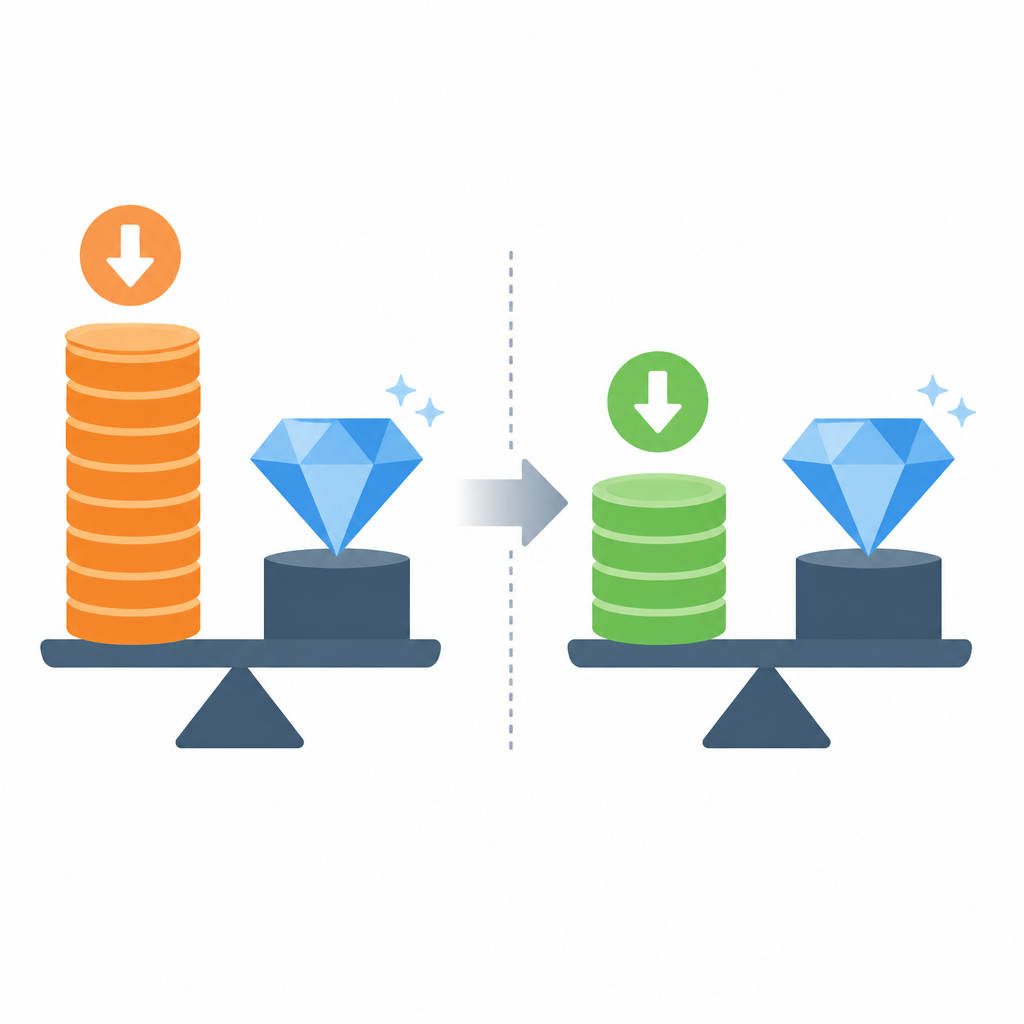
The useful version is when a lower-cost flagship lets me move tasks up a tier. I can stop using the “good enough” model for borderline work and just use the stronger one by default. That reduces prompt branching, simplifies code paths, and often improves the user experience more than any single feature tweak.
Here’s the way I think about it in practice:
- use the cheaper strong model for first-pass generation
- reserve the older or smaller model for simple classification and routing
- use the expensive fallback only when the task is high stakes or the first pass fails
I ran into this pattern when building internal assistants. The model that was “too expensive” to use everywhere suddenly became affordable enough to use for drafting, summarizing, and tool planning. That shaved off a bunch of glue code. Fewer model-specific branches means fewer bugs I have to chase at 11 p.m.
How to apply it: recalculate your default model choice after any price change. Don’t just update a spreadsheet. Ask which workflows can move up a tier because the cost ceiling got lower. That’s where the real savings show up.
Safety talk is not side chatter anymore
The source article mentions the timing around Anthropic’s latest back-and-forth with the U.S. government and the broader safety debate triggered by OpenAI’s recent incident. I’m not going to dress that up as drama for clicks. It matters because model adoption is no longer just a developer preference. It’s product risk, compliance risk, and sometimes reputational risk all rolled into one ugly bundle.
When a vendor pushes a flagship model, I now ask a boring set of questions before I ask about benchmarks. What are the failure modes? How do refusals behave? Does the model get weirdly overcautious in normal workflows? Does it hallucinate less, or just refuse more? Those are not academic questions. They decide whether support tickets go up after rollout.
What this actually means is I should test the model’s refusal style as carefully as I test its answer quality. A model that’s “safer” in the abstract can still be a headache if it becomes overly defensive in everyday tasks.
How to apply it: add a safety regression pass to your evals. I’d include:
- requests that should be answered normally
- requests that should be refused
- ambiguous prompts that need a clarification question
- tool actions that should be blocked unless the user confirms
If a new model changes the shape of refusals, I want to know before users do. That’s especially true when the model is being sold as a premium option. Premium failures are still failures.
Use the release as a routing problem, not a hero model story
I don’t like the habit of treating one flagship model like it has to do everything. That’s how teams end up with a giant prompt, a giant bill, and a giant headache. The better move is to make the model part of a routing system. Let the expensive model handle the hard stuff. Let smaller models handle the easy stuff. Stop pretending one model should be emotionally available for every task.
That’s where a release like Opus 5 can actually help. If the pricing drops and the quality stays high, I can route more work to the stronger model without making the finance team hate me. But I still wouldn’t make it the only path. I’d use it where judgment matters: synthesis, complex planning, messy context, and tasks where a weak first draft costs me more time than the token bill saves.
How to apply it: build a simple routing policy around task complexity. Start with three buckets:
- low complexity: classify, extract, route
- medium complexity: draft, summarize, rewrite
- high complexity: reason, plan, multi-step tool use
Then assign the model that makes sense for each bucket. If Opus 5 is strong enough and cheap enough, it moves into the medium and high buckets by default. That’s the practical win. Not “we used the newest model.” More like “we stopped wasting expensive intelligence on trivial work.”
Benchmarks are nice. My logs are better.
I’ve been burned too many times by benchmark talk to take it as the main event. Benchmarks are useful, sure, but they don’t capture my users’ weird phrasing, my app’s tool latency, or the fact that one bad answer can trigger a whole support chain. I’d rather trust a week of logs than a shiny chart with perfect conditions.
The original write-up is clearly trying to frame Opus 5 as a meaningful release in a tense moment for the industry. Fair enough. But for me, the question is simpler: does it reduce friction in the places where my product actually hurts?
What this actually means is I need a rollout plan, not a fan reaction. I should compare old and new models on the same traffic slice, watch real user outcomes, and keep a rollback path ready. That’s the difference between adopting a model and just admiring one.
How to apply it: run a controlled migration with these checks:
- sample 100 to 500 real requests from production
- score answer quality with a small internal rubric
- measure latency and retry rate
- track user-visible failures, not just model output quality
If Opus 5 wins on your logs, great. If it only wins on a slide deck, I’d keep my current setup and wait.
The template you can copy
# Model swap evaluation template: Opus 5-style upgrade

## Goal
Replace the current flagship model only if the new model lowers cost without hurting task success.

## Decision rule
Adopt the new model if all three are true:
- cost per successful task is lower
- latency stays within acceptable bounds
- user-visible quality does not drop on real traffic

## Test set
Use 50-100 real prompts from production, including:
- clean requests
- messy requests
- contradictory follow-ups
- long-context prompts
- tool-use prompts with missing or partial fields

## Evaluation rubric
Score each response from 1-5 on:
- correctness
- completeness
- instruction following
- refusal behavior
- tool-call quality
- latency

## Routing policy
- low complexity tasks: small/cheap model
- medium complexity tasks: flagship model
- high complexity tasks: flagship model with fallback

## Rollout plan
1. Shadow test on real traffic
2. Compare outputs side by side
3. Measure cost, latency, and failure rate
4. Roll out to 10%
5. Roll out to 50%
6. Roll out to 100% only if metrics hold

## Rollback trigger
Revert if any of these happen:
- quality drops on core tasks
- refusal rate rises unexpectedly
- latency spikes beyond your threshold
- support tickets increase after rollout

## Notes
Keep the old model available for at least one release cycle so rollback is cheap and boring.
The template above is my copy-paste version of how I’d evaluate Opus 5 in a real product. It’s intentionally boring because boring is what keeps model migrations from turning into week-long incidents.
Source attribution: the original framing comes from the Zhihu post at https://zhuanlan.zhihu.com/p/2064338482990952939, which points to Anthropic’s official release materials at https://www.anthropic.com/. The commentary, rollout advice, and template here are my own synthesis.
// Related Articles
- [MODEL]
OpenAI Cuts GPT-5.6 Prices as AI Bills Climb
- [MODEL]
Opus 5 proves premium AI is becoming a commodity
- [MODEL]
OpenAI Gives Scientists Free GPT-5.6 Access
- [MODEL]
Google ships Gemini 3.6 Flash and 3.5 Lite
- [MODEL]
Kimi K3 Is Forcing Silicon Valley to Pick Sides
- [MODEL]
Opus 5 lets you ship with fewer refusals