Proper positive-only learning gets a full characterization
A new result characterizes when proper learning from positive-only samples is possible.

A new result characterizes when proper learning from positive-only samples is possible.
- Research org: Unspecified in arXiv abstract
- Core data: No benchmark numbers in abstract
- Breakthrough: Finite VC dimension plus uniform exterior separability
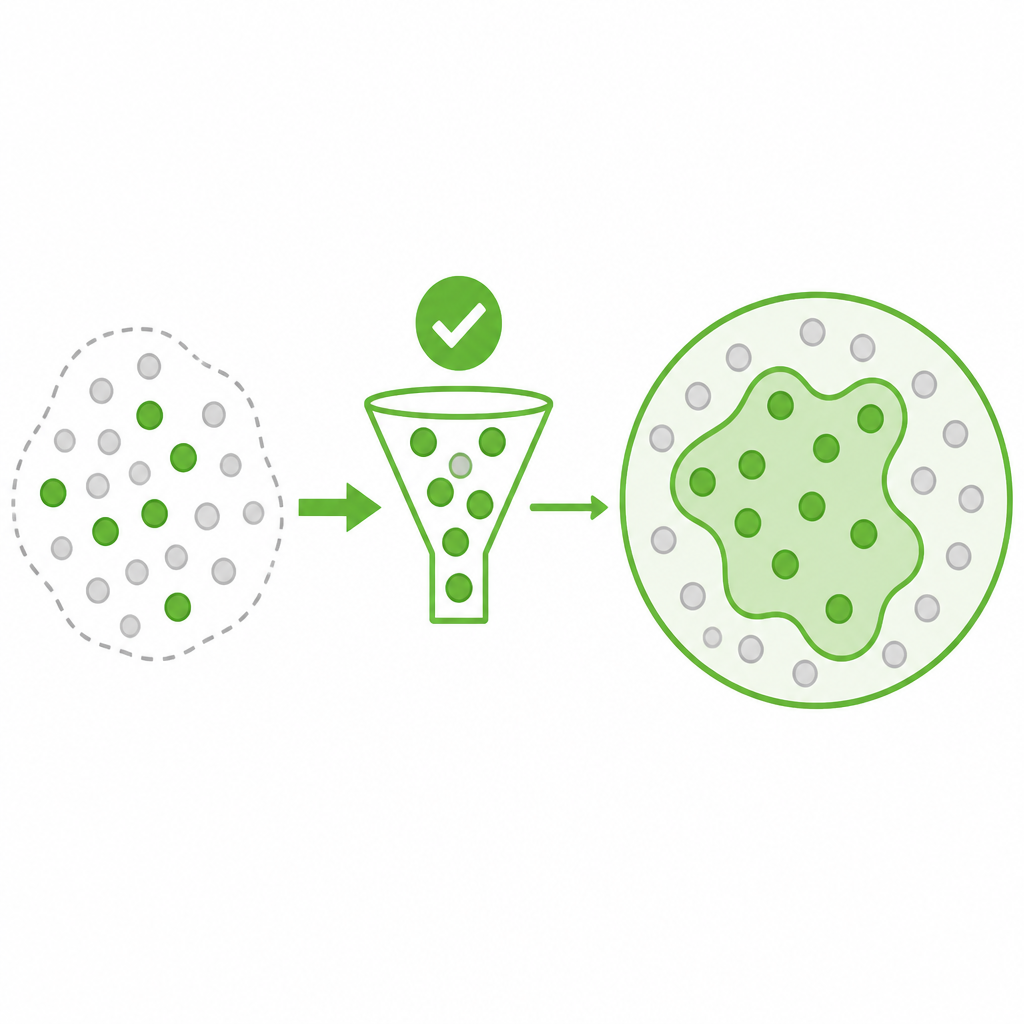
Positive-only learning sounds simple, but it hides a nasty twist: the learner only sees examples from the positive region, while evaluation still happens on the full original distribution. That makes the problem very different from standard PAC learning, and it has been open for decades in the proper-learning setting.
This paper closes that gap. The authors give a clean characterization of when proper positive-only learning is possible, and the answer is not just “finite VC dimension.” They show that you also need a new combinatorial property they call uniform exterior separability.
What problem this paper is trying to fix
Get the latest AI news in your inbox
Weekly picks of model releases, tools, and deep dives — no spam, unsubscribe anytime.
No spam. Unsubscribe at any time.
In ordinary binary classification, a learner gets labeled examples from both classes. In positive-only learning, the learner only receives i.i.d. samples from the positive region of the target concept. That means the training data is biased by construction: you never directly observe negative examples, even though the final predictor is judged against the original distribution that includes both positive and negative mass.

This model goes back to Natarajan’s 1987 STOC work, and the improper-learning story is already well understood. But the proper-learning case — where the learned hypothesis must belong to the same concept class as the target — had remained unresolved. The paper is about that missing piece.
For engineers, the practical lesson is that “learning from positives only” is not just a data sparsity issue. It changes the geometry of the learning problem itself. Some concept classes that look manageable under standard PAC assumptions stop being learnable once you require proper learning from positive-only samples.
How the method works in plain English
The authors revisit the problem through the lens of combinatorial characterization. Their main result says a concept class is properly learnable from positive-only samples if and only if two conditions hold: the class has finite VC dimension, and it satisfies uniform exterior separability.
VC dimension is familiar territory for anyone who has worked with statistical learning theory. It measures how expressive a class is. The new part is uniform exterior separability, which is the extra structural constraint needed to make proper positive-only learning work. The abstract does not spell out the full formal definition, but the key point is that this property captures something about how a class behaves outside the positive region.
They also introduce new combinatorial dimensions along the way. The abstract does not list them by name or define them in detail, but it does say they may be of broader interest in learning theory. That suggests the paper is not only answering an old question, but also adding tools for analyzing related learning models.
What the paper actually shows
The headline result is an “if and only if” characterization. That matters because it turns a vague open question into a precise boundary: proper positive-only learning is possible exactly when both conditions are met. In other words, finite VC dimension alone is not enough.
The paper also reports several separation results, and these are where the landscape gets interesting. Proper and improper learning are separated. Randomized and deterministic proper learning are separated. There are concept classes for which no empirical risk minimizer, or ERM, is a learner. And even finite VC dimension does not guarantee non-uniform learnability in this setting.
Those separations are important because they show the positive-only model is not just a small variant of standard PAC learning. It has its own failure modes and its own hierarchy of learnability notions. If you assumed the usual intuition from standard classification would carry over, this paper says it does not.
One thing the abstract does not provide is benchmark numbers. There are no accuracy percentages, sample complexity tables, or runtime measurements to compare. This is a theory paper, so the value is in the characterization and the separation results rather than empirical performance.
Why developers and ML practitioners should care
If you build systems where you only observe positives — for example, cases where negatives are unlabeled, missing, or too expensive to collect — this paper is a reminder that the learning setup itself can block you before optimization even starts. The right question is not only “can my model fit the data?” but also “is my hypothesis class learnable under this feedback model?”
That distinction matters for model selection. A class that is fine under standard supervised learning may fail under positive-only supervision if it lacks uniform exterior separability. In practical terms, this means you may need to rethink the hypothesis class, not just the training procedure.
The paper also gives theory practitioners a sharper map of the space. By separating proper from improper learning, and randomized from deterministic proper learning, it shows there are multiple layers of difficulty hiding under the same positive-only label. That can guide future work on weak supervision, one-class-style settings, and other regimes where the training signal is incomplete.
Limitations and open questions
The abstract is clear about what is proven, but it does not give algorithmic details, sample complexity bounds, or implementation guidance. So while the characterization is mathematically complete, it does not immediately translate into a recipe for production systems.
It is also worth noting that the result is about concept classes in the PAC framework. If your problem is noisy, non-i.i.d., or involves richer supervision signals, the theorem may not apply directly. The paper’s contribution is foundational, not a plug-and-play method.
- Proper positive-only learning has a complete characterization in terms of VC dimension and uniform exterior separability.
- The positive-only setting behaves differently from standard PAC learning, with separations between several learning notions.
- The paper is theoretical and does not report benchmark numbers or empirical results in the abstract.
For anyone working on learning from incomplete labels, the main takeaway is simple: positive-only data can be fundamentally more restrictive than it looks. This paper pins down exactly when proper learning survives that restriction, and when it does not.
// Related Articles
- [RSCH]
Test-Time Harnesses Transfer Skills Without Retraining
- [RSCH]
DreamFly improves aerial VLN with memory and planning
- [RSCH]
AVA-Encoder turns films into editable knowledge graphs
- [RSCH]
Sparse Autoencoders Don’t Behave Like Feature Bags
- [RSCH]
ConVAWG generates controlled VAWG dialogues
- [RSCH]
Surgical WAM uses video to train robot control