Rust’s top-10 Tiobe jump changes language choices
1 Rust hit Tiobe’s top 10 with 1.34%, forcing teams to weigh memory safety, speed, and ecosystem fit.

Rust’s top-10 Tiobe debut shifts attention from legacy C and C++ tradeoffs to safer systems programming.
Until now, many teams treated Rust as a promising niche; now its first top-10 Tiobe finish gives buyers a clearer signal about where it fits among mainstream languages.
| Item | Tiobe July 2026 rating | Rank |
|---|---|---|
| Python | 18.94% | 1 |
| C | 10.86% | 2 |
| C++ | 9.12% | 3 |
| Java | 8.03% | 4 |
| Rust | 1.34% | 10 |
1. Rust’s first top-10 finish
Get the latest AI news in your inbox
Weekly picks of model releases, tools, and deep dives — no spam, unsubscribe anytime.
No spam. Unsubscribe at any time.
Rust reached 10th place in the Tiobe Programming Community index for July 2026 with a 1.34% rating. That is the headline change: it is the first time Rust has entered Tiobe’s top 10.

For developers, this does not mean Rust is suddenly the default choice for every project. It does mean the language now has stronger visibility when teams compare it with older systems languages and ask which one is getting more attention from developers, courses, and vendors.
- July 2026 rank: 10
- Tiobe rating: 1.34%
- Milestone: first top-10 appearance
2. Memory safety with fast code
Tiobe CEO Paul Jansen said Rust’s rise comes from its focus on memory safety while still producing very fast code. That combination matters for teams that want performance without the same class of memory bugs that have long haunted lower-level development.
The appeal is practical. Rust gives engineers a way to write systems code with stricter compile-time checks, which can reduce entire categories of runtime failures. That is one reason it keeps showing up in conversations about infrastructure, security-sensitive services, and performance-heavy components.
- Focus: memory safety
- Strength: fast generated code
- Common fit: systems programming
3. A direct challenge to C and C++
Rust is increasingly viewed as a direct competitor to C and C++, both of which still rely on explicit memory management. Tiobe’s view is that this makes them harder to use safely in some modern development settings.
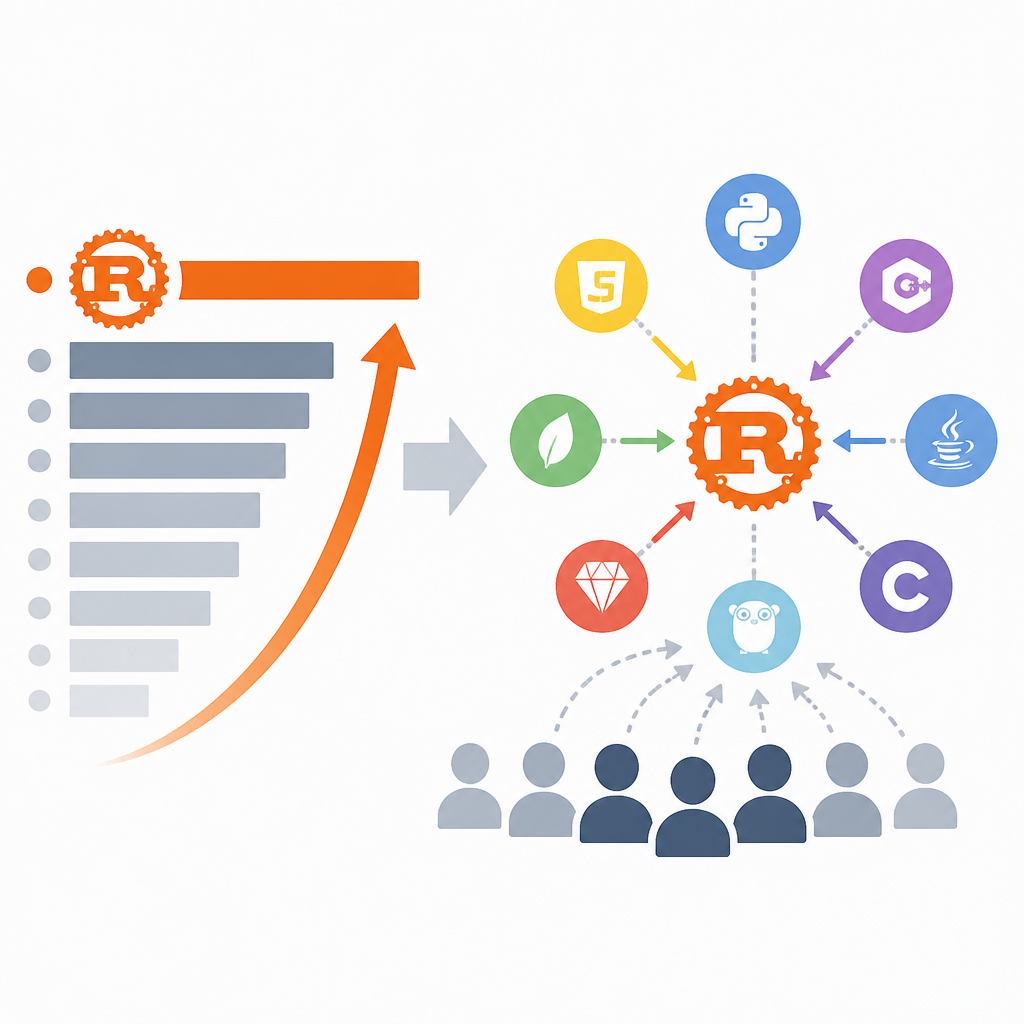
That does not make C or C++ obsolete. Their ecosystems remain huge, and their performance profile still matters. But Rust’s pitch is easier to explain to teams that want lower-level control without manually managing as much memory risk.
- C and C++: explicit memory management
- Rust: memory safety by design
- Decision point: safety versus legacy compatibility
4. Tiobe’s ranking method explains the signal
Tiobe does not measure GitHub stars or package downloads. Its index is based on the number of skilled engineers, courses, and third-party vendors tied to a language, using search data from sites such as Google, Bing, Amazon, and Wikipedia.
That makes the ranking useful as a broad popularity signal rather than a pure usage meter. If Rust climbs here, it suggests the language is becoming easier to hire for, learn, and buy around, which matters for enterprise planning even if your own stack is still dominated by other languages.
- Inputs: engineers, courses, vendors
- Data sources: search and reference sites
- Use case: popularity and ecosystem visibility
5. The other rankings still put Rust in context
Rust’s Tiobe result looks stronger when you compare it with the Pypl Popularity of Programming Language Index, which tracks tutorial search activity. In Pypl’s July 2026 top 10, Rust is tied at 2.06% and sits below languages such as Python, Java, and C/C++.
That gap is a reminder that “popular” depends on the metric. Tiobe emphasizes broader ecosystem presence, while Pypl reflects tutorial interest. If you are choosing a language for a team, it helps to read both as signals about demand, learning pressure, and long-term support rather than as a single verdict.
- Tiobe: broader ecosystem signal
- Pypl: tutorial search interest
- Rust in Pypl July 2026: 2.06%
How to decide
Pick Rust if you are building systems software, security-sensitive services, or performance-focused components and want stronger guardrails around memory handling. It is also a good fit if your team is willing to invest in a language with a steeper learning curve in exchange for safer low-level code.
Stick with C or C++ when you need deep legacy compatibility or an existing codebase already anchored there. Choose Tiobe and Pypl together as a market check, but choose the language based on your runtime needs, hiring pool, and tolerance for memory risk.
// Related Articles
- [IND]
Anthropic’s Mythos and Fable got pulled back
- [IND]
AWS’s 2026 story is OpenAI, chips, and layoffs
- [IND]
This GitHub repo publishes one AI deep dive a day
- [IND]
OpenAI’s 5% deal turns policy into equity
- [IND]
OpenCode vs Cursor: Open-Source CLI vs AI Editor 2026
- [IND]
Rust Adoption Is Moving Into Production