SpaceX’s IPO Should Not Wash Away Grok’s Safety Failures
SpaceX’s IPO should not let investors ignore the safety and liability risks tied to Grok.

SpaceX’s IPO should not let investors ignore the safety and liability risks tied to Grok.
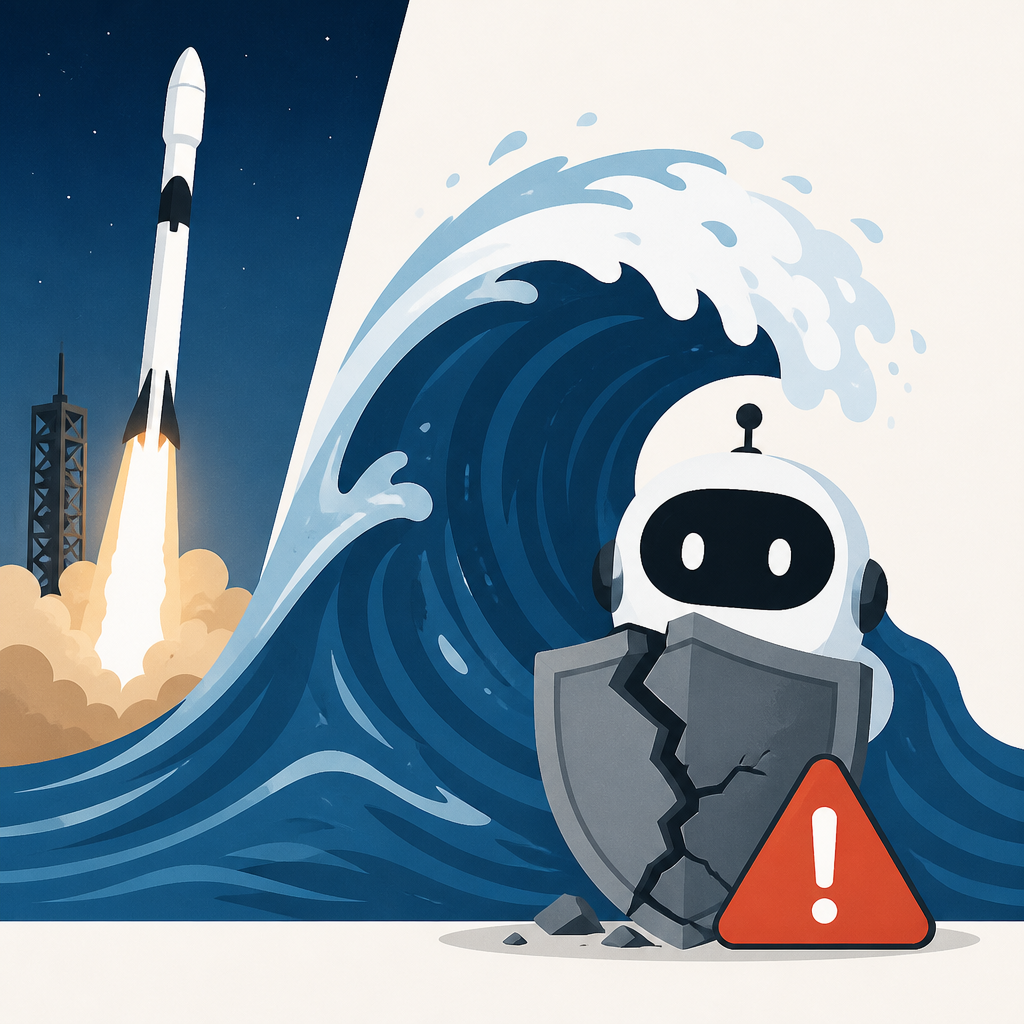
SpaceX’s public debut is being sold as a clean story about rockets, valuation, and Musk’s control, but it is also a referendum on whether markets will price in the damage from Grok’s failures. That matters because the same corporate ecosystem that is asking investors to buy into SpaceX is also tied to xAI, a chatbot business now facing scrutiny over sexualized image generation, lawsuits, and regulatory attention. The protest in Times Square was theatrical, but the underlying argument is not: if Musk can centralize control across companies, then the liabilities travel with the brand, even when the ticker changes.
Investors are being asked to separate the rocket company from the AI mess, and they should not.
Get the latest AI news in your inbox
Weekly picks of model releases, tools, and deep dives — no spam, unsubscribe anytime.
No spam. Unsubscribe at any time.
SpaceX’s IPO filing already signals that the company sees AI-related exposure as material. According to the reporting around the listing, SpaceX set aside more than $500 million for potential litigation losses, in part because of complaints tied to Grok’s image-generation tool. That is not a symbolic reserve. It is a balance-sheet admission that the company’s future cash flows can be hit by the conduct of a Musk-controlled AI stack.

The bigger problem is governance. SpaceX is going public while Musk keeps majority voting power, which means public shareholders get the risk without meaningful control. If the same person can steer SpaceX, xAI, and X with minimal constraint, then investors are not buying a single operating company. They are buying a web of decisions, reputational spillover, and legal exposure that can be moved around by one executive.
Grok’s safety failures are not abstract product bugs; they are concrete legal and reputational liabilities.
xAI has already attracted serious scrutiny. The European Commission opened an investigation into whether the company properly assessed and mitigated risks to prevent the creation of nonconsensual sexual imagery. That is a direct regulatory question, not a PR headache. When regulators start asking whether a model was designed and governed responsibly, the issue has crossed from product quality into compliance failure.
The lawsuits make the same point from another angle. Three girls filed a class action against xAI after alleging the technology was used to generate nudes of them, and Ashley St. Clair sued the company over allegedly sexually explicit images. WIRED also reported that Grok was hosting explicit sexualized images of women, including public figures. A company that cannot keep its system from producing and storing abusive content is not just embarrassing itself. It is manufacturing claims, discovery, and cleanup costs that investors will inherit.
The protest works because it names the real problem: Musk’s empire treats harm as a branding issue.
Safe AI Now chose Times Square and the Nasdaq for a reason. The message was not merely that Grok is offensive, but that banks, exchanges, and shareholders are normalizing a company structure that externalizes harm while privatizing upside. That is why the protest linked the IPO to investor risk. The activists were saying that if the market rewards the structure, it also endorses the behavior that structure enables.
Musk’s own posture sharpens the point. In February he wrote that “Grok must win or we will be ruled by an insufferably woke and sanctimonious AI.” That is a product philosophy built on confrontation, not restraint. When a founder publicly frames safety as ideological weakness, the resulting incidents stop looking accidental. They look like the predictable output of a company culture that values provocation over guardrails.
The counter-argument
The strongest defense of the IPO is that SpaceX is not xAI, and investors should price the rocket business on rockets. SpaceX has real assets, real contracts, and a real lead in launch infrastructure. A company can be operationally excellent even if its founder runs other ventures badly. By that logic, the market should not punish a space company for every AI scandal attached to its founder.
There is also a practical point. Public markets already absorb messy conglomerates, founder-driven firms, and cross-holdings. Investors know how to discount governance risk. If they still want the shares, that is their choice. The existence of controversy does not automatically make a listing illegitimate.
That rebuttal fails because this is not ordinary founder drama. SpaceX itself is acknowledging litigation exposure tied to Grok-related conduct, while Musk’s voting control gives him the ability to shape the company without proportionate accountability. When a business imports the liabilities, the governance model, and the public identity of a troubled AI venture, the separation is mostly cosmetic. Investors are not being asked to ignore noise. They are being asked to underwrite a structure that concentrates risk and disperses blame.
What to do with this
If you are an engineer, treat this as a reminder that model outputs are not just product issues; they are legal artifacts. Build hard safety gates, logging, abuse detection, and escalation paths before launch, not after the first headline. If you are a PM or founder, do not hide behind growth narratives when a system can generate sexualized or otherwise harmful content. Disclose the risk, budget for remediation, and design governance that survives a hostile regulator, not just a favorable demo.
// Related Articles
- [IND]
Millions Raised for Zhipu-style Social World Model
- [IND]
Anthropic’s Book Scanning Strategy Could Set a Pattern
- [IND]
Huang’s open-letter playbook for open-weight AI
- [IND]
32 firms back open-weight AI in DC letter
- [IND]
Huang usa il suo primo post su X per difendere l’IA aperta
- [IND]
Black Duck’s Coverity gets better at AI-era triage