SpeechLLM Gives L2 Scores and Rationales
A finetuned SpeechLLM scores L2 speech and explains its judgments in one response.

A finetuned SpeechLLM scores L2 speech and explains its judgments in one response.
- Research org: Unspecified in arXiv abstract
- Core data: No benchmark numbers in abstract
- Breakthrough: Rubric-guided SpeechLLM with supervised fine-tuning and Bounded Direct Preference Optimization
This paper is about making automated second-language speech assessment more useful to humans, not just more accurate on a leaderboard. Instead of outputting a score and stopping there, the model is trained to produce multi-granular labels plus a natural-language rationale in the same response. That matters if you are building tools for language learning, pronunciation feedback, or any workflow where an explanation is as important as the prediction.
What problem the paper is trying to fix
Get the latest AI news in your inbox
Weekly picks of model releases, tools, and deep dives — no spam, unsubscribe anytime.
No spam. Unsubscribe at any time.
Automated L2 speech assessment can already assign proficiency labels, but the abstract says it often lacks interpretability. In practice, that means a system may tell a learner or teacher that a sentence is weak in fluency or that a word-level pronunciation is off, without showing why it thinks so. For developer-facing products, that creates a trust problem: users are more likely to question a black-box score than a score backed by a readable explanation.

The paper targets that gap by treating assessment as both a prediction task and a rationale-generation task. The model is not just asked to classify speech; it is also asked to explain the classification in natural language. That is a meaningful design choice because it pushes the system toward outputs that can be inspected, debugged, and potentially shown directly to learners or instructors.
How the method works in plain English
The core idea is a rubric-guided SpeechLLM. “Rubric-guided” here means the model is trained around assessment dimensions that already make sense to human evaluators: sentence-level accuracy, fluency, and prosody, plus word/phoneme-level accuracy. The model is therefore not trying to invent its own notion of quality; it is learning to map speech into an existing evaluation rubric.
The training setup combines supervised fine-tuning with Bounded Direct Preference Optimization. The abstract does not spell out implementation details, but the high-level takeaway is clear: the model learns from labeled examples and then gets an additional preference-based optimization step. That suggests the authors are trying to shape not only what the model predicts, but also how well its responses align with preferred assessment behavior.
Another important design point is that the model produces all outputs in one response: ordinal labels at the sentence level, word/phoneme-level accuracy, and a natural-language rationale. For engineers, that means a single model endpoint could potentially serve multiple downstream needs: scoring, feedback generation, and explanation.
What the paper actually shows
The paper evaluates the approach on SpeechOcean762. According to the abstract, the model matches or outperforms single-granularity models while remaining competitive with prior approaches. The abstract does not give the exact benchmark numbers, so there is no way to compare the gains numerically from this source alone.
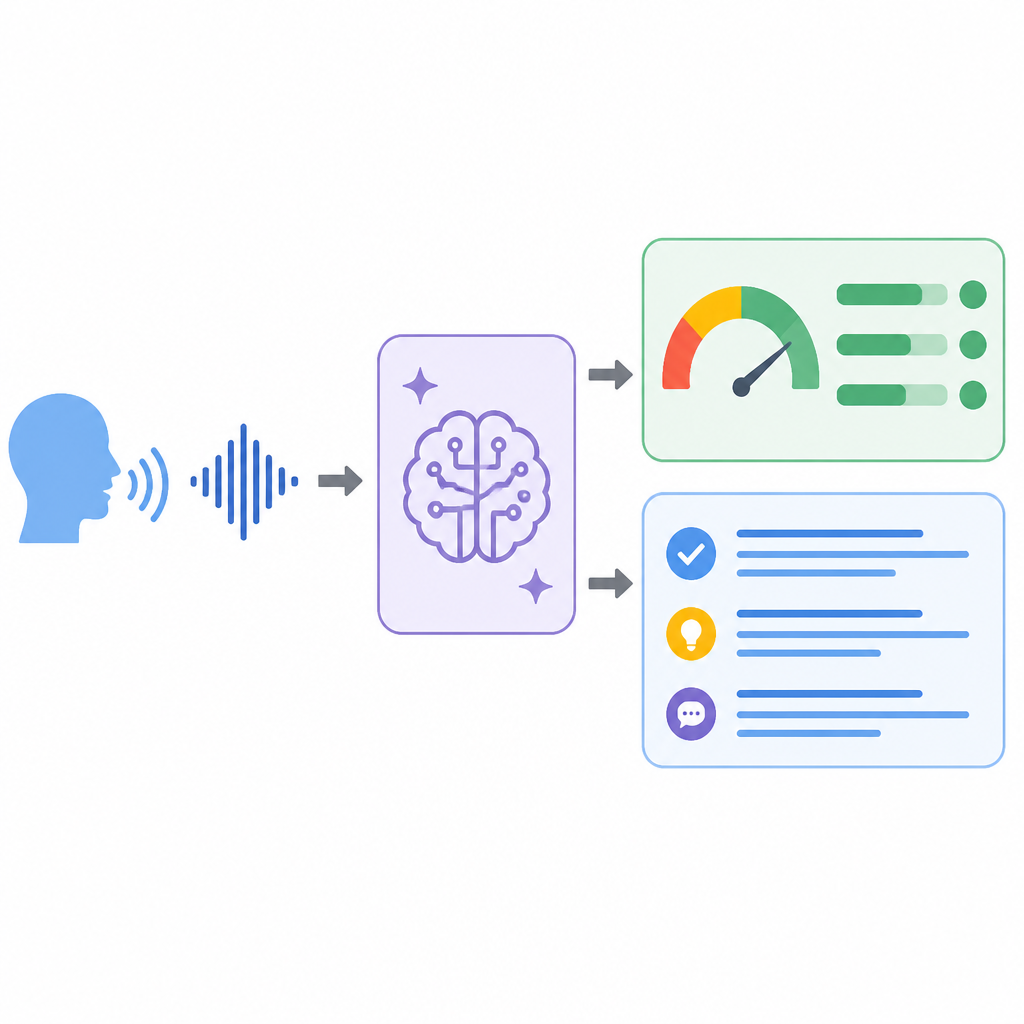
That said, the result is still useful because it addresses a common tradeoff in applied ML systems: adding explainability often hurts performance, and improving performance often makes outputs less interpretable. Here, the authors are claiming they can do both at once, at least at the level of the reported evaluation.
The paper also studies rationale reliability along two axes. The first is self-consistency with model predictions, measured using sentiment consistency, which they call plausibility. The second is alignment with ground-truth labels, measured using mention-based agreement, which they call faithfulness. This is a practical distinction: a rationale can sound reasonable without actually matching the labeled evidence, and the paper explicitly separates those cases.
The abstract’s main caution is that rationale quality is not uniform across granularity. Rationales are plausible at the sentence level, but faithfulness drops at the word/phoneme level because references are sparse and weakly aligned with token-level labels. In other words, the model can explain broad sentence-level judgments more convincingly than fine-grained token-level ones.
Why developers should care
If you are building speech feedback systems, this paper points toward a more product-ready interface: one model can return a score and a plain-English explanation together. That can reduce friction in UX, support teacher review, and make automated assessment easier to audit. It also opens the door to richer analytics, where the system can explain whether the issue is accuracy, fluency, prosody, or a lower-level pronunciation problem.
There is also a broader systems lesson here. When a model is asked to justify itself, you need to evaluate the justification separately from the prediction. The authors do that by checking both plausibility and faithfulness. That is a good pattern for developers working on any explainable AI workflow, because a fluent explanation is not automatically a truthful one.
Limitations and open questions
The abstract is honest about one major limitation: token-level rationales are weak. If your application needs precise feedback on individual words or phonemes, this paper suggests the model’s explanations may not yet be reliable enough to trust on their own. The sparse alignment between rationales and token-level labels is a warning sign for any deployment that depends on fine-grained feedback.
Another limitation is that the abstract does not provide benchmark numbers, detailed error analysis, or implementation specifics for the training recipe. We know the model uses supervised fine-tuning and Bounded Direct Preference Optimization, but not how those components are balanced, what the prompt format looks like, or how robust the approach is across different L2 populations.
Still, the direction is promising: rather than treating interpretability as a post-hoc add-on, the paper bakes it into the assessment model itself. If you are designing the next generation of speech evaluation tools, that is the part worth paying attention to.
Bottom line
This paper shows that a finetuned SpeechLLM can jointly produce multi-granular L2 assessment labels and natural-language rationales, with the strongest explanation quality at the sentence level. It is a practical step toward speech systems that are easier to inspect, easier to present to users, and easier to integrate into real feedback loops.
- The model combines sentence-level scoring, word/phoneme-level accuracy, and rationale generation in one response.
- Performance is reported as competitive on SpeechOcean762, but the abstract does not include exact benchmark numbers.
- Explanations are more reliable for sentence-level judgments than for token-level feedback.
// Related Articles
- [RSCH]
NVIDIA Nemotron 3 Ultra proves open models can still compete
- [RSCH]
EEVEE tackles prompt learning across real-world streams
- [RSCH]
A New Way to Think About SFT Targets
- [RSCH]
A phase diagram for multimodal learning
- [RSCH]
CRDTs keep replicas in sync without locks
- [RSCH]
Post-Deterministic Systems for Autonomous Infra