A phase diagram for multimodal learning
This paper maps when multimodal training should align views, predict across them, or be avoided.

This paper maps when multimodal training should align views, predict across them, or be avoided.
- Research org: Unspecified in arXiv abstract
- Core data: Four regimes
- Breakthrough: Unified linear phase diagram for cross-modal alignment and prediction
Multimodal systems often look straightforward in hindsight: combine two or more data sources and let training discover the shared structure. In practice, that can fail for reasons that are hard to diagnose. This paper argues that the real question is not just how to train across modalities, but whether a given dataset should be trained with cross-modal alignment, cross-modal prediction, or not trained cross-modally at all.
That matters for engineers working with messy real-world data. If you are building on paired views from microscopy, audio, images, captions, sensors, or astrophysical instruments, the wrong objective can waste compute or even make representations worse. The paper’s main contribution is a framework for deciding which multimodal objective fits the data before you commit to training.
What problem this paper is trying to fix
Get the latest AI news in your inbox
Weekly picks of model releases, tools, and deep dives — no spam, unsubscribe anytime.
No spam. Unsubscribe at any time.
Cross-modal alignment and cross-modal prediction are the two dominant ideas in multimodal representation learning. Alignment tries to make representations from different views match. Prediction tries to use one modality to predict another. The authors point out a practical gap: there has not been a systematic understanding of when each method succeeds, when each fails, and when cross-modal training helps at all.
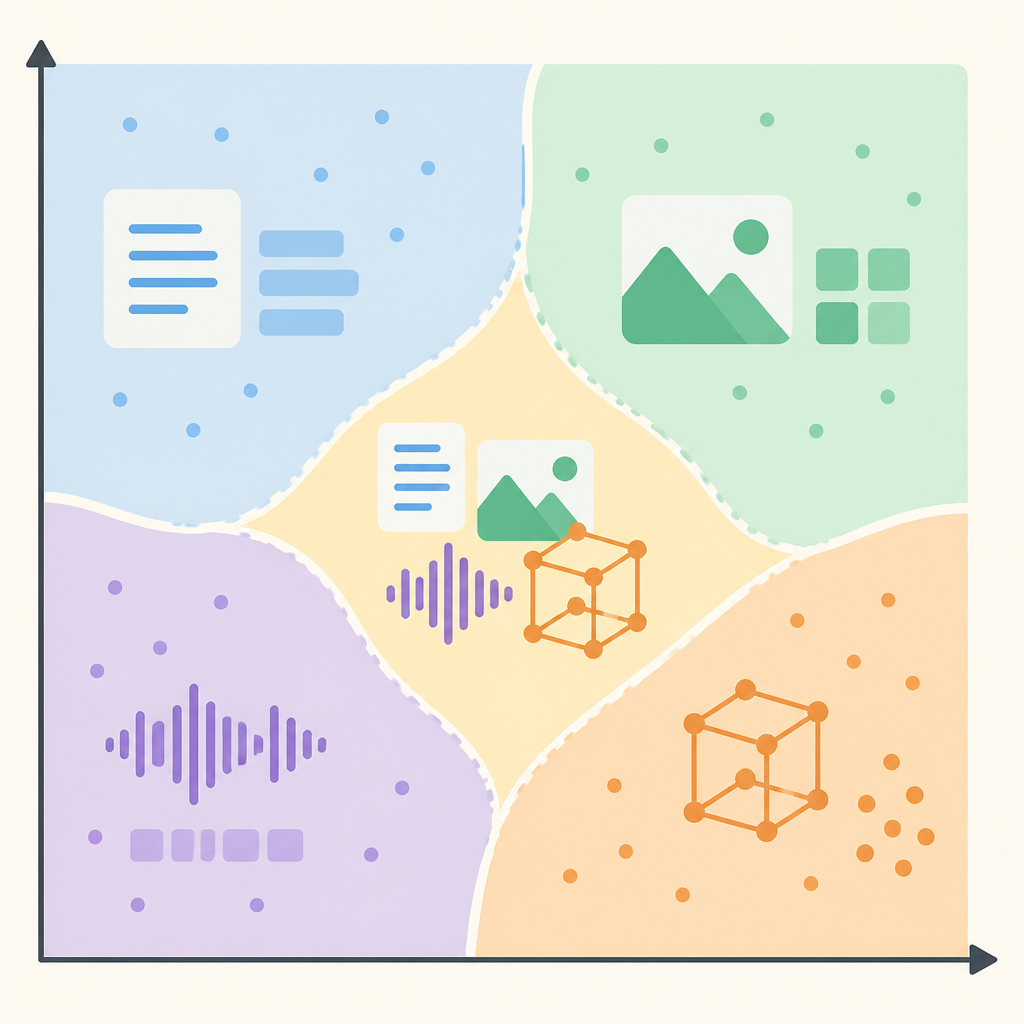
That gap becomes especially painful in scientific settings. The abstract specifically calls out domains like biomedicine and astrophysics, where data often comes from heterogeneous instruments and multiple levels of organization and measurement. In those settings, standard multimodal methods can underperform the best single modality, but it is not always obvious why.
The paper is trying to turn that guesswork into a diagnosis tool. Instead of treating multimodal learning as a single problem, it separates the problem into regimes where the data structure itself determines whether alignment or prediction is the better bet.
How the method works in plain English
The authors build a unified linear framework that covers both cross-modal alignment and cross-modal prediction. The model is based on a spiked signal-plus-noise setup with structured cross-modal nuisance correlation. That sounds technical, but the practical idea is simple: each modality contains useful signal, noise, and nuisance structure, and some of that nuisance may be correlated across modalities.
From that setup, they derive separation ratios for both objectives. These ratios expose different failure modes. Alignment whitens each modality, which helps in some cases but can fail when nuisance is strongly correlated across views. Prediction uses a one-sided whitening and learns whatever is cross-predictable, with recovery governed by the quality of the source modality.
In other words, the two objectives are not interchangeable. Alignment and prediction are sensitive to different kinds of structure in the data, so a dataset that looks favorable for one can be a poor fit for the other.
The phase diagram: four regimes, not one rule
The paper’s central result is a phase diagram that divides multimodal problems into four regimes: Both, CA only, CP only, and Neither. “Both” means either objective can work. “CA only” means cross-modal alignment is the right fit. “CP only” means cross-modal prediction is the better choice. “Neither” means cross-modal training is not helpful and can be actively harmful.
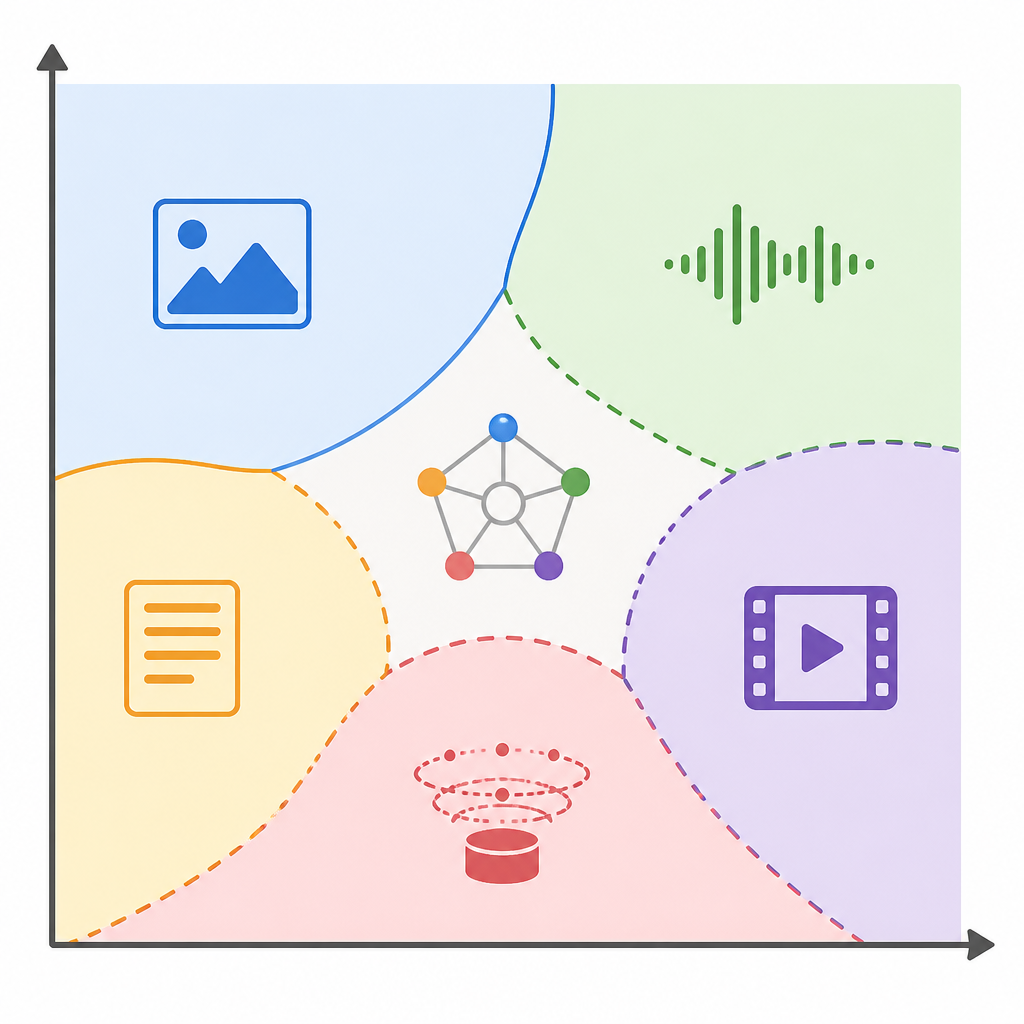
For practitioners, this is the most actionable part of the paper. It reframes multimodal learning as a routing problem: first identify the regime, then choose the objective and direction of prediction accordingly. That is a much more concrete workflow than trying alignment or prediction blindly and hoping the downstream result is good.
The authors also describe a data-driven procedure for locating real datasets in this diagram using a small labeled subsample. The goal is to identify the preferred objective and prediction direction before any cross-modal training starts. The abstract does not give the size of that labeled subsample, so there are no concrete sample-count benchmarks to report here.
What the paper actually shows
The paper validates the framework on synthetic data, stereo-vision benchmarks, image-caption pairs, and real astrophysical data. The abstract says these experiments support the predictions of the phase diagram in the nonlinear regime, which is important because the theory itself is linear. That suggests the framework is not just a toy result tied to an idealized model.
One especially useful claim is that the framework captures the Neither regime, where cross-modal training is actively harmful. That is a strong warning for teams that assume pairing modalities is always beneficial. If the two views are structured in the wrong way, forcing them together can degrade performance instead of improving it.
The abstract does not include benchmark numbers, accuracy scores, or throughput measurements. So while the paper reports experimental validation, it does not provide numeric results in the source text we have here. That means the safest takeaway is directional rather than quantitative: the phase diagram predicts which objective should work, and the experiments support that prediction.
Why developers should care
If you build multimodal models, this paper gives you a pre-training decision rule. Before spending time on architecture tuning, you can ask whether your dataset is likely to land in a CA-only, CP-only, Both, or Neither regime. That can save you from treating a data problem like a modeling problem.
It is also useful for debugging. When a multimodal model underperforms a single-modality baseline, the issue may not be optimization or scale. The problem may be that the modalities are related in a way that makes the chosen objective a bad fit. This paper gives you a vocabulary for that failure mode.
The proposed procedure uses a small labeled subsample to locate a dataset in the phase diagram. That makes it more practical than a purely theoretical result, but the abstract does not specify the labeled fraction, computational cost, or how robust the procedure is under different label budgets. Those are important implementation details that readers would need from the full paper.
Limitations and open questions
The framework is built on a linear model, even though the experiments extend into nonlinear settings. That is a sensible starting point, but it also means the theory is not a full description of modern deep multimodal systems. The paper claims validation in nonlinear regimes, yet the abstract does not tell us how broad that validation is or where the boundaries are.
Another limitation is that the abstract does not spell out the exact dataset sizes, labeled-subsample requirements, or performance numbers. So while the method sounds practical, the source text does not let us judge how expensive it is to apply or how sensitive it is to noisy labels and domain shift.
Still, the core idea is strong: multimodal learning is not one problem, and the choice between alignment and prediction should be informed by data structure, not habit. For teams working on scientific or heterogeneous multimodal data, that is a useful lens to have before training starts.
Bottom line
This paper gives multimodal learning a map. Instead of asking which method is best in general, it asks which regime your data lives in and whether cross-modal training should happen at all. For developers, that means fewer blind experiments, better objective selection, and a clearer explanation when multimodal training disappoints.
// Related Articles
- [RSCH]
Explainable RL for Air Traffic Control
- [RSCH]
Skill Self-Play lets LLMs co-evolve skills
- [RSCH]
SM4RT brings rigid motion into 4D reconstruction
- [RSCH]
Prompt engineering turns codegen into a repeatable workflow
- [RSCH]
CLEAR prompts turn AI search into usable answers
- [RSCH]
Prompt engineering in 2026: the cheat sheet