A New Way to Think About SFT Targets
This paper reframes supervised fine-tuning as designing target distributions, not just minimizing token loss.

This paper reframes supervised fine-tuning as designing target distributions, not just minimizing token loss.
- Research org: Unspecified in arXiv abstract
- Core data: Ten reasoning dataset-model settings
- Breakthrough: Q-target framework separates token trust from leftover probability mass
Supervised fine-tuning is one of the main tools developers use to make pretrained models follow instructions, solve tasks, and align more closely with a desired behavior. But this paper argues that the usual setup is too rigid: if the training data says a token should be exactly one thing, SFT tries to force the model to treat that token as the only correct answer, even when the observed token is noisy, ambiguous, or at odds with what the pretrained model already knows.
That matters because most real training data is not perfectly clean. In practice, a demonstrated trajectory may contain multiple valid continuations, imperfect labels, or choices that conflict with the model’s prior. The paper’s main point is that the problem is not only the loss function itself. It is the target distribution that the loss is implicitly asking the model to match.
What problem this paper is trying to fix
Get the latest AI news in your inbox
Weekly picks of model releases, tools, and deep dives — no spam, unsubscribe anytime.
No spam. Unsubscribe at any time.
Classic SFT usually maximizes the likelihood of every token in a demonstration. In plain English, that means the model is trained to copy the observed token sequence as if each token were the single correct target. The authors argue this can be suboptimal when the token is non-unique, noisy, or misaligned with the pretrained model’s prior knowledge.

For engineers, this is a useful reframing. If you have ever fine-tuned a model on demonstrations and wondered why it overfit to brittle wording, this paper is pointing at the supervision target itself. The issue is not just “how hard” the model is trained, but what distribution over next tokens the training objective is actually trying to impose.
The paper does not present this as a new benchmark trick or a dataset-specific hack. Instead, it tries to identify a more general design principle for SFT: choose the target distribution deliberately, rather than assuming one-hot labels are always the right answer.
How the method works in plain English
The authors introduce what they call the Q-target framework. The idea is to break SFT supervision into two explicit decisions. First, how much should the training target trust the observed token? Second, how should the remaining probability mass be spread across alternative tokens?
That second part is important. A one-hot target says the observed token gets all the mass and every alternative gets none. Q-target instead turns that into a design choice. You can keep the observed token dominant while still giving nonzero weight to other plausible options, depending on how much you trust the demonstration and how much you want to preserve the model’s prior.
In effect, the paper treats SFT as a problem of target distribution design. Rather than focusing only on the loss objective, it asks what token-level distribution the loss is pushing the model toward. The authors say this viewpoint unifies many existing SFT variants as implicit choices of the same underlying target distribution Q.
That is the conceptual contribution: many methods that looked different on the surface can be interpreted as different ways of defining supervision targets. The paper claims that this opens a broader search space for SFT objectives, because researchers can now reason about supervision more directly instead of only tweaking the loss formula.
What Target-SFT adds
Building on the Q-target view, the authors propose Target-SFT. According to the abstract, this method constructs the training objective directly from the desired target distribution. In other words, it does not just inherit a fixed one-hot label convention and then modify the loss around it; it starts from the target distribution the authors want the model to match.
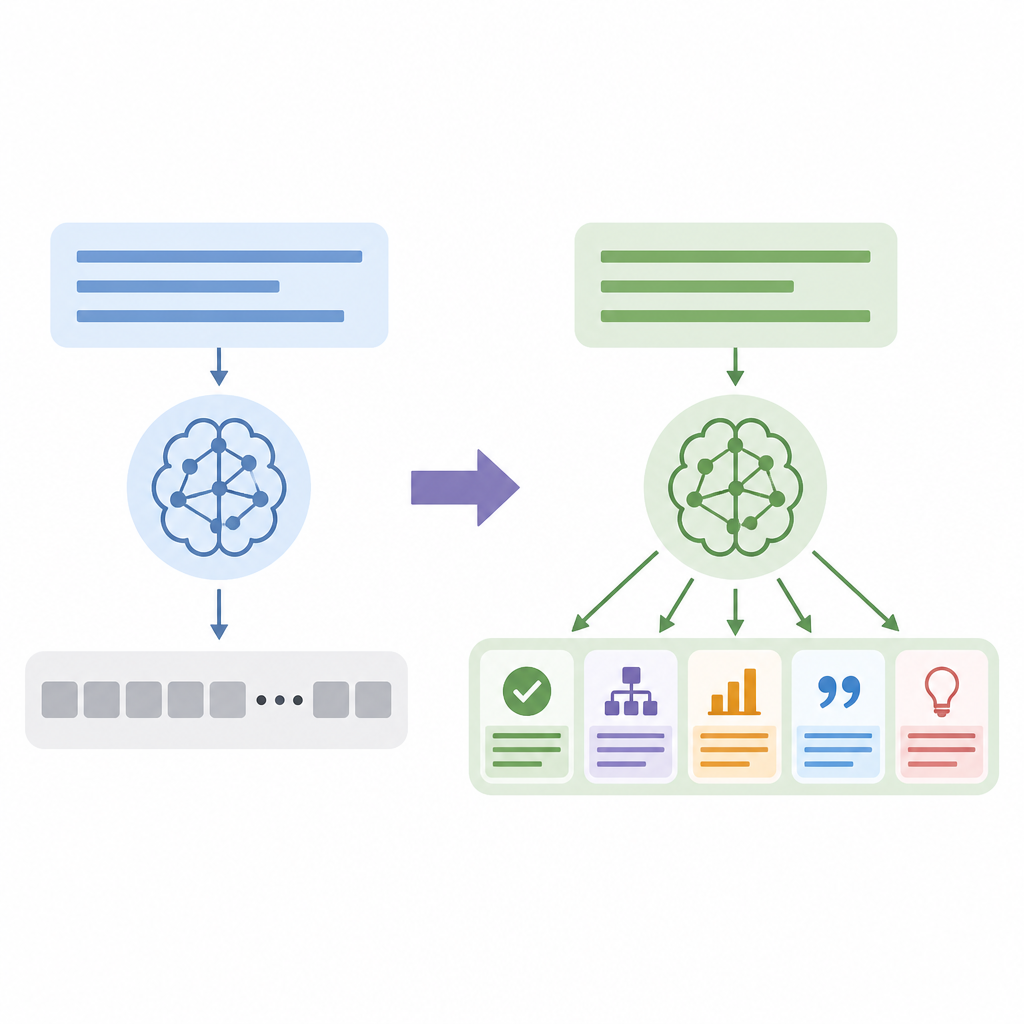
This is the practical move in the paper. If the target distribution is the real design variable, then the training objective should be built around that variable from the start. The paper presents Target-SFT as the implementation of that idea.
The abstract does not spell out the full mathematical form in detail, so the safest way to read it is as a framework-level contribution rather than a single narrowly defined algorithmic tweak. The key novelty is the separation between supervision trust and leftover probability allocation, then using that separation to define a new SFT objective.
What the paper actually shows
The abstract says Target-SFT consistently outperforms across ten reasoning dataset-model settings evaluated. That is the only concrete result stated in the source, and it does not include the exact benchmark names or numerical scores. So there are no reported percentages, exact accuracy values, or throughput numbers in the abstract to quote here.
Even without numbers, the result is still meaningful in context. “Consistently outperforms” across ten settings suggests the authors tested the method in more than one narrow scenario and saw the same direction of improvement. For practitioners, that is a signal that the target-distribution idea may be robust rather than a one-off win on a single task.
Still, the abstract leaves important details open. We do not know from the provided text how large the gains were, which models were used, how the reasoning datasets were selected, or whether the improvements came from better calibration, better generalization, or simply a better fit to the training distribution. Those are the kinds of questions you would want to answer before adopting the method in production.
Why developers should care
If you fine-tune models, this paper offers a different mental model for supervision. Instead of treating labels as fixed facts, it asks whether the target should reflect uncertainty, ambiguity, or prior knowledge. That is especially relevant when your training data comes from demonstrations, human traces, synthetic traces, or any other source where the “correct” token is not always uniquely determined.
The paper also gives a language for comparing SFT variants. If multiple methods can be interpreted as different target distributions, then you can evaluate them as design choices rather than isolated tricks. That makes it easier to reason about why one fine-tuning recipe behaves better than another.
There are also practical limitations to keep in mind. The abstract does not claim a universal fix for all fine-tuning problems, and it does not show benchmark numbers in the provided text. It also does not say whether the method is more expensive, harder to tune, or sensitive to the way alternatives are weighted. So while the framework looks general, the engineering tradeoffs are still not fully visible from the abstract alone.
What to take away
The main lesson is simple: in SFT, the target distribution may matter as much as the loss. The paper argues that one-hot supervision is only one point in a larger design space, and that better fine-tuning may come from choosing the target distribution more carefully.
For teams building or tuning language models, that is a useful shift. It suggests you should not only ask “what loss should we use?” but also “what distribution are we asking the model to learn?” That question is especially relevant when demonstrations are noisy, ambiguous, or partially aligned with the pretrained model’s prior.
- It reframes SFT around supervision design, not just loss minimization.
- It proposes Q-target as a way to separate token trust from alternative mass.
- It reports consistent gains across ten reasoning dataset-model settings, but no exact scores in the abstract.
Overall, this is a framework paper with practical implications: it does not just propose another fine-tuning recipe, it argues that the right abstraction for SFT is the target distribution itself. If that framing holds up beyond the abstract, it could change how developers think about data, labels, and fine-tuning objectives.
// Related Articles
- [RSCH]
Explainable RL for Air Traffic Control
- [RSCH]
Skill Self-Play lets LLMs co-evolve skills
- [RSCH]
SM4RT brings rigid motion into 4D reconstruction
- [RSCH]
Prompt engineering turns codegen into a repeatable workflow
- [RSCH]
CLEAR prompts turn AI search into usable answers
- [RSCH]
Prompt engineering in 2026: the cheat sheet