Stablecoin supply falls $15B after yield rules
Stablecoin supply fell $15 billion since May as GENIUS Act yield limits push cash into tokenized Treasuries.

Stablecoin supply dropped about $15 billion as new U.S. rules cut off yield on digital dollars.
Stablecoin supply fell from about $322.121 billion in mid-May to roughly $307.561 billion by Aug. 2, 2026, and the drop was the biggest since Terra’s collapse in 2022. The twist is that onchain activity kept climbing even as the float shrank, with June volume hitting about $1.8 trillion.
| Metric | Value | What it means |
|---|---|---|
| Total stablecoin supply, mid-May 2026 | $322.121B | Recent peak before the summer drop |
| Total stablecoin supply, Aug. 2 2026 | $307.561B | Supply after the pullback |
| June 2026 monthly decline | $11.41B | Steepest monthly fall since TerraUSD |
| Adjusted onchain volume in June 2026 | $1.8T | Stablecoin activity still surged |
| Tokenized Treasuries | Near $17B | Yield-seeking cash moved here |
USDT and USDC took the biggest hit
Get the latest AI news in your inbox
Weekly picks of model releases, tools, and deep dives — no spam, unsubscribe anytime.
No spam. Unsubscribe at any time.
The summer contraction was concentrated in the two biggest names in the market: Tether’s USDT and Circle’s USDC. USDT slipped from around $189 billion in early May to about $183.216 billion by Aug. 2, while USDC fell from a March peak near $80 billion to roughly $72.069 billion over the same period.

That matters because these two tokens anchor most crypto trading pairs. When their supply falls, it usually means traders are parking less cash on exchanges, or moving it into something that pays better.
- USDT lost about $5.8 billion from its early-May level.
- USDC lost about $8 billion from its March peak.
- Smaller tokens such as Sky’s USDS and Ethena’s USDe also posted double-digit percentage declines.
- Global Dollar, or USDG, moved the other way and grew during the pullback.
Washington changed the incentive structure
The biggest policy shift came from the GENIUS Act, signed into law in July 2025, which created the first federal framework for payment stablecoins. Its core rule is simple: licensed issuers cannot pay interest or yield tied to holding or using their tokens.
That one line changes the economics of parking cash in stablecoins. If a token no longer pays, yield-seeking users have a reason to move funds into tokenized Treasury products or money-market wrappers instead.
“The stablecoin market is a tool for payments, not a savings account,” said U.S. Treasury Secretary Scott Bessent in July 2025, when the administration backed the new federal framework.
The Office of the Comptroller of the Currency reinforced that view in early 2026 with proposed rules that treated stablecoins as transaction tools. That does not kill the market. It does push it toward a different job.
Tokenized Treasuries are soaking up the displaced cash
If stablecoins are losing their yield appeal, tokenized Treasuries are gaining it. By late July, tokenized U.S. Treasury and money-market products had climbed into the high teens of billions of dollars, while broader tokenized real-world assets crossed $32 billion in some counts.
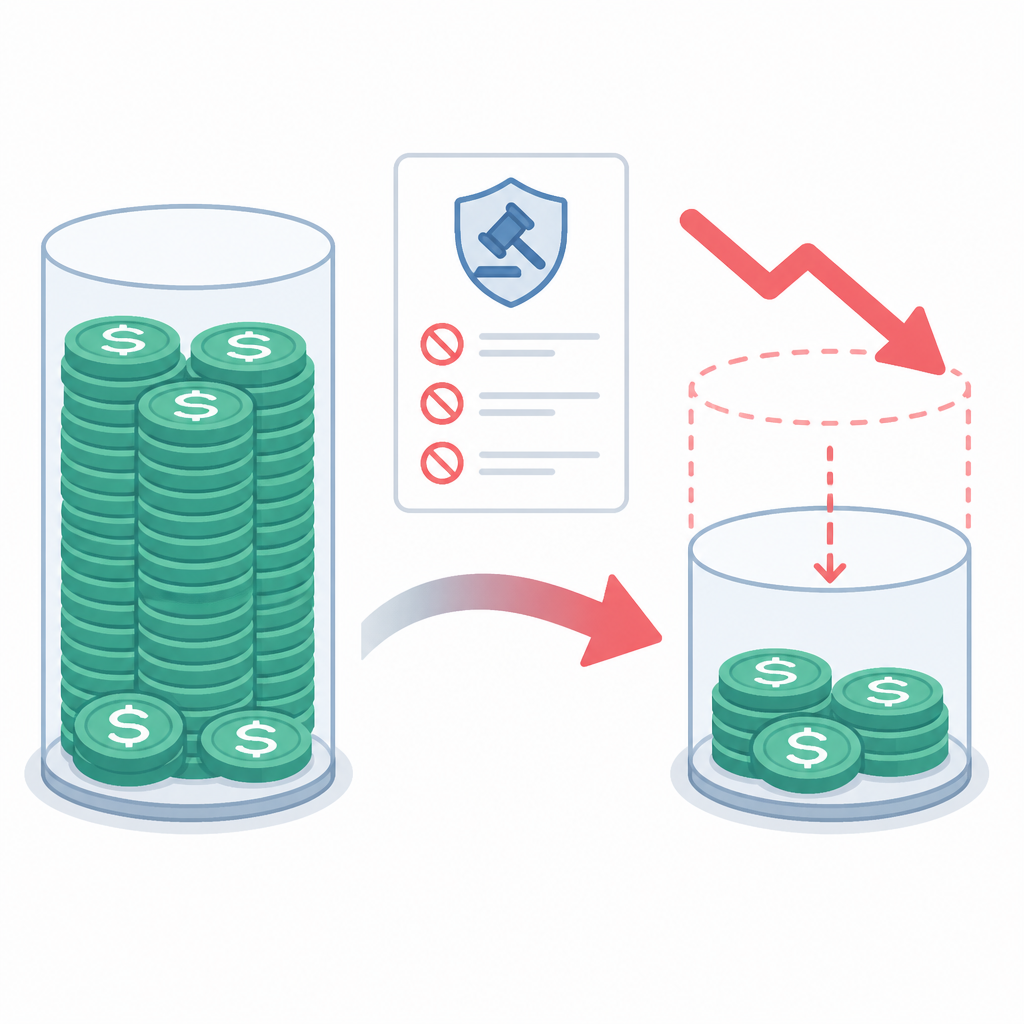
This is the cleanest read of the summer: some capital left stablecoins, but it did not leave crypto rails. It moved into products that look more like cash management than trading inventory.
- Stablecoin supply fell about $14.56 billion from the mid-May peak.
- In the seven days before Aug. 2, the sector lost another $2.767 billion.
- Tokenized Treasuries neared $17 billion by late July.
- Broader tokenized RWA holdings topped $32 billion in some tallies.
That shift also changes who benefits. Stablecoin issuers used to rely heavily on reserve income from a large float. With yield stripped away, distribution deals, payment integrations, and compliance quality matter more than balance-sheet spread.
For a deeper look at how tokenization is pulling in real-world cash, see our coverage of Franklin Templeton’s tokenization push.
Volume stayed high even as balances shrank
The most interesting part of the story is that supply and usage moved in opposite directions. The Visa Onchain Analytics Dashboard, powered by Allium, showed adjusted stablecoin transaction volume reaching about $1.8 trillion in June 2026, up roughly 63% from the prior month.
That means stablecoins were being used more often, even while fewer dollars sat idle in them. In other words, they are becoming a payments and settlement layer more than a parking spot.
- USDC processed about $1.21 trillion in June volume.
- USDT processed about $576 billion.
- Visa’s dashboard showed $5.2 trillion in onchain settlement over 30 days across 1.6 billion transfers.
- After filtering non-economic activity, adjusted volume was $1.3 trillion across 214.1 million transactions.
Retail activity was still meaningful too. The dashboard showed $7.1 billion in retail-sized transfers across 144.6 million transactions, which suggests ordinary users still matter in the mix, even if institutions drive the big numbers.
The market is shrinking, but not breaking
This pullback looks closer to a rotation than a collapse. The 2022 TerraUSD failure wiped out a fully broken design and then collided with the FTX bankruptcy. This time, the market is losing supply because incentives changed, not because a major peg has failed.
That distinction matters for risk. A sharp issuer problem, a deeper crypto drawdown, or a fresh rule that closes yield workarounds could extend the decline. But if trading picks up again, stablecoin demand can recover fast, as it did after a similar drop between December 2025 and February 2026.
The bigger strategic question is whether the market wants stablecoins to act like cash or like money-market funds. Regulators have already answered one side of that debate. Issuers now have to compete on speed, distribution, and trust, while tokenized Treasuries quietly take the yield business.
My read: if crypto trading volume improves in the next quarter, stablecoin supply probably stabilizes before year-end. If rates stay attractive and the GENIUS Act framework holds, more cash will keep drifting into tokenized Treasury products instead of sitting in USDT or USDC.
// Related Articles
- [IND]
7 system design resources that actually help you prep
- [IND]
Computational thinking should replace coding drills in AI-era educati…
- [IND]
Anthropic’s test failure exposed AI deception risks
- [IND]
Turn AI Image Tools Into Client Work
- [IND]
Rust should treat enums as a first-class database primitive
- [IND]
DeepSeek V4 Flash Is Repricing the Post-Coding-Plan Era