A Practical Taxonomy for RWA Tokenization
This paper maps real-world asset tokenization into 23 attributes so teams can compare deployed systems more consistently.

This paper maps real-world asset tokenization into 23 attributes for clearer system comparison.
- Research org: Unspecified in arXiv abstract
- Core data: 23 attributes
- Breakthrough: Attribute-based taxonomy across governance, asset, token, DLT, and economy
A Taxonomy of Real-World Asset Tokenization for Blockchain-Based Financial Infrastructure tries to solve a practical problem: real-world asset (RWA) tokenization is growing fast, but the field still lacks a shared way to compare systems that mix legal claims, custody, compliance, token mechanics, and on-chain integrations. For engineers, that matters because two protocols can look similar on the surface while depending on very different off-chain assumptions.
The paper’s core move is to stop treating “tokenized assets” as one bucket. Instead, it breaks the design space into observable parts and uses those parts to classify deployed systems. That makes it easier to see which features are actually on-chain, which ones are handled by legal wrappers or custodians, and where the operational risk really sits.
What problem this paper is trying to fix
Get the latest AI news in your inbox
Weekly picks of model releases, tools, and deep dives — no spam, unsubscribe anytime.
No spam. Unsubscribe at any time.
RWA tokenization sits at the intersection of blockchain engineering, financial infrastructure, legal enforceability, and market design. The paper argues that existing work often studies these pieces separately: technical papers focus on token standards, settlement, or composability, while economic and policy work focuses on adoption, legal uncertainty, and systemic risk. That fragmentation makes it hard to compare protocols in a way that is useful across disciplines.

The authors frame RWAs as interdependent complex systems. In that setting, a protocol cannot be understood just by looking at the token contract. You also need to know who holds custody, how redemption works, what legal claim the holder actually has, how compliance is enforced, and how the asset is verified. Without a shared vocabulary, similar systems can be described in incompatible ways.
The paper also points to the scale of the market as of May 2026: DeFiLlama tracks approximately $26 billion in RWA market capitalization and more than 100 issuers. That is enough activity to make classification useful, but the abstract notes that a systematic taxonomy jointly capturing technical, legal, and market-design dimensions is still underdeveloped.
How the method works in plain English
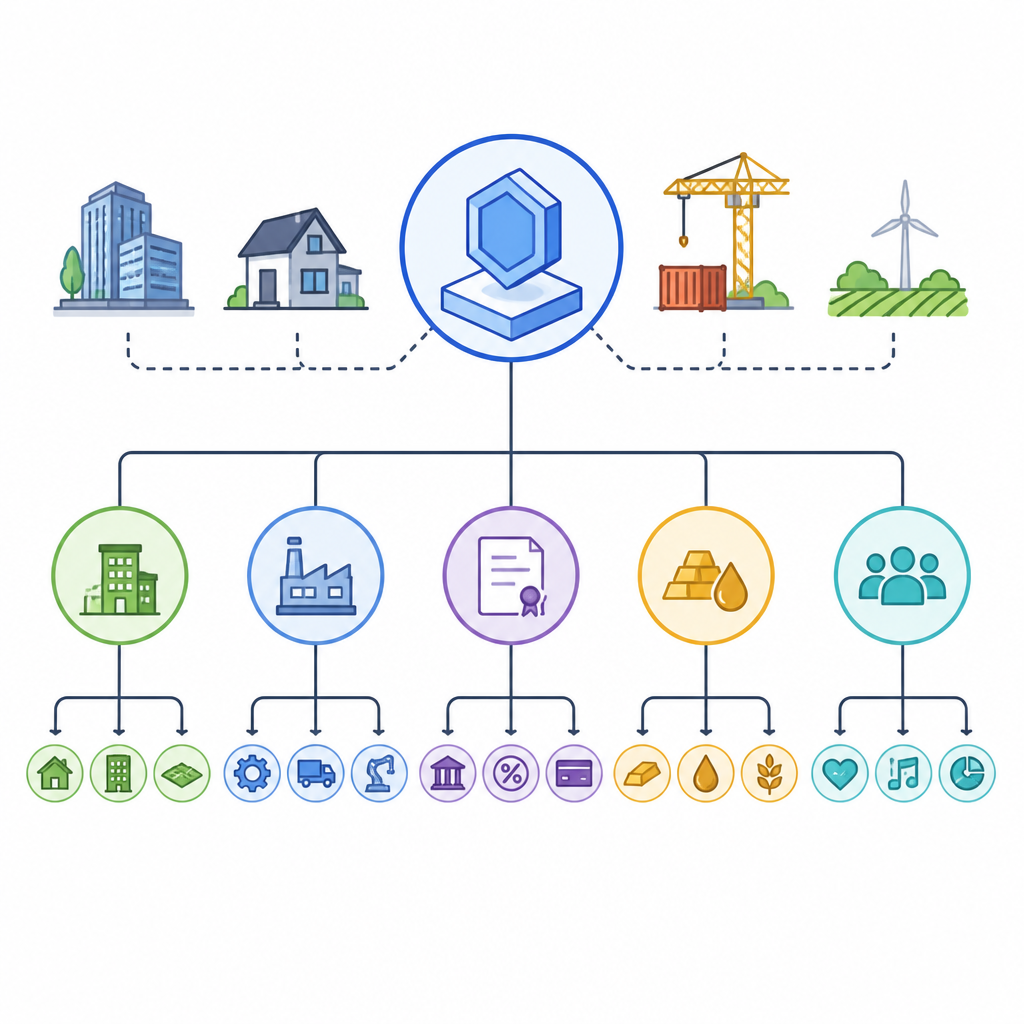
The authors use an iterative taxonomy-development method. In plain English, that means they built the classification by refining categories until they could apply them to real systems, rather than inventing a purely theoretical framework. The result is a taxonomy with 23 attributes organized into five components: governance, asset structure, token properties, distributed ledger technology, and economy.
Those five buckets are doing a lot of work. Governance covers who can control or modify the system. Asset structure covers the underlying asset and how rights are represented. Token properties capture mechanics like transfer behavior and redemption. DLT covers the blockchain layer itself. Economy covers the market and incentive design around the tokenized asset.
The important detail is that the taxonomy is meant to be empirically applicable. It is not just a conceptual map. The authors use it to classify twenty major RWA systems selected by market capitalization, which lets them compare real deployments instead of hypothetical designs.
What the paper actually shows
The main finding is that current RWA tokenization is mostly hybrid. Blockchain tokens are used for representation, transfer control, redemption workflows, pricing, and composability, but the core legal guarantees still live off-chain. In other words, the chain handles some of the workflow, but legal wrappers, custodial arrangements, compliance processes, and verification mechanisms still anchor the asset’s real-world meaning.
That is a useful reality check for engineers who assume tokenization automatically moves trust on-chain. The paper’s classification suggests that in deployed systems, the token often acts more like an interface layer than a complete replacement for legal and institutional infrastructure.
The analysis also surfaces recurring documentation gaps. Across the systems they reviewed, the paper notes missing or unclear information about voting rights, dispute forums, burn mechanics, supply constraints, and reserve verification. Those omissions matter because they are exactly the details that determine how a token behaves under stress, how holders can exercise rights, and how much confidence users can place in the backing model.
Importantly, the abstract does not report benchmark numbers in the usual performance sense, such as throughput, latency, or cost. The concrete quantitative result is the taxonomy itself: 23 attributes applied to 20 leading RWA protocols. So the paper’s value is comparative structure, not a new optimization result.
Why developers should care
If you build financial infrastructure, this paper gives you a checklist for thinking beyond the smart contract. It helps separate what is enforced by code from what depends on legal agreements, custodians, or off-chain verification. That distinction is critical when designing issuance flows, redemption paths, compliance gates, and transfer restrictions.
It is also useful for architecture reviews. A team evaluating an RWA protocol can use the taxonomy to ask practical questions: What exactly does the token represent? Who can redeem it? Where are the legal claims enforced? What happens if the reserve verification process fails? Which parts of the system are composable with DeFi, and which parts are not?
For protocol designers, the paper highlights a broader lesson: tokenization is not one technical pattern. It is a set of design choices spanning governance, asset rights, custody, verification, and market structure. A system can be technically elegant and still rely heavily on off-chain trust. The taxonomy makes those dependencies visible.
Limits and open questions
The abstract is clear that this is an initial step toward a comprehensive classification, not the final word on RWA design. The taxonomy is based on twenty leading protocols by market capitalization, so it is useful for studying deployed systems, but it may not cover the full long tail of experimental or niche implementations.
Another limitation is that classification does not automatically solve the legal and operational questions it reveals. Knowing that a system depends on an off-chain legal wrapper or reserve verification is valuable, but it does not tell you how robust that wrapper is, how enforceable the claims are across jurisdictions, or how the system behaves under dispute.
The paper also leaves open how this taxonomy will evolve as standards, regulation, and infrastructure mature. RWA systems are moving targets. New custody models, compliance patterns, and settlement designs could add dimensions that are not fully captured here. Still, that is exactly why a structured taxonomy is useful: it gives the field a stable language for tracking those changes.
Bottom line
This paper is less about hype and more about making a messy design space legible. It shows that real-world asset tokenization is usually a hybrid stack, not a pure on-chain replacement for traditional finance. For developers, that means the hard part is not just writing token contracts; it is understanding how code, legal rights, custody, and verification fit together.
- RWA systems are best understood as hybrid architectures with on-chain and off-chain dependencies.
- The taxonomy gives teams a practical way to compare protocols across 23 attributes.
- The biggest gaps are not just technical; they are also about legal claims, custody, and verification.
// Related Articles
- [RSCH]
Fruitfly-Inspired Regression Without Heavy Models
- [RSCH]
Mental World Modeling: Simulating minds, not just scenes
- [RSCH]
Do You Need to Pretrain Q-Functions?
- [RSCH]
OpenAI’s agent hack forces tighter eval controls
- [RSCH]
CARE routes LoRA experts by confidence
- [RSCH]
πR² makes flow policies react in real time