Vector databases will reshape financial search, not replace core syst…
Vector databases will matter in financial search, but only as a layer on top of governed systems, not as a replacement for core platforms.

$6.11 billion by 2030 signals that vector databases are becoming a real layer in financial search.
That number matters because financial firms are not buying hype, they are buying retrieval that works across documents, tickets, research notes, and client records. A market forecast tied to vector databases for financial search points to a simple truth: the pain is not storage, it is finding the right context fast enough to make a decision.
Vector search solves a real financial problem
Get the latest AI news in your inbox
Weekly picks of model releases, tools, and deep dives — no spam, unsubscribe anytime.
No spam. Unsubscribe at any time.
Traditional keyword search breaks down when the question is fuzzy, the language is inconsistent, or the answer lives across multiple systems. In finance, that shows up in compliance review, analyst research, support, and internal knowledge bases. A vector database gives teams semantic retrieval, which means the system can find meaning, not just matching words.

That matters most where precision is costly. If a risk team needs every mention of a counterparty across PDFs, chat logs, and policy docs, keyword search misses variants and synonyms. Semantic search narrows the gap between the question a human asks and the evidence the firm already owns.
The real buyer is the workflow owner, not the infrastructure team
Financial search is not purchased because someone wants a new database. It is purchased because a workflow is too slow, too manual, or too error-prone. The people with budget are the teams that feel the cost of delay: compliance, operations, research, and customer support.
That changes how adoption works. A platform team can expose vector search, but the value lands only when it is embedded into a concrete workflow such as case triage, advisor support, or due diligence. The market grows when the tool removes minutes from a process that repeats thousands of times a day.
Governance will decide who wins
Finance punishes systems that cannot explain themselves. Search results that are useful but opaque are not enough when the output feeds audits, customer decisions, or regulated advice. The strongest vector database products will pair semantic retrieval with access controls, lineage, logging, and human review.
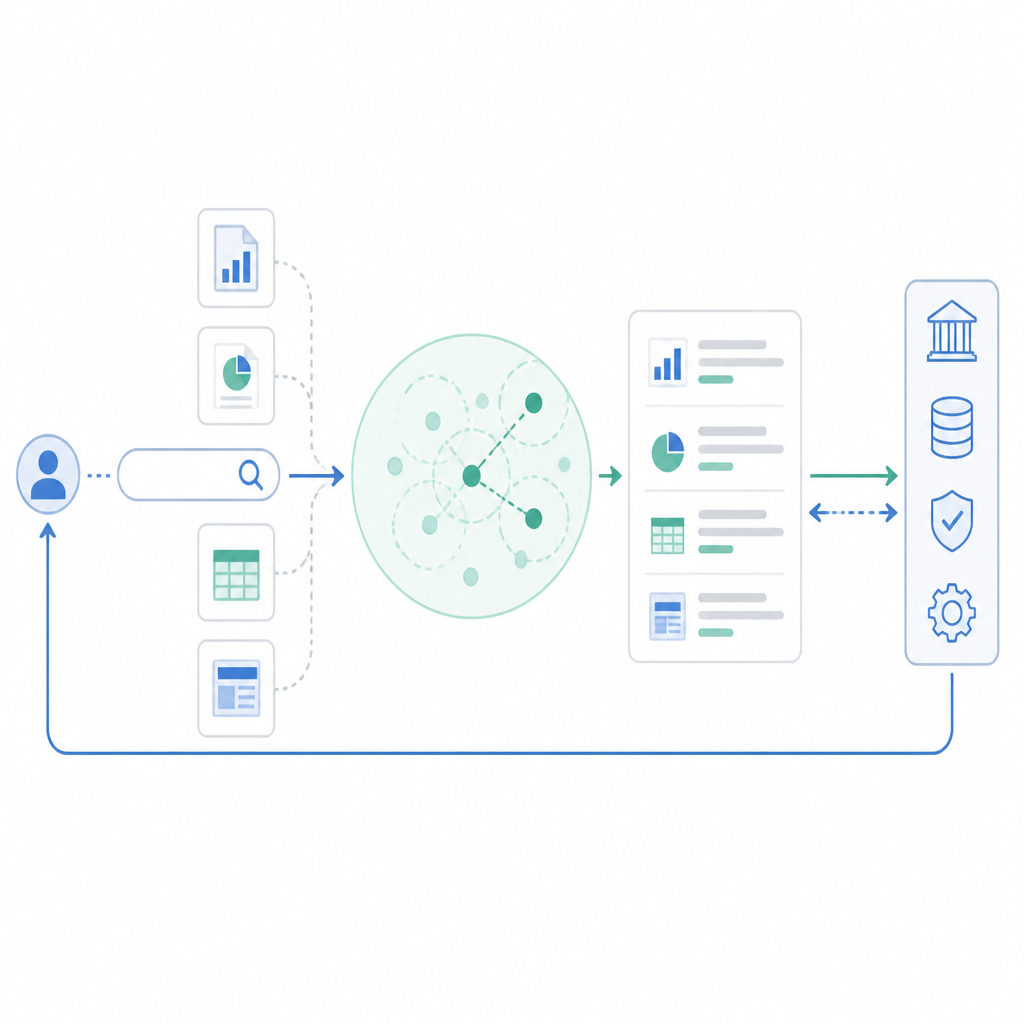
The market forecast is not a license to ignore this. A search layer that cannot show why a document surfaced, or cannot enforce permissions cleanly, will stall in procurement. In financial services, trust is not a feature add-on; it is the product.
The counter-argument
The skeptical view is straightforward: this is still a press-release market story built on inflated category growth, and finance already has search tools, data warehouses, and enterprise content platforms. From that angle, vector databases look like a feature, not a category, and the $6.11 billion figure reads like vendor optimism dressed up as inevitability.
There is also a good reason to resist overreach. Not every financial search problem needs embeddings, and not every team should introduce another database layer. If the use case is simple lookup on structured fields, traditional indexing is cheaper, easier to govern, and easier to defend in production.
That criticism is valid, but it does not defeat the category. Vector databases win where the question is semantic, the corpus is messy, and the cost of missing the right record is high. In finance, those conditions are common enough to support real growth, even if the technology stays narrow and workflow-specific.
What to do with this
If you are an engineer, start with one search workflow that fails today and measure retrieval quality, time to answer, and permission safety before you touch architecture. If you are a PM or founder, sell the workflow outcome, not the database, and prove that semantic search reduces manual review, shortens case handling, or improves analyst throughput. The winners in this market will be the teams that treat vector search as governed infrastructure for a specific job, not as a generic platform bet.
// Related Articles
- [IND]
Milvus 3.0 adds lake-native vector search
- [IND]
Google’s Q2 2026 results prove AI spend is now the story
- [IND]
AI regulation in India is now a business risk
- [IND]
Europe should standardise the AI Act through harmonised technical rul…
- [IND]
AMD and Anthropic’s 2GW deal reshapes AI supply
- [IND]
OpenAI’s comeback proves coding now drives the AI race