Web3 platforms need fee discipline, not token theatrics, to make money
Web3 platforms only become profitable when fees, token design, and compliance all reinforce real usage.

Transaction fees and disciplined tokenomics are the only durable Web3 monetization model.
Web3 platforms do not need more clever monetization ideas; they need fee discipline, real utility, and compliance-first token design if they want to stay profitable.
The reason is simple: decentralized products still pay the same bills as centralized ones. Teams must fund engineering, security audits, infrastructure, support, and legal work. A token that only exists to speculate on future growth does not cover those costs for long. A platform that charges for actual usage, by contrast, creates a direct line between value delivered and revenue collected.
Transaction fees are the cleanest source of revenue
Get the latest AI news in your inbox
Weekly picks of model releases, tools, and deep dives — no spam, unsubscribe anytime.
No spam. Unsubscribe at any time.
Transaction fees are the most honest monetization model in Web3 because they charge only when the platform creates value. A swap, transfer, mint, or settlement is a measurable action, so the fee is easy to justify. That matters in decentralized systems, where users reject hidden markups and rent-seeking behavior faster than they do in traditional software.

Ethereum proved this at scale. Gas fees are not elegant, but they are legible: users pay for block space, validators earn for securing the network, and the protocol keeps working. That model has flaws, especially during congestion, yet it remains the clearest example of Web3 revenue tied to usage rather than hype. If a platform cannot charge for activity without scaring users away, it does not have a monetization problem, it has a product problem.
Token sales are funding events, not business models
Token sales and ICOs can raise money, but they do not create durable profitability. They front-load revenue, then leave the team with a harder job: converting a liquid asset into a platform people repeatedly use. Too many projects treat the sale as proof of product-market fit when it is really only proof that demand exists for the token narrative.
The market has already punished that confusion. Projects that relied on token appreciation instead of product usage often collapsed once speculative demand cooled. By contrast, platforms with recurring on-chain activity, such as exchanges, lending protocols, and NFT marketplaces, can survive bear markets because users keep paying for access, execution, or liquidity. That is the difference between financing a roadmap and running a business.
Tokenomics only works when it serves utility
Good tokenomics is not about making a token scarce for its own sake. It is about making the token necessary for a useful action: governance, staking, fee discounts, collateral, access, or settlement. When the token has a job, demand can grow with platform adoption. When it has no job, supply mechanics become a slow-motion value leak.
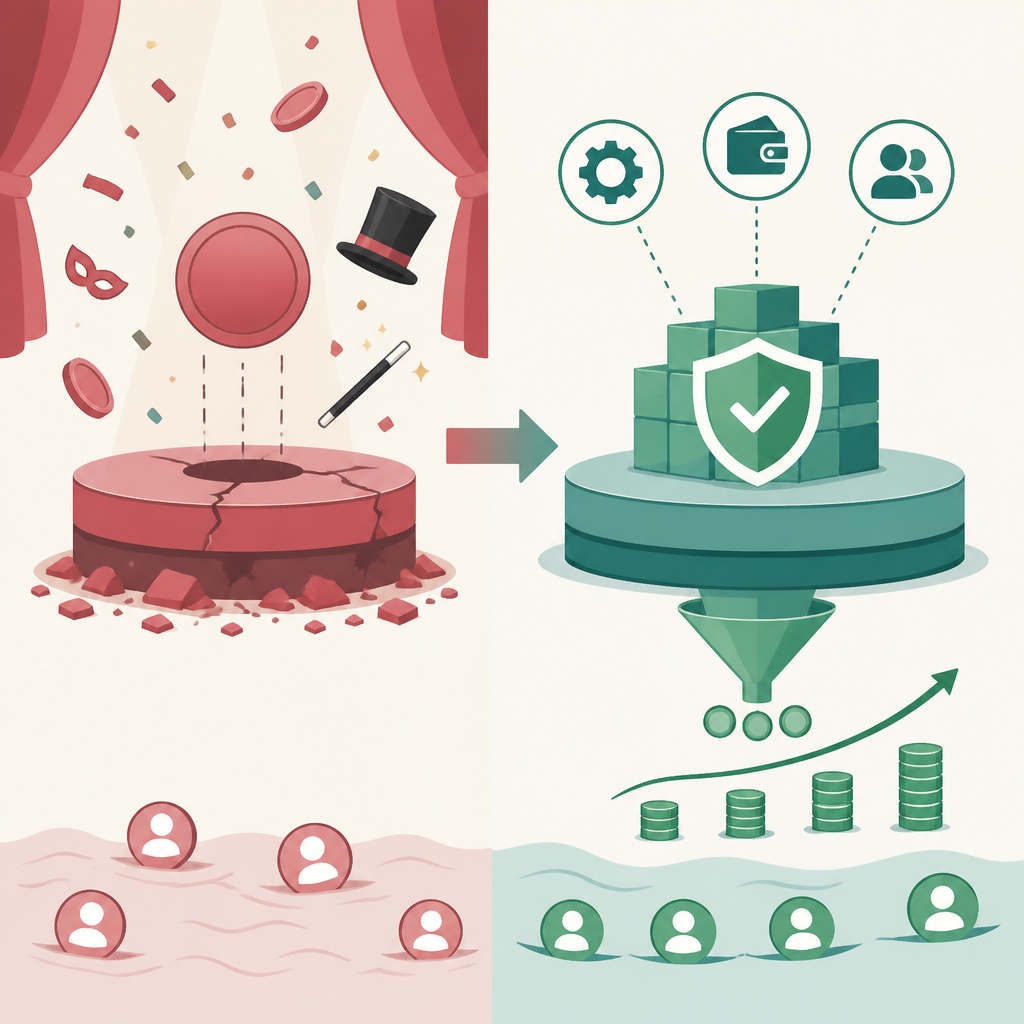
We have seen the failure mode repeatedly. Reward emissions attract users quickly, then dilute holders and create constant sell pressure. That pattern looks active on dashboards but weak on balance sheets. Sustainable token economies use deflationary or sink mechanisms with restraint, because the goal is not to starve supply. The goal is to keep the token tied to real network behavior so revenue rises with usage instead of fighting it.
The counter-argument
Supporters of broader Web3 monetization are not wrong to push beyond fees. Some ecosystems need subscriptions for premium analytics, membership tiers for communities, sponsorships for distribution, or in-game purchases for virtual economies. A pure fee model can be too narrow for consumer apps, creator platforms, and media products that depend on engagement rather than direct financial transactions.
They also make a fair point about user experience. High transaction fees can suppress participation, and aggressive monetization can make a decentralized product feel just as extractive as the Web2 services it was meant to replace. In that view, flexible revenue streams are not a luxury. They are a survival tactic for platforms that need to grow before they can charge much at all.
That counter-argument is valid, but it does not overturn the core rule: every extra revenue stream must reinforce usage, not replace it. Subscriptions, sponsorships, and digital goods work only when the underlying product is already valuable enough to retain users. If a platform cannot earn from transactions or utility-linked demand, then layering on ads or memberships just delays the reckoning. The business still depends on attention without proving durable demand.
What to do with this
If you are an engineer, PM, or founder building in Web3, design monetization from the protocol outward: charge for actions users already understand, make the token necessary for those actions, cap emissions, and keep compliance in the loop from day one. Do not start with a token sale and hope usage appears later. Start with a service people will pay for repeatedly, then make the economics transparent enough that users can see exactly why the platform deserves to exist.
// Related Articles
- [CHAIN]
Riyadh’s blockchain show proves Web3 is now infrastructure
- [CHAIN]
Web3 game developers turn stacks into ecosystems
- [CHAIN]
Layer 2 is changing blockchain payments for banks
- [CHAIN]
Ethereum.org’s app list turns discovery into a map
- [CHAIN]
Celestia’s Fibre push targets 1 Tb/s blockspace
- [CHAIN]
AI utility tokens are still just presale marketing, not infrastructure