Why Fintech and Web3 Startups Need Legal Support Before Scaling Inter…
Fintech and Web3 startups need legal support before international expansion, not after it starts.

Fintech and Web3 startups need legal support before international expansion, not after it starts.
Fintech and Web3 founders who wait until after launch to get legal help are building on sand, because the first real obstacle is not product-market fit but regulatory fit.
That is not a theoretical warning. The source article lays out a familiar pattern: startups enter new markets by translating a site, turning on local payments, or opening access to users abroad, then discover they need licensing, AML controls, data protection rules, tax planning, and corporate substance in place already. By then, the company has users, bank accounts, investors, and transaction history that make cleanup far harder and more expensive.
International growth is a legal event, not just a sales event
Get the latest AI news in your inbox
Weekly picks of model releases, tools, and deep dives — no spam, unsubscribe anytime.
No spam. Unsubscribe at any time.
Fintech and Web3 companies often think of expansion as a product milestone. In practice, it is a jurisdiction-by-jurisdiction legal test. A startup that serves users in several countries is not merely scaling traffic. It is exposing itself to different rules on licensing, promotion, consumer protection, and operational control. The article is right to frame international growth as a regulatory project first.

One concrete example is market targeting. A company incorporated offshore does not escape local law if it localizes marketing, supports local currency, or builds a meaningful user base in a country. Regulators care about substance, not slogans. If a payment app or crypto platform behaves like it is operating in a market, it will be treated like it is operating there.
AML failures break banking access before they trigger fines
The strongest argument for early legal support is anti-money laundering readiness. Even small startups are expected to have customer due diligence, transaction monitoring, sanctions screening, suspicious activity reporting, and internal risk procedures. For Web3 businesses, that extends to wallet screening, blockchain monitoring, Travel Rule controls, and enhanced checks for high-risk counterparties.
This matters because the immediate consequence of weak AML is often not a regulator knocking on the door. It is a bank or payment provider shutting the door. The article correctly notes that poor AML controls can block corporate accounts, merchant services, card acquiring, and institutional partnerships. In fintech, compliance is not just a legal defense. It is infrastructure access.
Bad structure kills fundraising, licensing, and tax planning
International scaling usually requires a deliberate corporate structure: a holding company, operating entity, IP owner, local subsidiary, or licensed vehicle. Startups that improvise this later end up with ownership confusion, licensing friction, and tax inefficiency. The article’s point is blunt and accurate: a “paper company” is not enough in regulated markets.
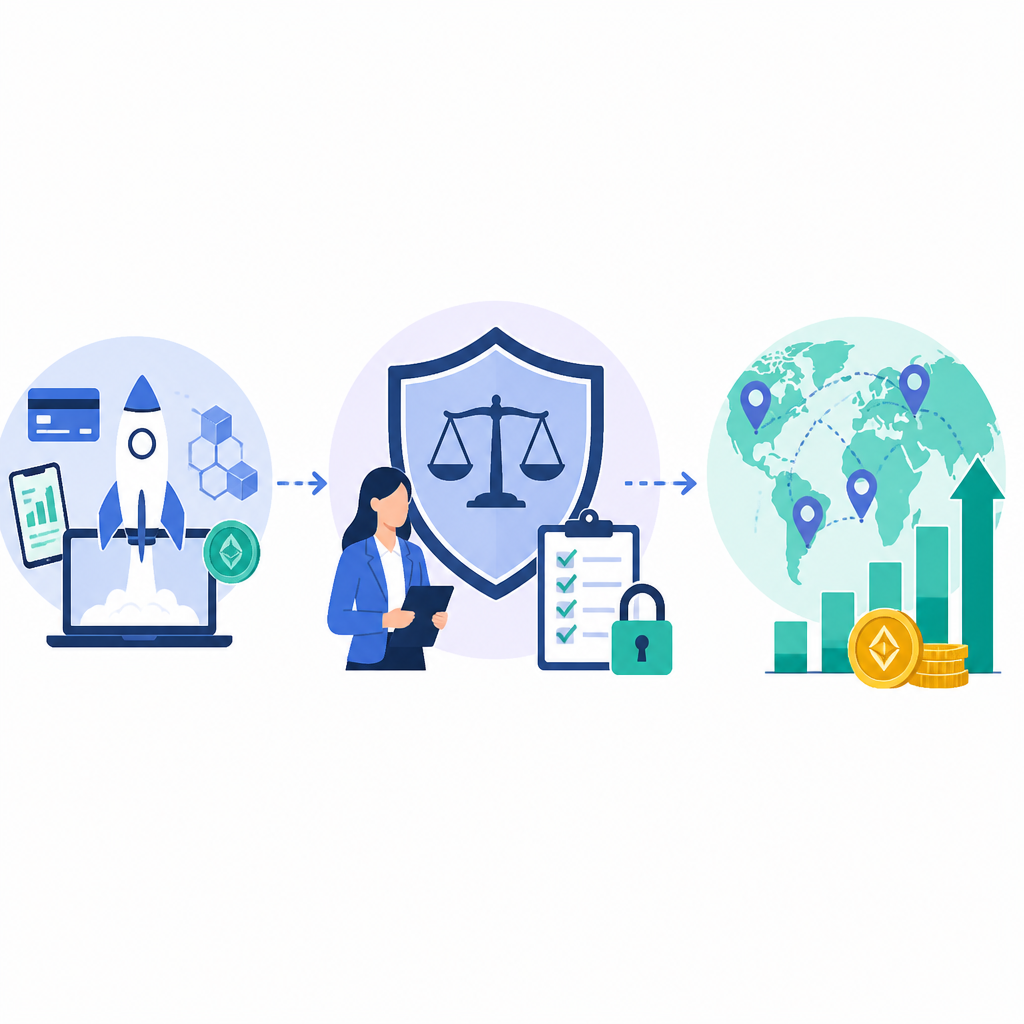
There is also a financing angle. Investors and acquirers do not want to untangle unclear IP ownership or regulated and unregulated activity inside the same entity. A startup that separates these functions early makes diligence simpler and valuation cleaner. A startup that does not will pay for the mess during fundraising or acquisition, when leverage is weakest.
The counter-argument
The opposing view is understandable: early-stage founders have limited cash, limited time, and a strong incentive to validate demand before spending on lawyers. In fast-moving markets, legal review can slow launches, and some founders believe they can fix compliance once traction proves the model. That argument has real force for unregulated software businesses.
But fintech and Web3 are not ordinary software businesses. The article’s core case is that the cost of waiting is disproportionate because the company’s early decisions shape whether it can even operate later. A startup can patch a landing page. It cannot easily patch a broken licensing strategy, a rejected bank account, or a token launch that was marketed into the wrong regulatory category. I accept one limit: not every legal memo should come before every experiment. But the moment a startup touches money, identity, assets, or cross-border users, legal review is not overhead. It is the operating system.
What to do with this
If you are a founder, engineer, or PM in fintech or Web3, treat legal as part of launch planning, not post-launch cleanup. Before adding a country, a payment rail, a wallet flow, or a token campaign, ask three questions: what license or exemption applies, what compliance controls are required, and what corporate structure supports the model. Build that checklist into product review, not just board review. The startups that scale internationally are the ones that make regulation a design constraint from day one.
// Related Articles
- [IND]
Vector databases will reshape financial search, not replace core syst…
- [IND]
Milvus 3.0 adds lake-native vector search
- [IND]
Google’s Q2 2026 results prove AI spend is now the story
- [IND]
AI regulation in India is now a business risk
- [IND]
Europe should standardise the AI Act through harmonised technical rul…
- [IND]
AMD and Anthropic’s 2GW deal reshapes AI supply