Tag
reasoning models
Reasoning models are built to handle multi-step inference, verification, and agentic tasks such as math, coding, and interactive problem solving. This tag covers training methods, cold-start behavior, RLVR, loss design, and the cost-performance tradeoffs that shape deployment.
5 articles
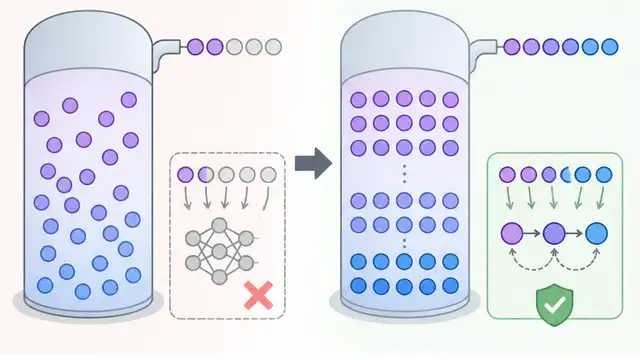
Relay-OPD fixes prefix failure in distillation
Relay-OPD lets a teacher briefly take over failed prefixes, improving on-policy distillation and cutting training trajectories by over 50%.

Direct-OPD reuses weak-model RL gains for stronger models
Direct-OPD lifts Qwen3-1.7B from 48.3% to 62.4% on AIME 2024 by distilling RL gains from a weaker model.

A New Way to Think About SFT Targets
This paper reframes supervised fine-tuning as designing target distributions, not just minimizing token loss.

Tsallis loss for faster reasoning-model training
A Tsallis-loss continuum may help reasoning models escape cold-start stalls faster than RLVR, with tradeoffs between speed, noise, and stability.

ARC Prize leaderboard shows cost still matters
ARC Prize’s leaderboard tracks how AI systems trade cost for score, and ARC-AGI-3 pushes agents into interactive tasks.