Open-source AI music generators that self-host well
10 self-hosted open-source AI music generators, compared for speed, vocals, control, and setup effort.

Ten self-hosted open-source music generators offer different mixes of speed, vocals, and control.
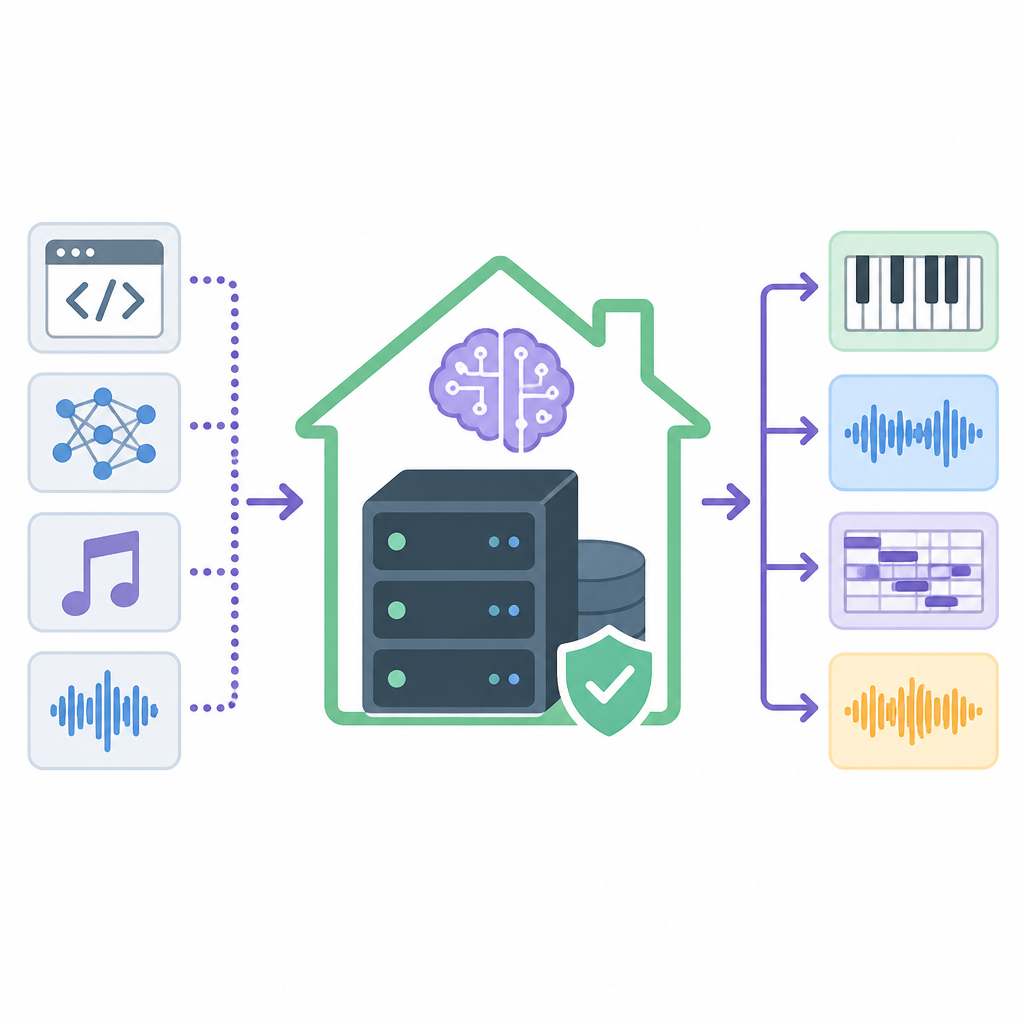
If you want to run music generation on your own hardware, these 10 projects cover everything from quick text-to-music ideas to full songs with vocals. One standout data point: ACE-Step can generate a 4-minute song in about 20 seconds.
| Item | Best for | Notable spec |
|---|---|---|
| DiffRhythm | Full songs with vocals | 1 million-song training set |
| AudioCraft | Research and custom pipelines | Includes MusicGen, AudioGen, EnCodec |
| Yue AI | Lyrics-first songs | Up to 5 minutes, 24GB VRAM minimum |
| Riffusion | Beginners and quick demos | Real-time generation |
| Mubert | Royalty-free loops | 15 seconds to 25 minutes |
| Magenta | Education and prototyping | TensorFlow-based, currently inactive |
| MusicGen | Instrumental music | Text or melody prompts |
| ACE-Step | Fast, editable tracks | 4 minutes in ~20 seconds |
| MusicLM-PyTorch | Developer experiments | MusicLM-style research code |
| OpenAI Jukebox | Audio researchers | Vocal-focused generation |
1. DiffRhythm
Get the latest AI news in your inbox
Weekly picks of model releases, tools, and deep dives — no spam, unsubscribe anytime.
No spam. Unsubscribe at any time.
DiffRhythm is the strongest pick if you want open-source song generation with vocals and accompaniment in one pass. It uses latent diffusion and a non-autoregressive design, so it can produce full-length songs quickly instead of stitching together short loops.

The project is trained on a large dataset and is built for lyric-driven creation. That makes it useful for composers who care about complete song demos more than tiny MIDI fragments.
- Inputs: lyrics plus a style prompt
- Output: vocals and instrumental backing
- Strength: quick full-song drafts
- Trade-off: less detailed manual control
2. AudioCraft
AudioCraft is Meta’s research library for audio generation, and it is the best fit when you want a flexible toolkit rather than a single app. It includes MusicGen, AudioGen, EnCodec, and related components, so developers can build their own pipelines around text prompts or reference audio.
This is the most modular option in the group, but it also asks for more technical setup. If you are comfortable with PyTorch and want to experiment with training or inference code, AudioCraft gives you a broad base to work from.
- Includes: MusicGen, AudioGen, EnCodec, Multi-Band Diffusion
- Use case: custom research and creator tooling
- Strength: transparent, open codebase
- Trade-off: higher setup effort
3. Yue AI
Yue AI focuses on complete songs with synchronized vocals, and it pushes harder into lyric understanding than many other open-source generators. It can create tracks up to five minutes long and adds fine vocal controls for timing, pitch, and emotional expression.
The catch is hardware. The full version needs at least 24GB of VRAM, so it fits users with strong GPUs or those willing to accept slower, lower-fidelity packages. For lyric-first demos, though, it is one of the most capable options here.
- Supports multiple languages
- Handles genre, lyrics, and accompaniment together
- Offers vocal tuning for pitch and timing
- Best for advanced users with strong hardware
4. Riffusion
Riffusion is the friendliest entry point in this list. It uses a Stable Diffusion approach for real-time music generation and includes a polished interface, community tracks, and tools for text-to-music, lyrics-to-song, AI covers, and section replacement.
It is a good fit for casual creators who want to hear results fast without wrestling with a complex stack. The downside is that prompt following can be uneven, especially when you ask for specific vocal styles or languages.
- Real-time generation
- Beginner-friendly UI
- Community sharing features
- Best for ambient, experimental, and quick drafts
5. Mubert
Mubert is aimed at royalty-free music creation, with controls for mood, genre, theme, instruments, BPM, and duration. It can turn text or image prompts into tracks and also offers an API, which makes it useful for developers building music into apps or workflows.
Its free tier is more limited than the others, but the parameter control is excellent. If you need background music, stream-safe loops, or a library-friendly output range, Mubert is easy to place in a production workflow.
- 150+ genres and moods
- Track length from 15 seconds to 25 minutes
- 12,000+ pre-generated song library
- Free plan: 25 generations and 10 downloads per month
6. Magenta
Magenta is Google’s open-source music and art project, built for exploration rather than polished output. It gives developers and musicians pretrained models, notebooks, and plugins for melody, harmony, rhythm, and improvisation work.
Because it is currently inactive, Magenta is less about production use and more about education, research, and creative prototyping. If you want to study how machine learning shapes musical ideas, it still has value.
- TensorFlow-based
- Works with DAWs through Magenta Studio
- Good for learning and experimentation
- Not ideal for modern production workflows
7. MusicGen
MusicGen is Meta’s open-source text-to-music model, and it is a strong choice for high-quality instrumental generation. It can take text or a short melody and expand that input into a fuller composition, which is useful when you already have a musical seed.
This model is lighter than many vocal-first systems and tends to run well on consumer GPUs. It is best for producers who want realistic instrumental ideas, not complete lyric-driven songs.
- Text-to-music and melody-to-music support
- Runs efficiently on consumer GPUs
- Good fit for musicians and AI researchers
- Limited vocal generation
8. ACE-Step
ACE-Step is built for speed, coherence, and control in the same system. It combines diffusion, a deep compression autoencoder, and a lightweight linear transformer, which helps it generate long tracks quickly while keeping musical structure intact.
It is the most versatile option for advanced users who want remixing, lyric editing, voice cloning, and track-level generation. The trade-off is complexity: this is not a beginner setup, and it wants powerful hardware.
- Generates a 4-minute song in about 20 seconds
- Supports text-to-music, lyric-to-vocal, and remixing
- Offers fine acoustic control
- Best for developers and researchers
9. MusicLM-PyTorch
MusicLM-PyTorch is a developer-oriented path for people who want to experiment with MusicLM-style generation in PyTorch. It is more of a research implementation than a polished creator app, so the value lies in studying the model behavior and adapting the code.
If your goal is to inspect architecture choices, test ideas, or build from a MusicLM-inspired base, this is a sensible place to start. If you want a ready-to-use music tool, it is not the easiest option.
- Research-first codebase
- Best suited to developers
- Useful for model experimentation
- Less appropriate for casual users
10. OpenAI Jukebox
OpenAI Jukebox remains one of the most interesting projects for vocal audio generation, even though it is far less practical than newer tools. It is designed for researchers who want to explore long-form audio generation with singing and stylistic variation.
Because it is heavy, complex, and research-focused, Jukebox is not the easiest self-hosted option for everyday creators. But for people studying early neural music generation, it is still worth knowing.
- Vocal-focused audio generation
- Research and archival value
- Good for studying long-form synthesis
- High setup and compute demands
How to decide
If you want full songs with vocals, start with DiffRhythm or Yue AI. If you want a flexible research stack, AudioCraft is the strongest base, while MusicGen is the better choice for instrumental output on lighter hardware.
For fast edits and advanced control, ACE-Step is the most ambitious option. For beginners, Riffusion is the easiest to try, and for education or model history, Magenta and OpenAI Jukebox still have a place.
// Related Articles