Prompt Engineering Is Becoming Infrastructure
Springer’s new chapter argues prompt engineering now needs ethics, governance, and domain expertise, not just clever wording.

Prompt engineering has moved far beyond writing a clever sentence into a chatbot. In Hamid Tavakoli’s new chapter in Prompt Engineering for Everyone, the field is framed as a discipline with technical, ethical, and institutional duties that reach into education, healthcare, governance, and industry.
That shift matters because prompts now shape decisions at scale. When a prompt influences a student tutor, a clinical assistant, a public-service workflow, or a customer-facing agent, the quality of the instruction is no longer a private productivity trick. It becomes part of the system design.
If you want a useful way to read this chapter, think of it as a warning label and a curriculum at the same time. Tavakoli is saying that the people writing prompts are already doing system work, whether they admit it or not.
From hobby skill to professional practice
Get the latest AI news in your inbox
Weekly picks of model releases, tools, and deep dives — no spam, unsubscribe anytime.
No spam. Unsubscribe at any time.
The chapter traces prompt engineering’s path from informal experimentation to a structured practice with real-world consequences. That evolution is easy to miss if your only exposure is a few ChatGPT tricks on social media, but the chapter pushes well past that surface layer.

In Tavakoli’s framing, prompts are part of the interface between human intent and model output. Once prompts affect decisions for other people, they stop being personal shortcuts and start becoming operational artifacts.
The chapter describes a broader prompt ecosystem made up of model builders, product teams, domain specialists, educators, policy people, and end users. That mix matters because prompt quality depends on context, and context is rarely owned by one person.
- Prompting now reaches education, healthcare, governance, and industry workflows.
- Prompt design can influence large-scale user experiences and decision paths.
- Domain knowledge matters as much as wording technique.
- Prompt work now includes organizational policy and oversight.
That last point is where the chapter gets interesting. It treats prompt engineering as a practice that needs version control, accountability, and review, the same way serious software work does. A prompt is not just text; in the wrong setting, it is a policy decision in disguise.
This is also why the chapter broadens the definition of a prompt engineer. Tavakoli includes anyone whose prompt design affects others in applied settings. That is a much wider group than the job titles people usually imagine.
The ethics problem is already here
The chapter gives a lot of attention to risk, and that feels appropriate. Systems that depend on prompts can produce representational harm, epistemic harm, and institutional harm. Those terms sound academic, but the underlying issues are practical: who gets misdescribed, who gets misled, and which organizations absorb the damage.
Springer’s chapter also points toward emerging regulatory frameworks and governance mechanisms. That matters because prompt engineering is now colliding with rules around safety, transparency, and responsibility. Once prompts help shape public-facing systems, the stakes start looking less like UX polish and more like compliance, auditing, and public trust.
“The field of artificial intelligence is moving from a race for capability to a race for responsibility.” — Margaret Mitchell
Mitchell’s point fits this chapter well. The conversation has shifted from what models can do to how people should direct them, monitor them, and constrain them. Prompt engineering sits right in that gap.
One useful way to read Tavakoli’s argument is to compare prompt engineering with older forms of technical communication. A badly written API spec can break a workflow, but a badly designed prompt can produce confident nonsense, encode bias, or steer a decision process without leaving an obvious trace.
That hidden influence is why the chapter leans so hard on ethics. If prompt engineering is part of the machinery of institutions, then the people writing prompts need more than fluency with model behavior. They need judgment, documentation habits, and a clear sense of who could be affected by the output.
What the competency map actually changes
One of the chapter’s most practical ideas is its competency map. Instead of treating prompt engineering as a single skill, Tavakoli lays out developmental pathways that move from foundational literacy toward system-level design and governance.
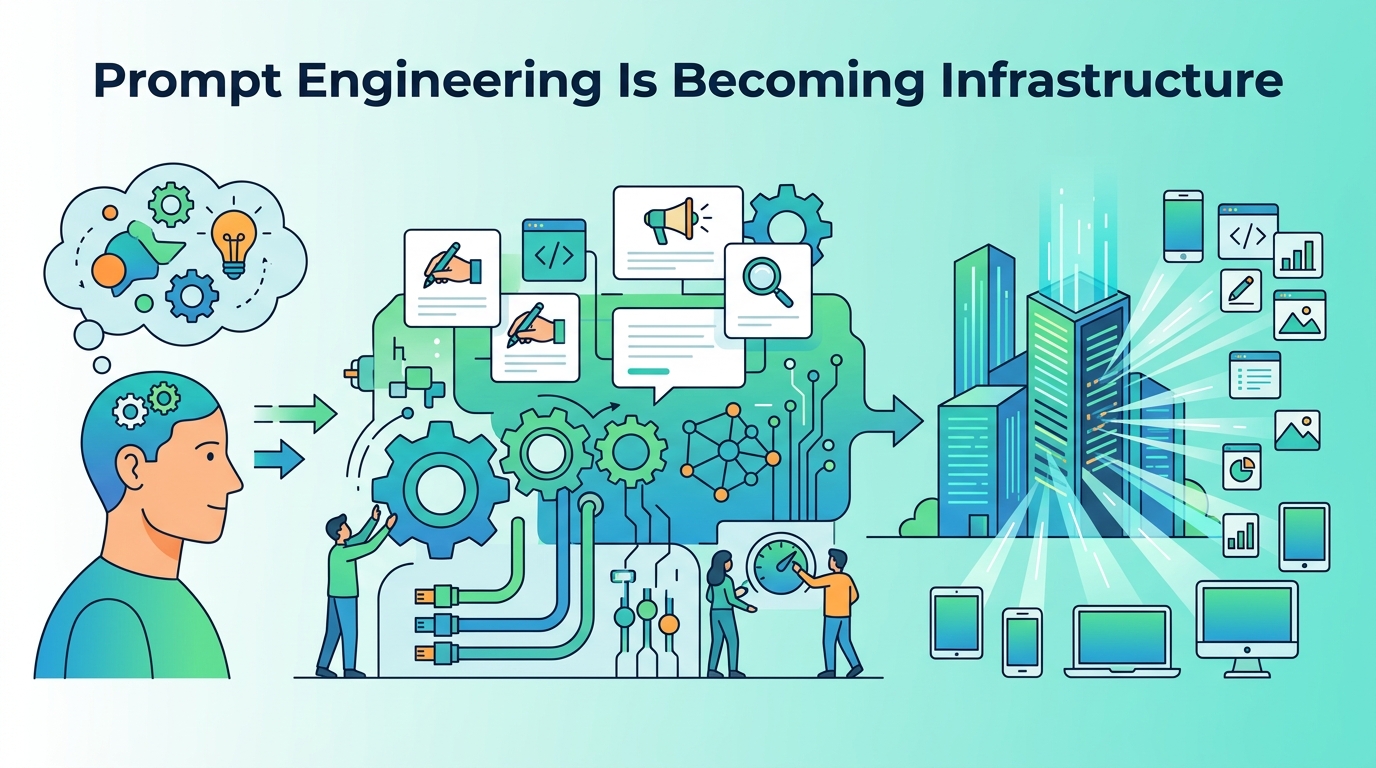
That structure is useful because it gives teams a way to think about maturity. A junior user who knows how to ask a model for a summary is not doing the same work as a product lead designing prompts for thousands of customers. The chapter makes that difference explicit.
Here is the kind of comparison the chapter invites:
- Foundational literacy: understanding model behavior, limits, and prompt basics.
- Cognitive and communicative skill: shaping intent clearly and checking output quality.
- System-level design: embedding prompts into products, services, and workflows.
- Governance: defining review, accountability, and ethical guardrails.
That progression is more useful than the usual “prompt tips” content because it maps to real organizational needs. A company does not need everyone to become a prompt wizard. It needs the right people to know when prompts are a design issue, when they are a risk issue, and when they are a policy issue.
The chapter also makes a subtle but important claim: prompt engineering is becoming infrastructure. That does not mean prompts are as visible as roads or fiber cables. It means they quietly shape how people access information, how decisions get framed, and how institutions interact with AI systems.
For developers, that has a direct implication. If your team ships AI features, prompt design should be treated like an engineering artifact with review cycles, ownership, and failure analysis. If your team has no process for that yet, the chapter is basically telling you that the process already exists, just informally and with more risk.
Why this matters for builders right now
The most interesting part of Tavakoli’s chapter is that it refuses to treat prompt engineering as a fad. It is not presenting prompts as a temporary trick that will disappear once models improve. It is treating prompt work as a durable layer in how humans and models coordinate.
That view lines up with what builders are seeing in production. As OpenAI, Anthropic, and Google Gemini push models into more products, the prompt layer becomes part of the product itself. The quality of that layer affects trust, accuracy, and consistency.
The chapter’s framing also matters for open-source and tooling teams. Prompt management tools, evaluation suites, and policy systems are all growing around the same problem: how do you make model behavior repeatable enough for real use? That question is bigger than prompt wording, and Tavakoli’s chapter gets that right.
- OpenAI Cookbook shows how prompting, evaluation, and tool use connect in practice.
- Anthropic’s prompt engineering docs focus on structure, clarity, and task framing.
- Google Cloud Vertex AI prompting guide treats prompts as part of application design.
- ISO/IEC 42001 gives organizations a management-system lens for AI governance.
That mix of tooling and standards is where the chapter feels most current. It is not arguing for more prompt hacks. It is arguing for process, accountability, and a shared vocabulary for risk.
For OraCore readers, the practical takeaway is simple: if your team uses prompts in production, assign ownership now. Document prompt intent, test failure modes, and decide who reviews changes. The chapter suggests that the next serious AI teams will treat prompt work less like copywriting and more like infrastructure policy.
What happens next
Tavakoli’s chapter makes a strong case that prompt engineering will keep expanding into formal roles, internal standards, and governance structures. The likely next step is not a single new title called “prompt engineer,” but a spread of prompt responsibility across product, compliance, research, and operations teams.
That is the real takeaway: prompt engineering is becoming a discipline of stewardship. The organizations that do well will be the ones that can explain why a prompt exists, who approved it, what it can break, and how it gets updated.
The question now is whether teams will build that discipline before a failure forces the issue. If prompts are already shaping institutional decisions, then the next competitive edge is not who can write the flashiest instruction. It is who can govern the instruction well enough to trust it.
// Related Articles
- [RSCH]
Test-Time Harnesses Transfer Skills Without Retraining
- [RSCH]
DreamFly improves aerial VLN with memory and planning
- [RSCH]
AVA-Encoder turns films into editable knowledge graphs
- [RSCH]
Sparse Autoencoders Don’t Behave Like Feature Bags
- [RSCH]
ConVAWG generates controlled VAWG dialogues
- [RSCH]
Surgical WAM uses video to train robot control