Adopt AI Code Review Without Losing Quality
A practical rollout for AI code review that keeps human oversight intact.

A practical rollout for AI code review that keeps human oversight intact.
This guide is for engineering leads, staff developers, and platform teams that want to add AI code review without weakening their standards. By following the steps below, you will have a layered review process, a safe pilot in one repository, and governance rules that keep humans accountable.
The approach reflects current tools and practices from GitHub Copilot Code Review docs and the CodeRabbit GitHub repository, plus the article’s guidance on using AI as an extra reviewer, not a replacement.
Before you start
Get the latest AI news in your inbox
Weekly picks of model releases, tools, and deep dives — no spam, unsubscribe anytime.
No spam. Unsubscribe at any time.
- GitHub, GitLab, Azure DevOps, or Bitbucket account with repository admin access
- AI code review tool account or trial, such as CodeRabbit, GitHub Copilot Enterprise, or Anthropic’s review system
- Node 20+ or your team’s standard runtime for local checks and CI
- Existing CI pipeline with linting, type checks, unit tests, and security scans
- One high-traffic repository for the first pilot
- Defined pull request review policy and a named engineering owner for rollout
Step 1: Map your review layers
Goal: define a review stack that separates mechanical checks, AI feedback, and human judgment so each layer does one job well.
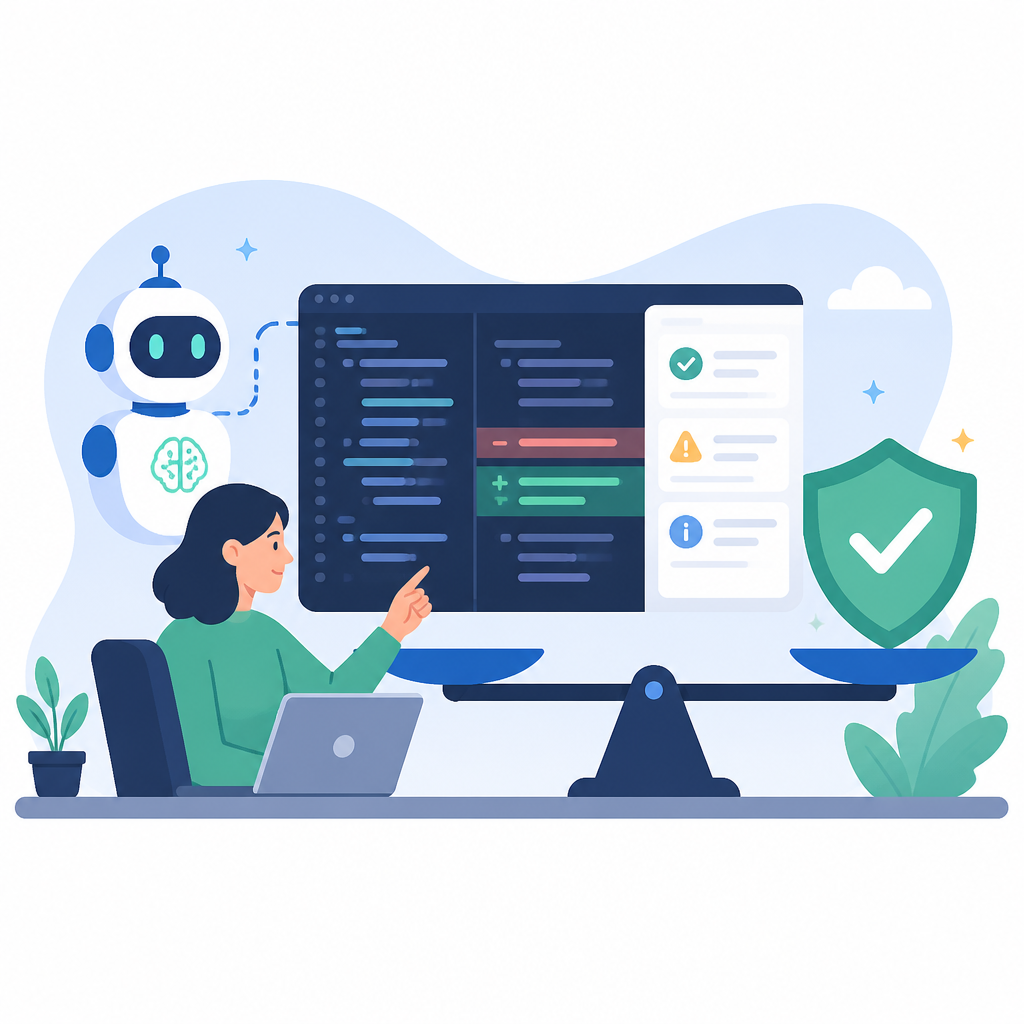
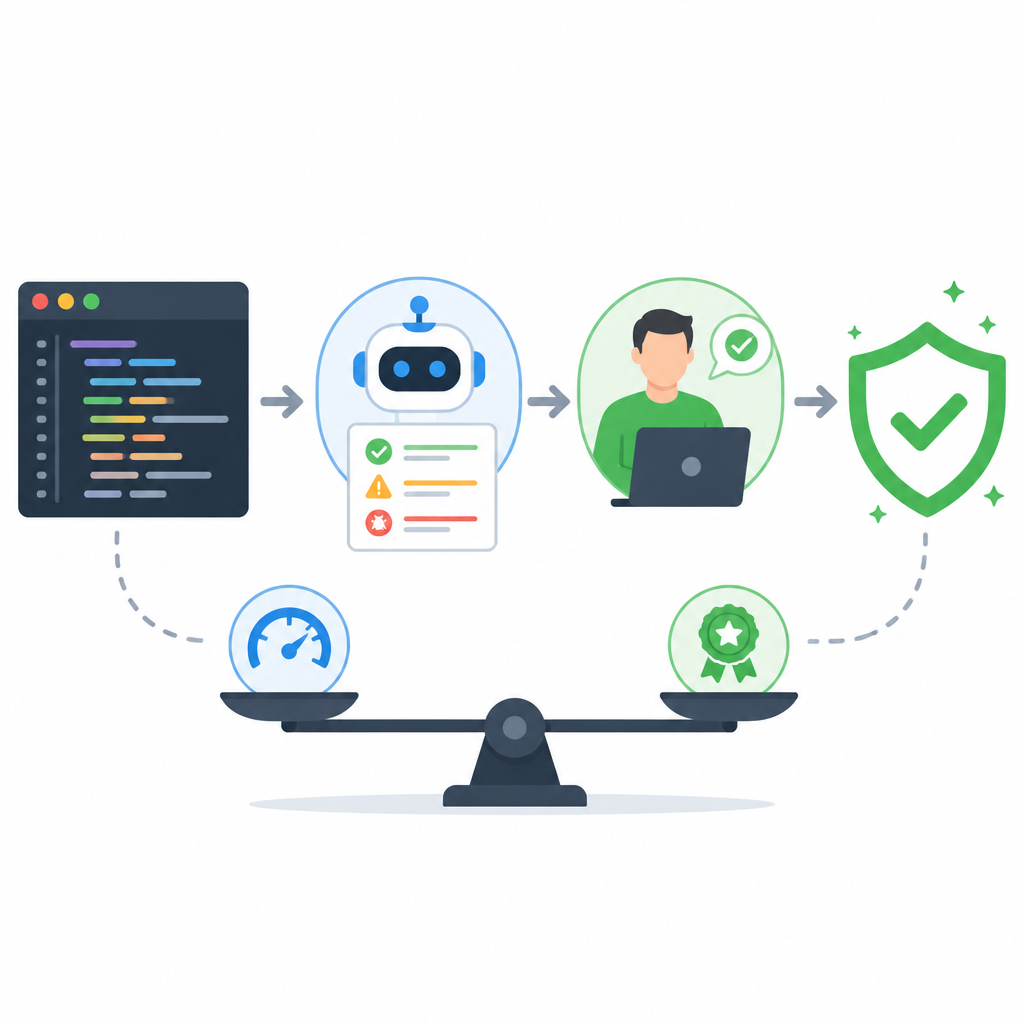
Start by writing down what should happen before merge: static analysis and tests in CI, AI comments on the diff, and a human sign-off on business and architectural concerns. Treat this as your target operating model, not a vague aspiration.
CI gates: lint, typecheck, unit tests, SAST, dependency scan
AI review: logic, security, performance, conventions
Human review: architecture, product fit, edge cases, accountability
You should see a clear division of responsibilities on paper, with no overlap that lets one layer quietly replace another.
Step 2: Pick one pilot repository
Goal: choose a repository where review pain is real enough to measure, but risk is low enough to learn safely.
Select a repo with steady pull request volume, familiar maintainers, and manageable blast radius. Put the AI reviewer in comment-only mode first, with no auto-approval and no merge blocking.
Use a two- to four-week pilot window. During that period, ask reviewers to keep doing normal human review so you can compare AI output against the existing process.
You should see AI comments appear on new pull requests without changing merge rules or slowing the team down.
Step 3: Configure the AI reviewer rules
Goal: tune the tool so it catches useful issues instead of flooding the team with generic noise.
Set severity levels, file scopes, and focus areas to match your codebase. Prioritize logic errors, security anti-patterns, performance regressions, and project-specific conventions. If the tool supports custom prompts or policy files, encode your house rules there.
For example, require extra scrutiny on authentication, payment flows, database migrations, and API contract changes. Those areas should produce stronger AI warnings, not weaker ones.
You should see fewer low-value comments and more feedback that your team would actually act on.
Step 4: Add governance guardrails
Goal: prevent approval fatigue and keep humans responsible for the decisions that matter.
Write a short policy that says AI approval is advisory only. Make human review mandatory for security-sensitive changes, schema changes, and anything touching auth or payments. Rotate reviewers so the same person does not rubber-stamp the same area every week.
Track review behavior in a simple dashboard. If someone approves critical pull requests in a couple of minutes every time, treat that as a signal to investigate, coach, or change the process.
You should see clearer accountability, with human reviewers still reading the code instead of trusting the AI blindly.
Step 5: Measure the pilot results
Goal: prove the rollout is helping before you expand it.
Compare review turnaround time, number of review rounds, AI-detected issues, human-detected issues, and post-merge defects before and after the pilot. Review a sample of AI comments manually to judge precision and relevance.
If you want a simple scorecard, use one row per pull request and capture whether the AI found a real issue, a false positive, or a missed problem. That gives you evidence for tuning and for stakeholder buy-in.
You should see a measurable change in at least one of these metrics, plus enough qualitative signal to decide whether the tool is helping or just adding noise.
Step 6: Roll out to more repositories
Goal: expand adoption without forcing every team into the same workflow at once.
Move from the pilot repo to a second and third repository only after the first team agrees the tool is useful. Keep rollout voluntary where possible, and let teams adopt the reviewer when they see value.
Document the final setup, the guardrails, and the owner for each repo. That makes the process repeatable when other teams ask to join.
You should see the same review pattern working in additional repositories without a spike in false confidence or process confusion.
| Metric | Before/Baseline | After/Result |
|---|---|---|
| Pull request review turnaround | Manual-only review queue | AI-assisted comments arrive before human review |
| Review rounds before merge | Multiple back-and-forth cycles | Fewer clarification cycles after tuning |
| Post-merge defects | Existing defect rate | Lower defect rate when AI, CI, and humans are layered |
| Reviewer engagement | Variable attention on large diffs | More focus on architecture and business logic |
Common mistakes
- Letting AI auto-approve pull requests. Fix: keep AI advisory and require a human sign-off on every merge.
- Turning on the tool for every repository at once. Fix: start with one high-traffic repo and expand only after the pilot is measured.
- Ignoring false positives and noise. Fix: tune rules, severity, and file scopes until the comments are specific and actionable.
What's next
Once the pilot is stable, build a deeper review policy that covers test generation, secure coding checks, and repository-specific prompts, then evaluate whether your team should pair AI review with automated test creation or multi-agent review for larger diffs.
// Related Articles
- [AGENT]
SALA Boosts Long Context on Edge AI
- [AGENT]
Anthropic’s breach proves AI agents need hard security limits
- [AGENT]
GenAI.mil turns a scary prompt into a report
- [AGENT]
EPAM’s OpenAI deal turns pilots into production
- [AGENT]
Prompt engineering is overrated for Claude Code
- [AGENT]
Grok Build adds live previews and rewind fixes