AI capex turns into a debt trap
A developer-style breakdown of Ed Zitron’s case that AI capex is propping up debt, not durable revenue.

I break down why AI capex is turning into debt, not durable revenue.
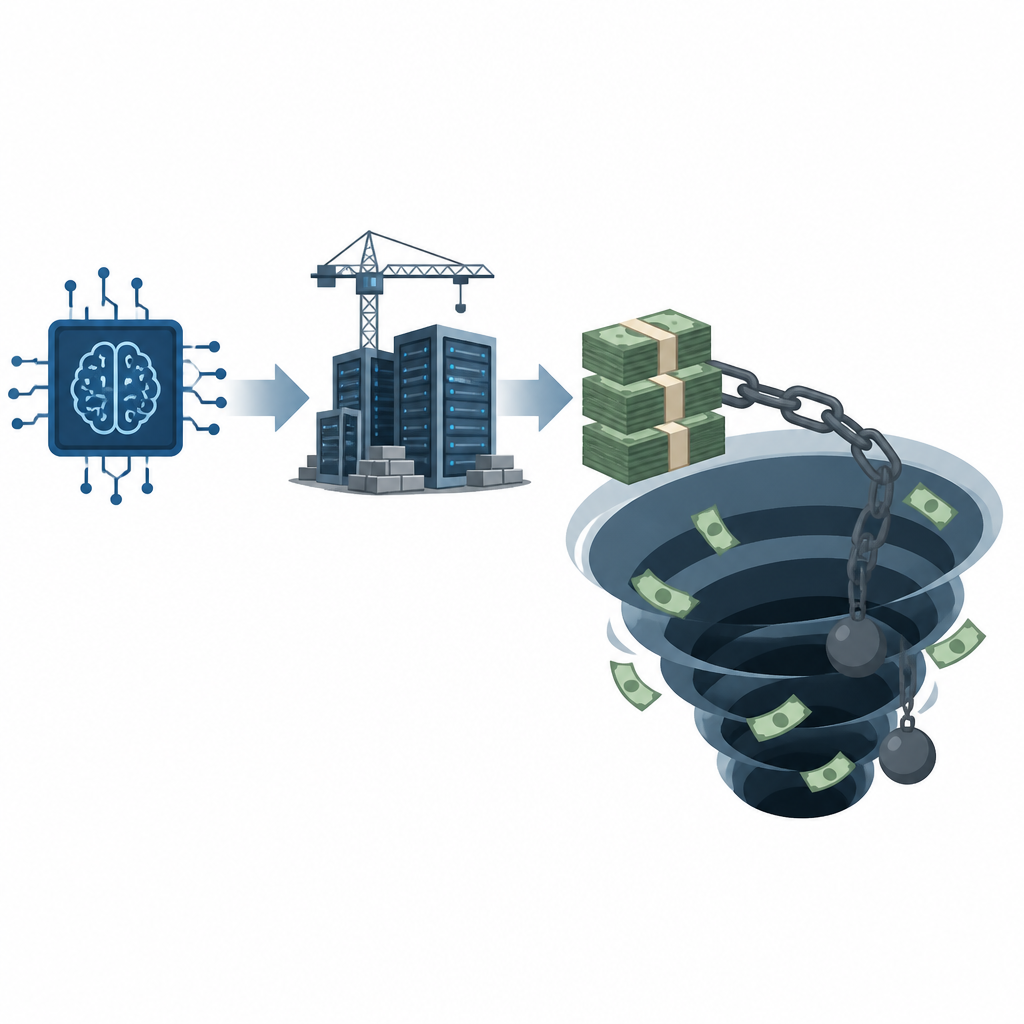
I've been watching the AI spending story for a while now, and honestly, it’s been off from the start. Every quarter, the same ritual: hyperscalers dump more money into GPUs, data centers, and “AI infrastructure,” then everyone pretends the numbers will magically make sense later. They don’t. What I keep seeing is a pile of capex chasing a tiny set of customers, with the whole thing held together by hype, debt, and a lot of squinting at “run rates.”
What really bothers me is how normal this has been made to look. If a startup burned cash like this, we’d call it a problem. If a public company did it without a clear return, we’d call it a warning sign. But because it’s AI, people talk like the spend itself is proof of progress. That’s backwards. The spending is the story, and the story is ugly.
This piece from Ed Zitron on wheresyoured.at is the cleanest version I’ve seen of that argument. It’s not a vibes post. It’s a numbers post, and the numbers are doing a lot of damage to the “this is fine” crowd.
1) The BIS just said the quiet part out loud
Get the latest AI news in your inbox
Weekly picks of model releases, tools, and deep dives — no spam, unsubscribe anytime.
No spam. Unsubscribe at any time.
“The five largest hyperscalers are set to spend over a trillion US dollars on AI-related capital expenditure from 2025 through 2026.”
What this actually means is simple: the biggest cloud companies are spending like demand is guaranteed, even though the return case is still mostly hand-waving. Zitron points to the Bank for International Settlements saying the obvious thing that a lot of people in tech have been dodging for years: if the returns disappoint, financing can snap back hard, and the whole capex machine can turn into a bust.

I’ve run into this pattern in product work too. Teams keep building infra because the last round of spend “already happened,” so now the only acceptable next step is more spend. Nobody wants to be the person who says, “Wait, what if this doesn’t pay off?” That same behavior scales up to hyperscalers, except now the bill has commas and debt markets attached.
How to apply it: when you see giant infrastructure spending, ask two questions before you ask anything else. First, what is the direct revenue source? Second, what happens if that source slows down? If the answer is “we’ll figure it out later,” that is not a strategy. That’s a pressure cooker.
2) OpenAI and Anthropic are not customers, they’re anchors
“Anthropic and OpenAI… are not startups, but subsidiaries of big tech that only exist as separate arms as a means of pumping equity positions and hiding the truth.”
This is the part that makes the whole system feel brittle. Zitron’s argument is that the AI economy is not broad-based. It’s concentrated. Hyperscalers are burning billions to support a small number of model labs, and those model labs are, in turn, burning billions to buy the same compute back. That’s not a healthy market. That’s a loop.
He says OpenAI and Anthropic account for a huge share of hyperscaler remaining performance obligations, and even if you don’t accept every estimate he gives, the shape of the problem is hard to miss. If a small number of buyers are doing most of the buying, then the “market” is really just a few giant balance sheets talking to each other.
I’ve seen this dynamic in enterprise software too, where one whale customer can distort an entire roadmap. The difference here is scale. When the whale is OpenAI, the whole ocean starts looking fake.
- Few customers means fragile revenue.
- Fragile revenue means debt becomes scarier.
- Debt plus hype means people start confusing activity with durability.
How to apply it: if you’re evaluating an AI vendor or investing in one, map the customer concentration. Not the “logo wall” on the homepage. The actual revenue mix. If one or two names are carrying the business, you do not have a diversified company. You have dependency risk with a nicer website.
3) “Run rate” is the favorite lie in this market
“They are continuing to invest… and the markets, analysts and journalists are acting as if everything is fine.”
What this actually means is that people keep using annualized snapshots to disguise weak economics. Zitron calls out Microsoft’s AI “run rate” language directly. A run rate is just a month stretched into a year and dressed up like certainty. It is one of the oldest tricks in the book, and somehow it still works.
I hate this one because it shows up everywhere. A dashboard says one thing for one month, and suddenly it becomes a narrative. But a month is not a business. A quarter is barely a business. A real business survives weird months, bad months, and customers who don’t behave like the pitch deck promised.
Zitron’s point is that the reported AI revenue is tiny compared to the capex required to support it. In other words, even the best-case public numbers do not justify the spend. If the only thing keeping the story alive is a run rate, the story is already weak.
How to apply it: never evaluate AI revenue on a run-rate headline alone. Ask for actual realized revenue, margin, and the cost to serve that revenue. If the company won’t give you those numbers, assume the gap is doing a lot of work.
- Run rate = snapshot, not proof.
- Revenue without margin is incomplete.
- Capex without payback is just expensive theater.
4) Oracle is the cautionary tale nobody wants to read
“Oracle has massively leveraged itself for the benefit of one company, OpenAI, and if that company can’t pay its bills, it’s fucked.”
This is where the article gets especially sharp. Oracle is not some scrappy neocloud. It’s an old, heavily indebted giant that decided to bet harder on AI compute because its core business was already slowing down. Zitron lays out the debt, the lease commitments, and the negative free cash flow, then ties it back to the one customer problem.
What this actually means is that AI is not just expensive for the labs. It is expensive for everyone upstream who decided to finance the labs. Oracle is basically turning itself into a giant financing vehicle for OpenAI, and that’s a wild thing to do when the customer can’t pay the bill on its own.
I’ve been in enough platform planning meetings to know how this starts. Someone says the demand is strategic, so they greenlight buildout. Then the buildout creates sunk cost pressure. Then sunk cost pressure gets renamed “commitment.” Before long, everyone is pretending the original assumption was stronger than it was.
How to apply it: if your infrastructure plan depends on one buyer, treat that buyer like a single point of failure. Stress test it. Ask what happens if the buyer halves spend, delays payment, or negotiates harder. If your model collapses, it wasn’t a model. It was hope with a spreadsheet.
5) The semiconductor boom is real, but that doesn’t make it sane
“Record sales across NVIDIA, Micron, Sandisk, SK Hynix, and Samsung are a direct result of an entirely speculative asset bubble.”
This is the part people keep messing up. A revenue surge in chips does not automatically mean the underlying demand is durable. It can just mean a lot of companies are buying ahead of need because they’re afraid of missing the next wave. That can still create real sales. It can still create real profits. It can also still be a bubble.
Zitron’s point is that the semiconductor boom is downstream of speculative capex, not proof of healthy end demand. If the capex slows, the chip orders slow. If the chip orders slow, the whole stack gets uglier fast. That’s why this matters beyond NVIDIA. It’s not just about one vendor winning. It’s about whether the demand base is real enough to support the entire chain.
I’ve seen this in cloud migrations too. Everyone rushes to buy capacity because everyone else is buying capacity. Then the actual workload growth shows up later, if it shows up at all. The invoice arrives on time. The demand does not.
How to apply it: separate “inventory build” from “end-user demand.” If the top-line growth is mostly upstream stocking, you need to be very careful about assuming permanence. That’s where people get trapped.
6) The whole thing only works if AI turns into something else
“There is no cogent or rational argument in favor of continued capital expenditures… without a tacit acceptance that much of the current spend has been a waste.”
This is the heart of the article. The current AI spending regime only makes sense if model labs become something radically more valuable than they are today. Not better autocomplete. Not “agentic workflows” in a slide deck. Something that produces enough new revenue to justify trillions in infrastructure and debt.
What this actually means is that the market is funding a future that does not exist yet, while pretending it already does. Zitron’s argument is that the current spend is not supported by current returns. The only way to defend it is to say the future will be so different that today’s math won’t matter. That is a very expensive bet.
I don’t buy the idea that you can keep scaling capex forever just because the narrative says the models are getting better. Better at what, exactly? If the answer is still “we’re figuring out the use cases,” then you’re not in a mature market. You’re in a funding round.
How to apply it: when someone pitches more AI spend, ask them to name the exact product behavior that changes, the user segment that pays for it, and the margin profile that makes it worth the build. If they can’t connect those three things, stop treating the spend like strategy.
The template you can copy
# AI capex risk review template

## 1. What is the spend?
- Annual capex:
- AI-specific capex:
- Debt used to fund it:
- Lease commitments:

## 2. Who pays for it?
- Direct customers:
- Concentration risk:
- Top 3 customer share of revenue:
- Dependency on one model lab or one hyperscaler:

## 3. What revenue is real?
- Actual booked revenue:
- Revenue reported as run rate:
- Gross margin:
- Operating margin:
- Payback period:

## 4. What breaks first?
- If customer spend drops 25%:
- If financing tightens:
- If utilization falls:
- If model quality stalls:

## 5. What should I ask in the meeting?
- What exact workload justifies this spend?
- Which customer is paying today?
- What happens if that customer pauses for two quarters?
- What debt or lease obligations are attached?
- What numbers are you not showing me yet?

## 6. Decision rule
If the business depends on future AI revenue that is not yet proven, treat the spend as speculative until actual margins and customer demand prove otherwise.
I built this template the way I wish more AI spending reviews were run: less theater, more accounting. It forces the conversation away from model demos and back toward cash, customers, and obligations. That’s where the real risk lives.
Use it for vendor reviews, internal budget requests, and any pitch that smells like “we’ll make it back later.” If the numbers are strong, this template will still work. If the numbers are weak, it will expose that fast.
The point of Zitron’s piece isn’t that AI is fake. It’s that the current financing structure is doing most of the work, and that structure is a lot shakier than the boosters want to admit. I think that’s the part people keep missing because it’s less sexy than talking about model capability. But it’s the part that decides who gets stuck holding the bag.
Source: Ed Zitron’s The AI Industry Is Losing at wheresyoured.at. I’m not claiming the template is original to Zitron; it’s my derivative developer-facing version of his argument, built to help you apply the same logic in reviews, planning docs, and budget conversations.
// Related Articles
- [IND]
Grok 4.6 matches top models as SpaceX eyes worker data
- [IND]
Wall Street Should Put Real Assets On Blockchains, Not Just Pilot Them
- [IND]
WorkBuddy Skills: 5 picks that fit real office work
- [IND]
GLM-5.3’s coding gains came from post-training
- [IND]
Anthropic’s data center push now has big capital backing
- [IND]
DailyArxiv turns arXiv keywords into a daily paper feed