AlphaFold’s breakup turns science into Gemini work
I break down Google DeepMind’s AlphaFold team shuffle and give you a copy-ready template for mapping research teams to product bets.
AlphaFold’s research team got split up and reassigned into Gemini and drug discovery work.
I've been watching Google DeepMind for a while, and this one landed with a dull thud. AlphaFold was the rare AI project that didn’t feel like a demo chasing its own reflection. It solved something real, shipped something useful, and gave researchers a tool they could actually use. That’s why the news that the AlphaFold team has been disbanded feels off in a very specific way. Not because teams never move. They do. Constantly. But because this was the team that looked like proof Google could still do patient, science-first work without immediately turning everything into product theater.
And now the story is basically: some people moved to Gemini, some went to Isomorphic Labs, some left, and the original unit is gone. If you’re building inside a company, you can probably feel the pattern already. The work that wins awards gets absorbed into the work that wins budgets. That’s not always wrong. It just means the org chart is telling you what the company values next.
I’m using the Engadget report as the trigger here, which cites Financial Times and DeepMind’s own statement. The key detail isn’t a single dramatic firing or shutdown. It’s the reallocation: staff moved to Gemini-focused projects, others reassigned to Isomorphic Labs, and a few people already gone. That’s the part worth unpacking, because it says more about Google’s current strategy than any polished blog post ever would.
AlphaFold didn’t die, it got absorbed
Get the latest AI news in your inbox
Weekly picks of model releases, tools, and deep dives — no spam, unsubscribe anytime.
No spam. Unsubscribe at any time.
“Google has reassigned some of the team's key members and the original authors of its papers to both Gemini-related projects and scientific research endeavors, while a few others have already left the company.”
What this actually means is simple: the standalone AlphaFold team is gone, but the capability didn’t vanish. Google is moving the people, the expertise, and probably the institutional memory into other buckets. That’s a very different thing from killing the underlying technology. In big companies, this is how a successful research line gets retired without anyone wanting to say “retired.”
I’ve seen this pattern before. A team builds something that proves the company can do serious work. Then leadership decides the next phase is not “keep this team intact,” but “spread these people across the bets that matter now.” The skill gets preserved. The identity gets dissolved. If you’ve ever watched a great internal platform team get chopped into product squads, you know the feeling.
AlphaFold’s record makes the move even stranger. DeepMind started in 2018, cracked the protein folding problem in 2020, published the methodology and whole-human-proteome predictions in Nature in 2021, and released the AlphaFold Protein Structure Database so researchers could use over 200 million predictions. That’s not a vanity project. That’s infrastructure for biology.
So when I read that the team is being broken up, I don’t read “failure.” I read “the company thinks the next central story is elsewhere.” In this case, elsewhere is Gemini. That tells me the science org is no longer the center of gravity. It’s a feeder system.
How to apply it: if you run a team, watch for the moment your work stops being protected as a unit and starts being mined for talent. That’s the point where the company is saying the artifact matters less than the people who built it. If you’re inside that shift, document the methods, the decision history, and the operational bits before the org gets rearranged and everyone pretends continuity is automatic.
The real headline is the Gemini pull
“This represents Google's decision to put more and more of its resources into developing Gemini.”
That line is the whole story. AlphaFold is not being treated as the main corporate engine anymore. Gemini is. And once you see that, the rest makes sense: the people get reassigned, the research gets redistributed, and the company’s narrative tightens around its flagship model family.
What this actually means is that Google is choosing concentration over breadth. It wants fewer heroic side quests and more muscle behind the model line it believes can carry the business. That’s a rational move if your board wants a clear AI story. It’s also a little brutal if you care about the weird, high-value work that doesn’t fit neatly into a chatbot-shaped funnel.
Pushmeet Kohli, DeepMind’s VP of research, said, “Our strategy over the last nine years has been to focus on grand challenges... a concrete goal every project is focused on,” and then added, “The strategy has evolved.” That’s corporate language doing what corporate language does: admitting a pivot while trying to make it sound continuous. I don’t hate it, but I also don’t buy the idea that this is just a natural evolution with no tradeoff.
The tradeoff is focus. Gemini gets more of it. AlphaFold gets folded into the broader machine. If you’re building AI products, this is the part to pay attention to, because it mirrors what happens in a lot of teams once one model family becomes the strategic center. Everything else becomes support work, even if it used to be the crown jewel.
- Gemini becomes the umbrella story.
- Specialized research gets routed into product-adjacent work.
- Scientific wins become proof points for the broader platform.
How to apply it: if your company has multiple AI efforts, write down which one gets the executive airtime, the hiring budget, and the “we should build around this” language. That’s the actual strategy. Not the slide deck. Not the blog post. The budget trail.
AlphaFold was never just a model
“AlphaFold is an AI program that can accurately predict three-dimensional structures of proteins from their amino acid sequences in minutes instead of years.”
That sentence is why the team mattered. AlphaFold wasn’t a language model with a science label slapped on top. It was a domain tool with real consequences. Predicting protein structures faster changes how researchers think about drug discovery, vaccines, and disease mechanisms like Alzheimer’s and Parkinson’s. That’s not abstract utility. That’s lab workflow.
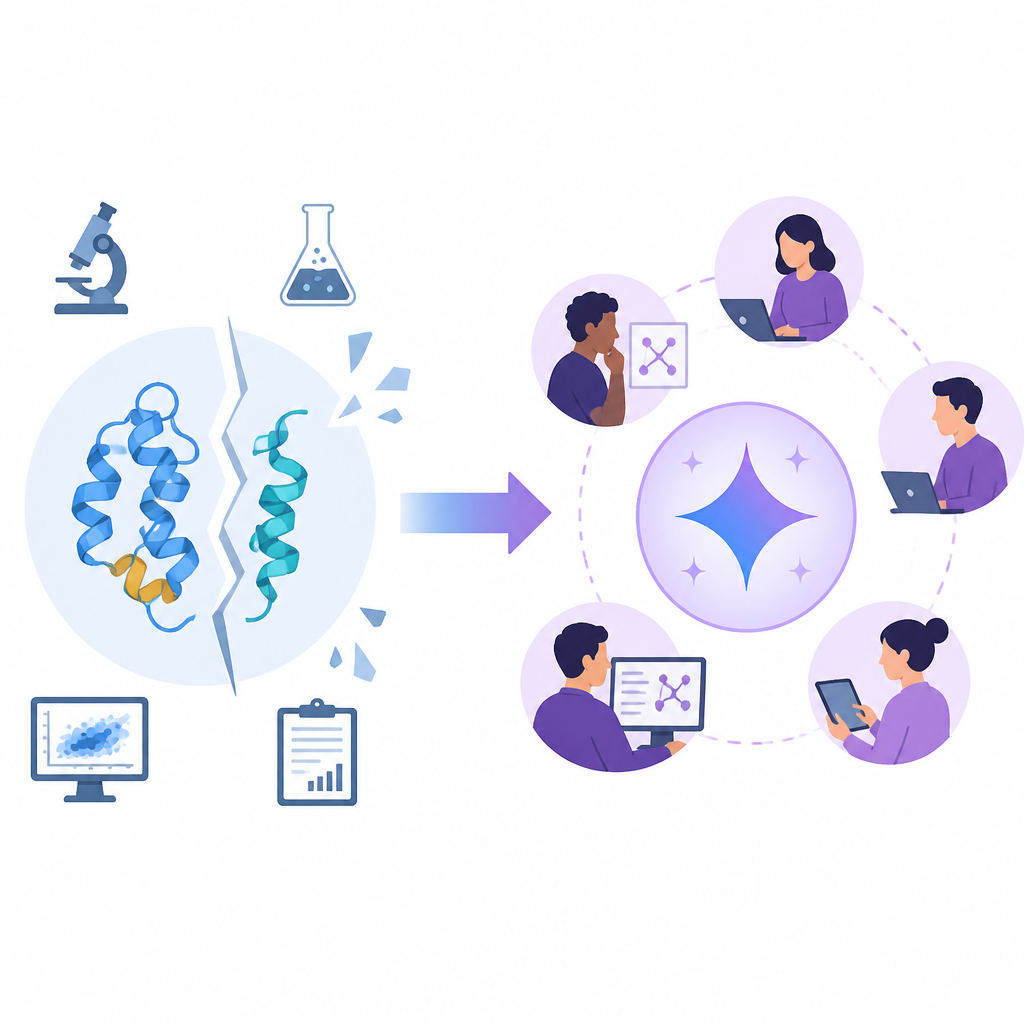
I think this is where a lot of AI coverage gets lazy. People hear “AI” and assume the same story applies everywhere. It doesn’t. A model that helps a biologist do work faster is not the same beast as a model that writes your email. The AlphaFold team earned its reputation because it solved a hard, specific problem that the field had been stuck on for decades.
DeepMind’s release of the database mattered just as much as the model itself. Free access to 200 million predictions is the kind of thing that changes who gets to do the work. It lowers the barrier for labs that don’t have giant compute budgets or in-house ML teams. That’s the part I’d hate to see lost in the shuffle.
And yes, the Nobel Prize matters here too. In 2024, Demis Hassabis and John Jumper won the Nobel Prize in Chemistry for AlphaFold. That’s about as close as a software team gets to a permanent stamp of legitimacy. Which makes the breakup even more telling. Awards don’t protect org structure. They just make the restructuring look more intentional.
How to apply it: if you’re building a specialized AI tool, don’t only measure model quality. Measure whether the tool changes who can participate, how fast they can move, and what downstream work becomes possible. That’s the real moat for applied research.
The people move, and the knowledge moves with them
“DeepMind has confirmed to the Times that it also moved staff members internally to Gemini-focused projects.”
This is the part that matters operationally. Companies love to talk about “knowledge transfer” as if it’s a clean handoff. It isn’t. Knowledge lives in the people, in the tiny habits, in the weird edge cases someone remembers because they were there when the thing broke at 2 a.m.
I ran into this years ago on a platform team. We thought we were being smart by moving senior people into a new initiative and leaving docs behind for everyone else. The docs were fine. The results were not. The docs didn’t know which assumptions had already failed, which shortcuts were temporary, or which corner cases had become folklore. The people did.
That’s why the AlphaFold move matters beyond the headline. If the same researchers are now working on Gemini or Isomorphic Labs, then Google isn’t just reallocating headcount. It’s redirecting deep technical memory into higher-priority bets. That can work. It can also flatten the unique culture that made the original work possible.
There’s also a subtle risk here: when a research team gets absorbed into a bigger model effort, the specialized problem starts competing with general-purpose priorities. If you’re not careful, the original mission becomes “help the main model look smart” instead of “solve the domain problem.” Those are not the same job.
- Keep a written record of the original research goal.
- Preserve evaluation metrics tied to the domain, not just the parent model.
- Track who owns the problem after the reorg, not just who got moved.
How to apply it: after any team reshuffle, ask one question in writing: “What problem does this group now exist to solve?” If the answer is vague, the team is already drifting.
Isomorphic Labs is the quiet tell
“Other former staff members were reassigned to Alphabet's drug-discovery company Isomorphic Labs.”
This detail is easy to miss, but I think it’s one of the most interesting parts of the whole story. Isomorphic Labs is a DeepMind spin-off focused on drug discovery, so it’s not like Google is throwing AlphaFold talent into random product work. It’s trying to keep the scientific thread alive in a more commercially legible wrapper.
That’s the compromise, right? Gemini gets the central AI narrative. Isomorphic Labs gets the biological application story. AlphaFold as a standalone team gets dissolved, but its people are still being used in places where their expertise actually matters. From a management perspective, that’s tidy. From a research-culture perspective, it’s a little sad.
I don’t think this means Google has given up on science. I think it means science now has to justify itself through the company’s current strategic lanes. If it can be tied to Gemini, great. If it can be tied to drug discovery with a spin-off, also great. If it can’t be neatly routed, it probably gets less room.
That’s the real lesson for anyone running technical teams inside a large organization. The company may still love the work. It just loves a clearer narrative more. And narratives, unfortunately, tend to eat structure for breakfast.
How to apply it: if you’re trying to protect a specialized team, give leadership two versions of the story. One version for the company narrative, one version for the technical mission. If you only give them the narrative version, they’ll eventually repurpose the team into something more convenient.
The template you can copy
# Team Reallocation Note: From Research Unit to Strategic Platform Work

## What changed
We are moving members of [original team] into [new strategic area] and [adjacent specialized group]. The original standalone team will no longer operate as a separate unit.

## Why we are doing this
The company is concentrating resources on [primary strategic bet]. The expertise built in [original team] is still valuable, but it now serves a broader set of priorities.

## What stays the same
- The core technical knowledge remains in the company.
- Existing research artifacts, docs, and benchmarks should be preserved.
- Ongoing domain-specific work continues under [new owner/team].

## What changes for the team
- Members will report into [new org/team].
- Success metrics will be updated to match the new mission.
- Any domain-specific roadmap items must be revalidated under the new ownership.

## Questions we need answered
1. Which problem is this group now responsible for?
2. Which metrics still matter from the old team?
3. What gets deprecated, and who decides?
4. What knowledge needs explicit transfer before the reorg completes?
5. What artifacts should be archived so the original work doesn’t get lost?

## Copy-ready transition checklist
- [ ] Name the new strategic owner.
- [ ] List the domain-specific outcomes that must survive.
- [ ] Identify the people whose knowledge is most critical.
- [ ] Preserve evaluation data and benchmark history.
- [ ] Publish a short FAQ for affected teams.
- [ ] Set a review date to confirm the new structure is working.

## One-sentence summary
We are not deleting the work; we are moving the expertise into the places where the company has decided it matters most.
If I were turning this into an internal memo, I’d keep it brutally plain. No slogans. No “exciting new chapter.” Just state what changed, where the people went, what problem they now own, and what has to be preserved before the old team disappears into the org chart.
That’s the part that usually gets skipped, and then everyone acts surprised when the specialized knowledge evaporates six months later.
Source: Engadget, which cites the Financial Times report and includes DeepMind’s statement. My breakdown is original, but the underlying facts and quotations come from that reporting and the linked company comments.
// Related Articles
- [IND]
The Rust-to-Zig rewrite is already past the hard part
- [IND]
Nvidia backs open AI security alliance with 20+ partners
- [IND]
Kimi K3 pushes open-weight AI toward default
- [IND]
Anthropic’s open-model fight reveals its lonely AI stance
- [IND]
Immich Docker Compose setup that avoids common errors
- [IND]
Millions Raised for Zhipu-style Social World Model