Anthropic’s $35 billion buildout proves AI now runs on finance and ch…
Anthropic’s new $35 billion capacity plan shows AI scaling is now a capital markets and infrastructure game.

Anthropic’s new $35 billion capacity plan shows AI scaling is now a capital markets and infrastructure game.
Anthropic’s $35 billion expansion is not just a bigger compute order. It is proof that frontier AI has crossed into a new phase where asset managers finance the hardware, chipmakers design the stack, and model labs become industrial buyers of power, networking, and custom silicon.
AI scale is now a balance-sheet problem
Get the latest AI news in your inbox
Weekly picks of model releases, tools, and deep dives — no spam, unsubscribe anytime.
No spam. Unsubscribe at any time.
The first thing this deal makes clear is that training and serving frontier models no longer fits inside normal venture funding cycles. Apollo and Blackstone are stepping in because the bill for compute has outgrown the patience of traditional startup capital. When a single expansion reaches $35 billion, the real constraint is not ambition. It is financing.

This matters because it changes who has leverage in AI. A lab that needs billions in capacity must answer to lenders, lessors, and infrastructure partners, not just product users. That shifts AI from a software story to an asset story, where uptime, depreciation, and utilization rates matter as much as model quality.
Broadcom’s role shows the winners are moving up the stack
Broadcom’s custom chips and networking gear are central to the tie-up, and that is the second signal worth reading carefully. The most valuable position in AI is no longer only the model API or the cloud wrapper. It is the layer that controls specialized hardware, interconnects, and the architecture that keeps giant clusters running efficiently.
That is why this kind of partnership is so powerful. Custom silicon reduces dependence on off-the-shelf supply, while tightly integrated networking improves performance at scale. In practice, that means the chipmaker is not just a vendor. It becomes a strategic enabler of the model company’s growth curve, with pricing power and long-term stickiness to match.
The compute race is becoming an industrial supply chain
There is a reason this announcement reads more like a factory expansion than a product launch. Frontier AI needs electricity, cooling, land, chips, fiber, and financing in one coordinated system. The era of a few rented GPUs and a clever team is over at the top end of the market.
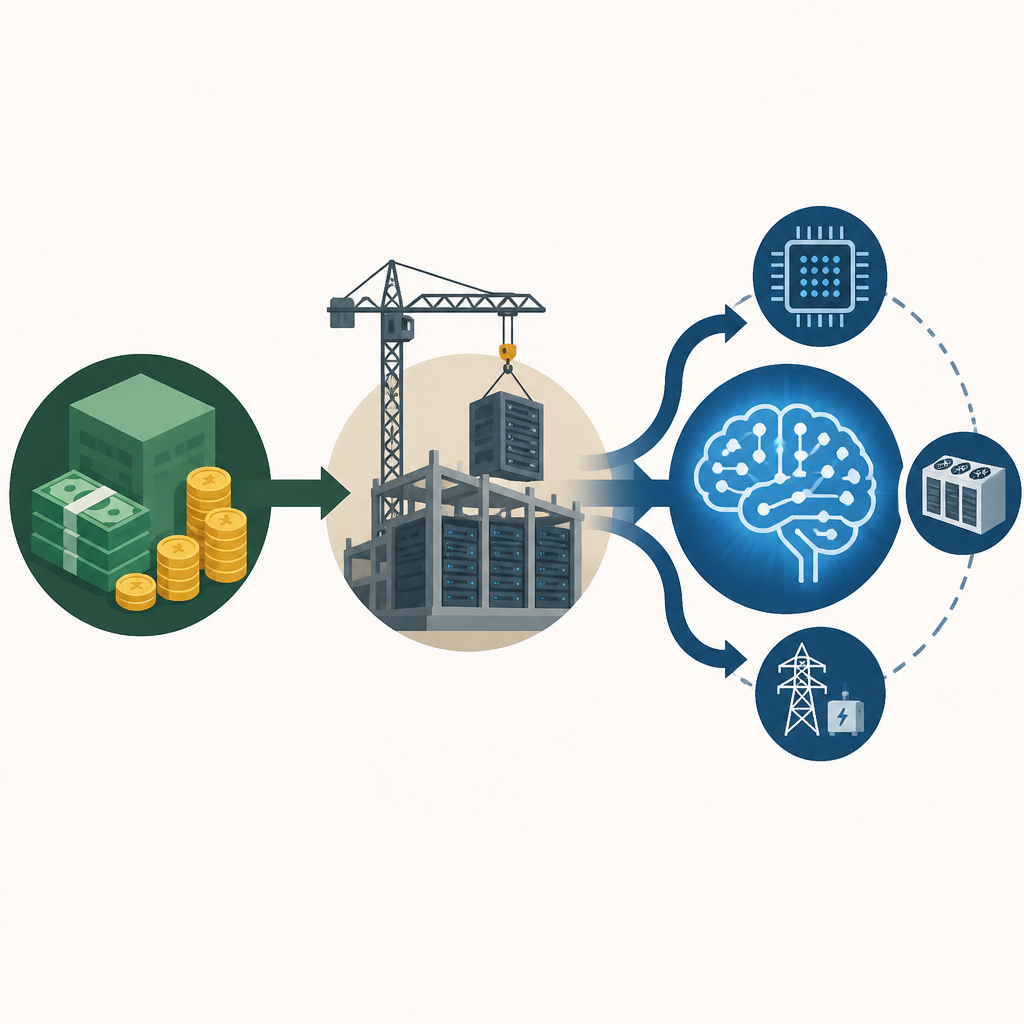
We have already seen the pattern in the broader AI boom: the companies that control scarce infrastructure capture durable advantage. This deal extends that logic. If Anthropic can secure capital and Broadcom can deliver the right hardware stack, the bottleneck moves from experimentation to deployment. That favors players who can execute like industrial operators.
The counter-argument
The strongest objection is that this is dangerous concentration. A handful of giant firms and financiers are locking up the compute supply, pushing the market toward overbuild, and making AI dependent on debt-like structures that punish any slowdown in demand. If model progress stalls, expensive capacity can turn into stranded assets fast.
That concern is real, and it should not be dismissed. AI spending has a history of outrunning near-term revenue, and the scale of this commitment raises the stakes. But the rebuttal is simple: frontier AI already requires industrial capital, and pretending otherwise would only hand the market to the best-capitalized incumbents later. The risk is not that this model exists. The risk is that it is financed without discipline. This deal is rational because it aligns long-duration infrastructure with long-duration demand.
What to do with this
If you are a founder, engineer, or PM, treat AI infrastructure as strategy, not plumbing. Build with cost per token, cluster efficiency, and supply security in mind from the start. If your product depends on frontier models, assume access to compute will be a competitive moat, and design your roadmap around partnerships that lock in capacity before the market tightens again.
// Related Articles
- [IND]
AlphaFold’s breakup turns science into Gemini work
- [IND]
The Rust-to-Zig rewrite is already past the hard part
- [IND]
Nvidia backs open AI security alliance with 20+ partners
- [IND]
Kimi K3 pushes open-weight AI toward default
- [IND]
Anthropic’s open-model fight reveals its lonely AI stance
- [IND]
Immich Docker Compose setup that avoids common errors