Anthropic’s daily brief turns news into a workflow
A plain-English breakdown of Anthropic’s AI brief, plus a copy-ready template for turning news into usable notes.

Anthropic’s AI brief turns scattered updates into a usable daily workflow.
I’ve been reading AI briefings for a while now, and most of them feel like a firehose with a nicer font. Too many headlines, too much context missing, and somehow I still end up opening five tabs just to figure out what actually changed. This one caught my eye because it looked less like a news dump and more like someone trying to compress the day into something I could actually use before my coffee got cold.
What I wanted was simple: tell me what matters, tell me what changed, and don’t make me reverse-engineer the point. The problem with a lot of AI roundups is that they’re written like they expect me to admire the volume. I don’t care about volume. I care about whether I can turn the update into a decision, a note, a prompt, or a task. That’s the bar.
The source here is a Zhihu post titled 【速览】AI 早报 2026-07-07. The excerpt I can see mentions Anthropic’s Claude Sonnet 5, a restored access update for Claude Fable 5 and Mythos 5, and a research AI workstation app called Claud… The post is clearly trying to package multiple AI updates into one daily briefing, but the snippet doesn’t give me the full article body, so I’m treating this as a structural breakdown of the briefing style, not a claim about every item in the full post.
Stop treating the brief like reading material
Get the latest AI news in your inbox
Weekly picks of model releases, tools, and deep dives — no spam, unsubscribe anytime.
No spam. Unsubscribe at any time.
AI 早报 2026-07-01概览要闻 Anthropic 发布 Claude Sonnet 5 模型 #1 Anthropic 宣布 Claude Fable 5 与 Mythos 5 出口管制已被解除 次日恢复访问 #2 Anthropic 推出科研 AI 工作台应用 Claud…
What this actually means is: the brief is not trying to be literature. It’s trying to be a control panel. You scan it, extract the delta, and move on. If I’m honest, that’s the only way these things are useful. The moment a daily AI roundup starts pretending to be a deep analysis piece, I stop trusting it.
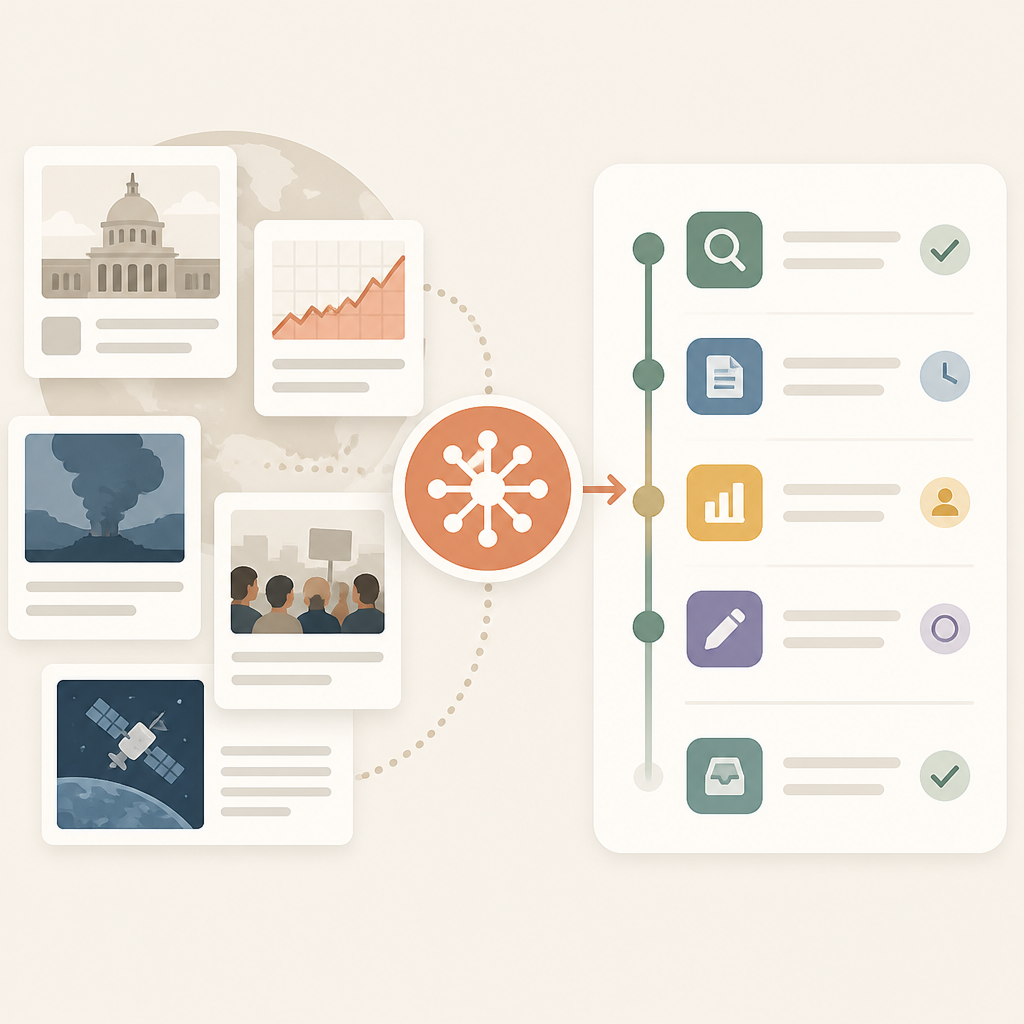
I ran into this constantly when I used to save every AI newsletter “for later.” Later never came. What came instead was a pile of unread tabs and a vague sense that I was missing something important. The useful version of a brief is the one that helps me answer three questions fast: what launched, what changed, and what should I do next.
How to apply it: write your own daily AI brief as an operator’s note, not a reader’s essay. Each item should earn its place by answering one of these:
- What shipped?
- What policy or access change happened?
- What can I test, adopt, or ignore today?
If an item can’t answer one of those, it’s probably filler.
The headline is the product, not the decoration
The snippet names three concrete things: Claude Sonnet 5, a restored access update for Claude Fable 5 and Mythos 5, and a research workstation app. That’s a good pattern because it puts the nouns up front. No warm-up, no throat clearing, just the thing.
What this actually means is that a brief should read like a changelog with context, not a magazine cover. I’ve seen too many AI updates hide the actual change behind a clever intro. That wastes time. If the model name or product name matters, put it in the first line. If access changed, say access changed. If there’s a new app, say what kind of app it is.
I like this format because it lets me triage fast. When I’m scanning a day’s worth of AI news, I’m not looking for elegance. I’m looking for signals. A model release is one signal. A policy reversal is another. A research tool is another. Different buckets, different reactions.
How to apply it:
- Start each bullet with the proper noun that matters most.
- Use one line for the event, one line for the implication.
- Don’t bury the company name or product name in the middle of the sentence.
If I were rewriting this for my own team, I’d make the first pass brutally literal. Then I’d add context only where it changes the action.
Model releases need a second line, not applause
“Anthropic 发布 Claude Sonnet 5 模型 #1” is exactly the kind of line that gets overhyped in other writeups. A lot of people would stop there and start guessing benchmark wins, pricing shifts, or agent behavior changes. But the brief itself doesn’t do that, and I think that restraint is healthy.
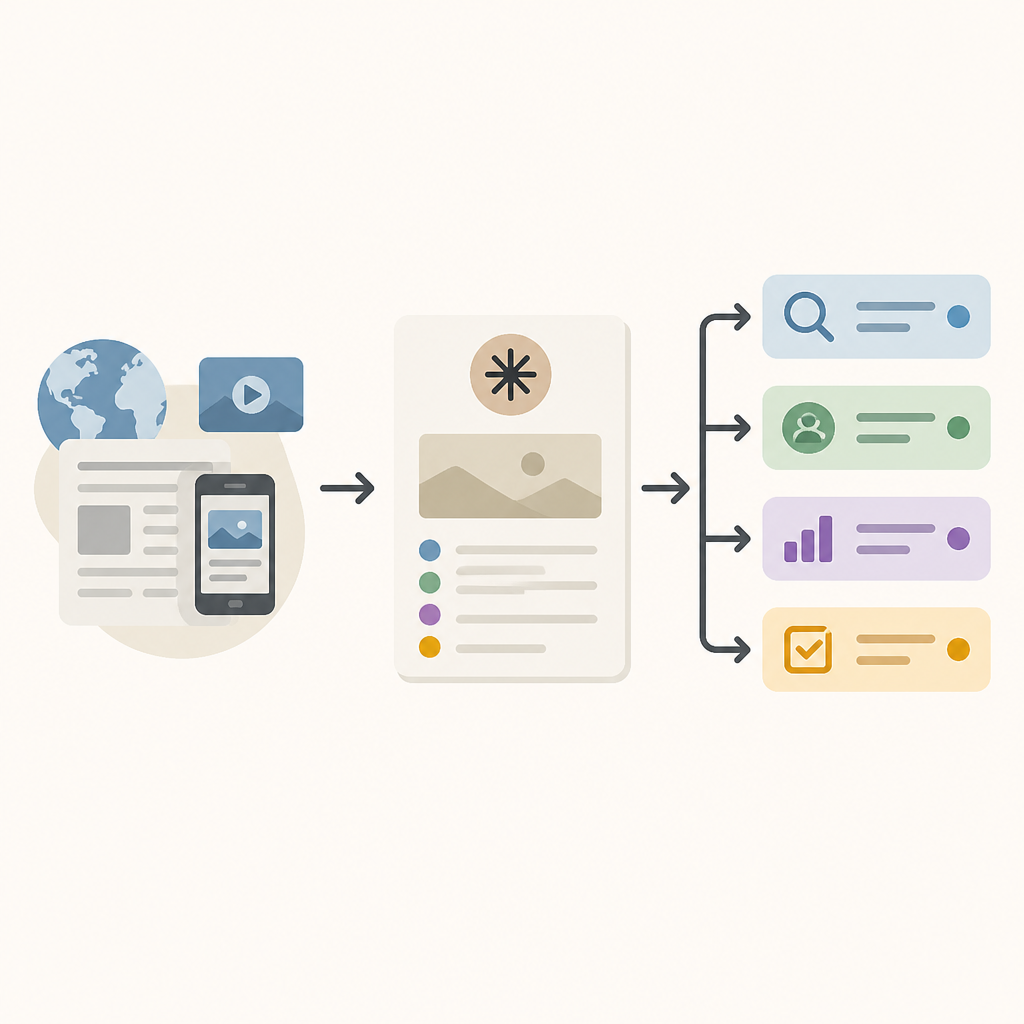
What this actually means is: a release note is just a starting point. The real value comes from the next line, the one that tells me whether this model changes my stack. Does it improve tool use? Is it cheaper? Does it change latency? Can I swap it into an existing workflow without rewriting half my prompts? That’s the stuff I care about.
I’ve been burned enough times by “new model” headlines that turned out to be mostly branding. The release sounded huge, but in practice I had to wait for docs, tests, and third-party comparisons before I knew whether it mattered. So when I write or read a brief, I want the release line, then a plain-English consequence line. No victory lap.
How to apply it:
- Pair every model announcement with one practical question.
- Note whether it affects cost, quality, speed, or access.
- Track it in your own system only after you know which workflow it touches.
If you’re managing an AI toolchain, this is the difference between “interesting” and “actionable.”
Access changes matter more than launch posts
The snippet says Anthropic announced that export controls for Claude Fable 5 and Mythos 5 were lifted and access resumed the next day. That kind of update is easy to skip if you only care about shiny launches, but I’d argue it can matter more than a model release. Access determines whether teams can actually use the thing.
What this actually means is that availability is part of the product. I don’t care how good a model is if my team can’t reach it, buy it, or deploy it. In real work, access friction kills adoption faster than mediocre benchmarks do. I’ve seen teams build plans around a tool that looked promising, then stall because procurement, policy, or regional limits got in the way. Dead on arrival.
This is why daily briefs need policy and availability updates right next to model announcements. If a model becomes accessible again, that’s not a side note. That can change experimentation plans, vendor comparisons, and internal rollout timing.
How to apply it:
- Track access updates separately from launch announcements.
- Mark which regions, accounts, or teams are affected.
- Revisit paused evaluations when access changes.
If you run AI adoption inside a company, these updates are often the difference between “we should test this” and “we can test this today.”
Research workbenches are where the real work happens
The snippet mentions a research AI workstation app, which is the part I find most interesting. A lot of AI coverage obsesses over models, but the actual day-to-day pain lives in the tooling around them. A workstation app says, “Here’s where you do the work,” not just “Here’s the engine.”
What this actually means is that the product is moving closer to a workflow, not just a demo. That matters because researchers, analysts, and builders don’t want another isolated chatbot tab. They want a place to collect inputs, test hypotheses, compare outputs, and keep the trail of what they tried.
I’ve tried enough AI tools to know the difference. The tools people keep are the ones that fit into a repetitive loop. The tools people abandon are the ones that require a fresh mental reset every session. A workstation app can be the difference between “cool demo” and “I use this every morning.”
How to apply it:
- Look for workflow primitives: notes, sources, runs, comparisons, exports.
- Ask whether the app supports repeatable research, not just one-off chat.
- Map the app to a real process before you adopt it.
If the app doesn’t reduce context switching, it’s just another window.
Daily briefs should make decisions easier, not just faster
This is the part a lot of people miss. A brief can be short and still be useless. Speed is not the goal. Decision quality is. If I can scan a post in thirty seconds and still not know whether I should care, the writing failed me.
What this actually means is that every item in a brief should point toward a next step. Maybe I ignore it. Maybe I test it. Maybe I send it to a teammate. Maybe I update a watchlist. But there has to be an action, even if the action is “do nothing.”
I like the structure of this Zhihu post because it hints at that workflow. It’s not pretending every update is equally important. It’s compressing the day into a sequence of named events, which is the right raw material for triage. The missing piece is the reader’s own filter.
How to apply it:
- Keep a three-column note: item, impact, next action.
- Use tags like release, access, policy, research, and tooling.
- Review your brief archive weekly and delete the items that never became action.
That last part matters. If a category keeps producing dead notes, it’s noise.
Write the brief like someone will reuse it tomorrow
The best daily AI brief is one I can steal from, honestly. Not copy verbatim, but reuse structurally. It should be clean enough that I can turn it into an internal update, a Slack summary, a prompt input, or a research log without rewriting the whole thing.
What this actually means is that the brief should be modular. Each item should be self-contained. Each line should survive being pasted into another doc. And the whole thing should be easy to skim on a phone, because that’s where a lot of us read this stuff anyway.
When I’m building this kind of format for myself, I use the same rules over and over: short headline, one-sentence consequence, one action. That’s it. No fluff, no fake urgency, no “what this means for the industry” paragraph that says nothing. The point is to leave with something I can do.
How to apply it:
- Write each item so it still makes sense outside the original article.
- Keep the language concrete and operational.
- Use the same template every day so scanning becomes automatic.
The template you can copy
# Daily AI Brief Template

## Overview
- Date:
- Source:
- Purpose: Turn today’s AI updates into decisions, tests, or notes.

## Items
### 1) [Company] [Product/Model] [Action]
What happened:
[One sentence with the concrete change.]

Why it matters:
[One sentence on cost, access, quality, workflow, or policy impact.]

What I should do:
- [Test it]
- [Ignore it]
- [Track it]
- [Share it with: ____]

### 2) [Company] [Policy/Access/Release Update]
What happened:
[One sentence with the concrete change.]

Why it matters:
[One sentence on who is affected and how.]

What I should do:
- [Revisit an evaluation]
- [Update a watchlist]
- [Notify the team]

### 3) [Company] [Tool/App/Workbench]
What happened:
[One sentence with the concrete change.]

Why it matters:
[One sentence on workflow fit.]

What I should do:
- [Map to an existing process]
- [Try a quick pilot]
- [Skip for now]

## Triage Rules
- If it changes access, mark it high priority.
- If it changes a model, note cost, quality, and speed.
- If it changes a workflow tool, test whether it reduces context switching.
- If it does none of those, archive it.

## One-line summary
Today’s AI updates suggest: [one sentence that captures the practical takeaway].
This is the version I’d actually use. It’s plain, boring, and easy to maintain, which is exactly why it works.
Source attribution: The original post is on Zhihu at https://zhuanlan.zhihu.com/p/2057748786638857477. My breakdown is original commentary built from the visible excerpt and the post’s structure, not a full reproduction of the article.
// Related Articles
- [TOOLS]
One API gateway turns six AI APIs into one
- [TOOLS]
OpenAI FDEs turn broken agents into shipped systems
- [TOOLS]
Claude Reflect turns usage into retention
- [TOOLS]
Midjourney turns prompt ideas into art
- [TOOLS]
Ultralytics YOLO26 powers fast vision tasks
- [TOOLS]
Windsurf AI Review 2026: Best AI Code Editor?