Ultralytics YOLO26 powers fast vision tasks
Ultralytics’ YOLO26, YOLO11, and YOLOv8 package fast computer vision tools for detection, segmentation, classification, pose, and tracking.

Ultralytics YOLO26, YOLO11, and YOLOv8 are Python tools for fast computer vision tasks.
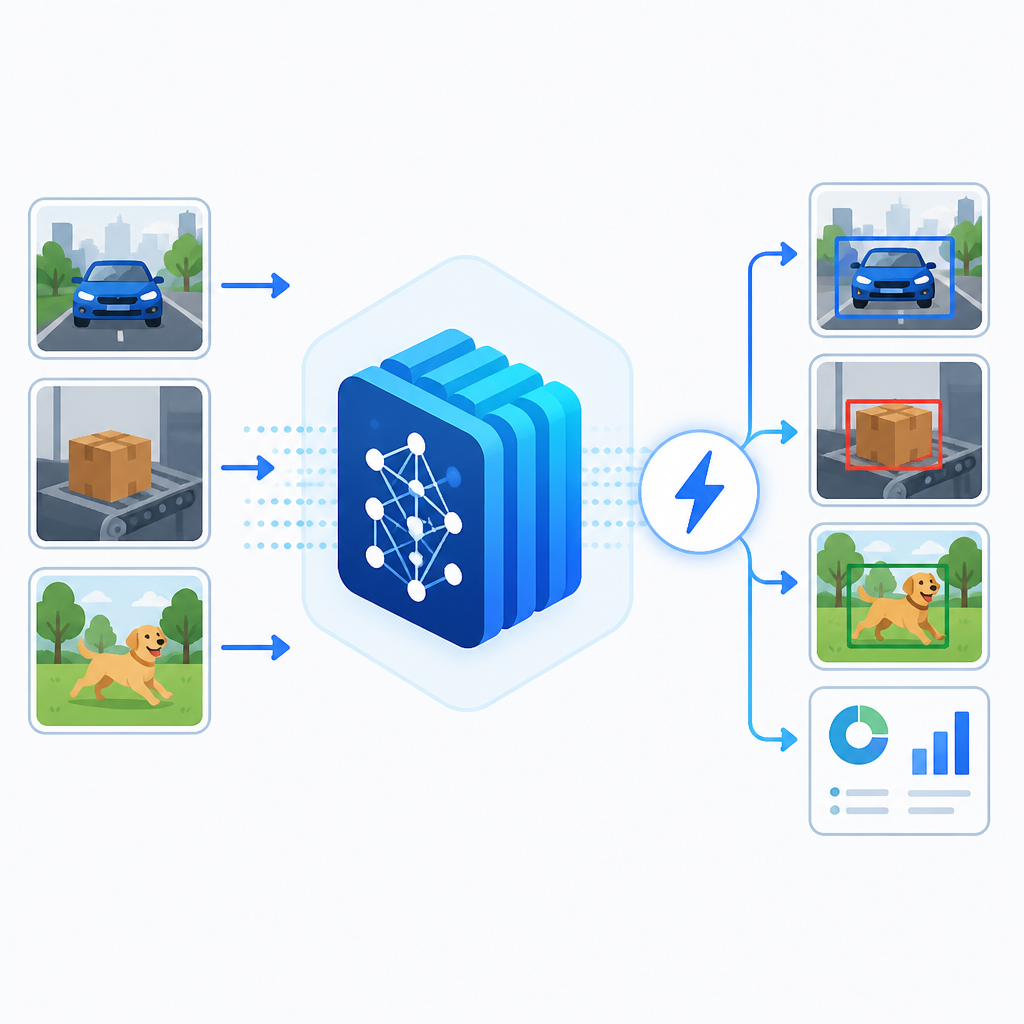
Ultralytics has turned its YOLO line into one of the most widely used computer vision stacks on GitHub, with 59,291 stars and 11,344 forks on the main repository. The project covers object detection, instance segmentation, semantic segmentation, image classification, pose estimation, and object tracking, all from a single Python package.
That matters because vision work often starts with a model zoo and ends with glue code. Ultralytics tries to compress that middle part: install one package, pick a task, train or infer, and move on.
| Metric | Value |
|---|---|
| GitHub stars | 59,291 |
| GitHub forks | 11,344 |
| Primary language | Python |
| Supported tasks | 6 |
| Minimum Python version | 3.8 |
| Minimum PyTorch version | 1.8 |
What Ultralytics actually ships
Get the latest AI news in your inbox
Weekly picks of model releases, tools, and deep dives — no spam, unsubscribe anytime.
No spam. Unsubscribe at any time.
The repository is the code home for the YOLO family, including YOLO26, YOLO11, and YOLOv8. The naming can look like version soup, but the practical pitch is simple: newer model families and older, battle-tested releases live in one place, with shared docs and shared install paths.

Ultralytics also pushes a broad set of usage paths through its docs, from training and validation to prediction and deployment. That means the repo is less a single model file and more a working toolkit for teams that need to move from notebook experiments to production inference.
- Object detection for bounding boxes and class labels
- Instance segmentation for per-object masks
- Semantic segmentation for pixel-level class maps
- Image classification for whole-image labels
- Pose estimation for keypoints and body tracking
- Object tracking for multi-frame identity management
Why the project keeps pulling developers in
Ultralytics has a strong adoption signal because it lowers the setup tax. The package installs with a single pip install ultralytics command, and the project documents support for Python 3.8+ and PyTorch 1.8+.
That matters in real teams. If a model repo needs a week of environment debugging, people quietly stop using it. If the first demo runs in minutes, the code gets shared, forked, and tested in more places.
“The YOLO family has become the default starting point for many computer vision projects.”
That line is a fair summary of how Ultralytics is used in practice, even if every team eventually customizes the stack. The repo’s popularity on GitHub and its active docs in multiple languages point to a project that is doing more than collecting stars.
Installation and deployment choices are part of the draw
Ultralytics does a better job than many ML repos at meeting developers where they already work. You can install from PyPI, use Conda, pull a Docker image, or build from source through Git. That spread matters when a team needs one path for laptops, another for CI, and another for production containers.
The project also links out to official docs, GitHub Issues, Discord, Reddit, and community forums. That mix suggests an ecosystem built for both quick troubleshooting and longer-term adoption.
- PyPI package for standard Python installs
- Conda Forge for managed environments
- Docker Hub for containerized deployment
- Quickstart guide for setup and source builds
- Ultralytics docs for training and inference workflows
How it compares with the usual CV stack
Compared with many computer vision libraries, Ultralytics puts more emphasis on one-package usability and less on forcing you to stitch together separate repos. It also keeps the docs close to the code, which reduces the usual mismatch between what a README promises and what the API actually does.
The tradeoff is that a broad toolkit can hide complexity behind friendly defaults. That is good for adoption, but serious users still need to understand model size, latency, dataset quality, and deployment constraints before they ship anything important.
- One repo covers detection, segmentation, classification, pose, and tracking
- Official docs are available in 10+ languages, including Chinese, Japanese, German, French, Spanish, and Arabic
- The project advertises support for commercial use through an enterprise license
- Community support spans GitHub Issues, Discord, Reddit, and forums
What this means for teams building with vision
Ultralytics is a practical choice when a team wants to move from prototype to usable model quickly. It is especially appealing for startups, internal tools, and research groups that care about speed of iteration more than building their own vision framework from scratch.
The bigger question is which YOLO branch will matter most in production over the next year: the newest model line, the widely adopted YOLOv8 stack, or a mix of both depending on latency and accuracy needs. For now, the safest bet is that Ultralytics stays a default first stop for Python-based computer vision work.
// Related Articles
- [TOOLS]
Windsurf AI Review 2026: Best AI Code Editor?
- [TOOLS]
Awesome-LLM turns LLM research into a map
- [TOOLS]
Microsoft 365 apps steer you to MAI models
- [TOOLS]
Docker Is the Right Default for MariaDB Setup
- [TOOLS]
11 Anthropic Skills That Make Codex Useful
- [TOOLS]
Claude Code’s hidden checks expose a bad habit