Bailey Smith turns midfield chaos into output
I break down Geelong’s Bailey Smith profile into a copyable way to spot elite midfield output and write about it.

I break down Geelong’s Bailey Smith profile into a copyable way to spot elite midfield output and write about it.
I've been reading player pages like this for a while, and most of them are basically wallpaper. Name, height, draft, a few highlights, and then the usual club fluff. But Geelong’s Bailey Smith page is different in a way that actually matters to anyone trying to understand performance. It tells a clean story: first season at the club, immediate impact, huge disposal volume, award recognition, and a midfield partner in Max Holmes that gives the whole thing shape. That’s the bit I care about. Not the glossy packaging. The signal.
What bothered me at first was how easy it is to miss the real takeaway if you skim. You see “All-Australian,” “Brownlow third,” “Champion Player of the Year,” and your brain just files it under “good player, moving on.” But if you read the page like a developer reads a framework README, there’s a pattern hiding in plain sight. This is a player profile built around evidence, not vibes. It points to repeatable outputs: disposals, centre clearances, inside 50s, and a season average that tells you how much control he had over games. That’s the useful part. The rest is just the wrapper.
And honestly, I like that angle because it’s the same problem I keep seeing in product docs and team retros. People describe the result, but they don’t explain the operating model. This page does a better job than most. It gives me enough to infer what Smith is doing, why it works, and how I’d write about a player like this without slipping into lazy hype.
The source that triggered this breakdown is Geelong’s official player page and its companion coverage on Smith’s 2026 form. The club page gives the baseline profile and season summary, while the linked feature Sizzling Smith Putting Opponents to the Sword in 2026 frames the current run of form. I’m not inventing the numbers here. I’m pulling from the club’s own wording: 31.3 average disposals, top 10 in centre clearances and inside 50s, first season at Geelong, and a 2025 award haul.
Stop reading player pages like bios
Get the latest AI news in your inbox
Weekly picks of model releases, tools, and deep dives — no spam, unsubscribe anytime.
No spam. Unsubscribe at any time.
“His ball-winning prowess was phenomenal, leading the competition for average disposals per game (31.3), while also finishing in the AFL's top 10 for centre clearances and inside 50s.”
What this actually means is that the page is describing a player by output, not by role labels. I don’t need to know whether someone calls him an inside mid, an accumulator, or a burst runner if the numbers already tell me he’s touching the ball constantly and moving it into dangerous areas.

I ran into this same problem when I used to write player summaries the lazy way. I’d front-load the biography, then tack on stats at the end like they were an afterthought. Readers would remember the awards and forget the mechanism. Geelong’s page avoids that. It puts the statistical case front and center, which is exactly what a good performance write-up should do.
How to apply it: when you write about a player, start with the output that changes games. Then explain the role. Then add the awards. If you do it the other way around, you end up with a profile that sounds impressive but teaches nobody anything.
- Lead with one measurable thing the player did better than most others.
- Use role language only after the output is clear.
- Keep awards as proof, not as the whole story.
For Smith, the output is obvious: he wins the ball, he gets it forward, and he does it at volume. That combination is why the profile feels more like a performance report than a standard club bio.
31.3 disposals is not a detail, it’s the headline
The page says Smith led the competition for average disposals per game at 31.3. That’s not a throwaway stat. That’s the center of the entire argument. If I’m trying to understand a midfielder’s influence, I want to know whether they are involved in the chain enough to bend the game. Thirty-one-plus disposals a game says yes, repeatedly.
What I like here is that the club doesn’t bury the number behind qualifiers. It doesn’t say “among the best” or “a strong contributor.” It names the figure. That matters because the number gives the reader a stable anchor. Without it, “dominant midfielder” is just marketing copy. With it, I can compare seasons, roles, and usage patterns.
I’ve seen teams do the opposite in their internal docs. They’ll use words like “high impact” and “elite involvement” and somehow never say how often the player actually touches the ball. That’s a waste of everyone’s time. If you can’t quantify the core action, you’re not describing performance, you’re decorating it.
How to apply it: if a player’s value is built on volume, make volume the first thing you show. Don’t hide behind highlights. One number, clearly stated, beats three paragraphs of adjectives.
- Use average disposals, not total disposals, when you want to show repeatability.
- Pair the number with one or two directional stats like inside 50s or clearances.
- Explain whether the number reflects usage, role, or pure dominance.
Smith’s 31.3 average tells me Geelong trusted him with the ball constantly. The rest of the profile just explains what they got out of that trust.
Top 10 in clearances and inside 50s is the real flex
The club says Smith finished in the AFL’s top 10 for centre clearances and inside 50s. This is the part I think casual readers underweight. Disposals are the broad metric. Clearances and inside 50s tell you where the disposals mattered. That’s the difference between a neat stat line and a player who actually tilts field position.
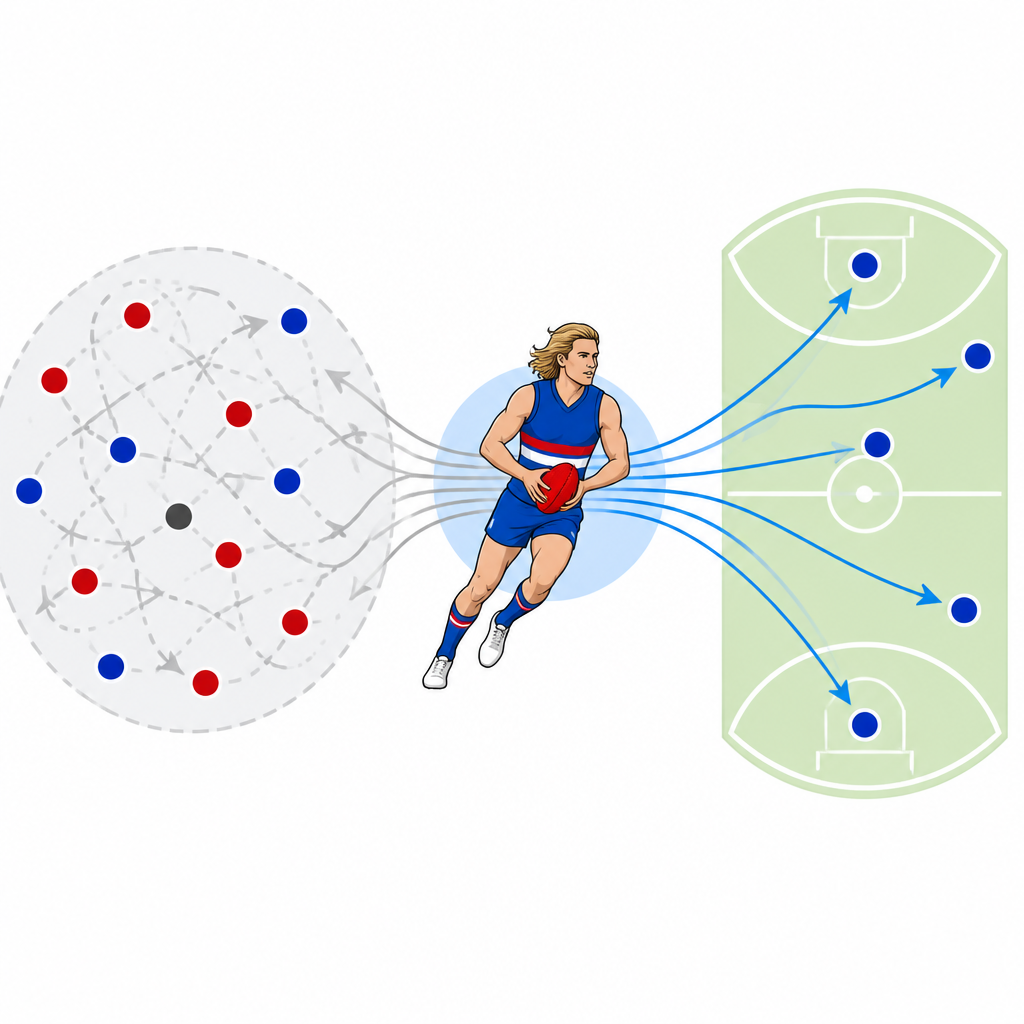
What this actually means is that Smith isn’t just collecting the ball in harmless spots. He’s helping Geelong exit congestion and then convert that movement into attack. That’s a much more valuable shape than just racking up touches around the outside. It also explains why the club sounds so confident talking about him in 2026. There’s a direct line from possession to territory to scoreboard pressure.
I ran into this distinction when reviewing midfielders for a fantasy draft model. A guy can look productive on raw touches and still do very little to move the game. Another player can have fewer possessions but create more damage because those touches happen in high-leverage areas. Smith’s profile says he’s in the second group, except the volume is there too. That’s why the season reads so strongly.
How to apply it: whenever you evaluate a midfielder, split the conversation into three buckets: getting the ball, moving the ball, and moving it where it hurts. If all three are strong, you’ve got a monster season. If only one is strong, you’ve got a stat line, not a performance case.
For anyone writing about AFL players, this is the cleanest lesson from the page. Don’t just say someone is “involved.” Show where the involvement happens.
First year at Geelong, and somehow the pressure got bigger
The profile makes a point of saying this was Smith’s first season at Geelong, and that he still produced at an elite level after missing the entire 2024 season through injury. That detail matters because it changes the interpretation. This wasn’t a comfortable, settled campaign. It was a comeback year, at a new club, with expectations all over the place.
What this actually means is that the performance wasn’t just good in isolation. It was good under adjustment. New system, new teammates, new pressure, no warm-up season. That’s the kind of context that separates “strong year” from “how did he do that?”
I’ve seen enough player transitions to know that the first year at a new club can go sideways fast. The role changes, the communication changes, the running demands change, and suddenly the player looks half a step off. Smith didn’t just avoid that trap. He walked straight through it and posted one of the best midfield seasons in the competition.
How to apply it: when you describe a new arrival, don’t treat the club change as a footnote. It’s part of the performance test. If the player hits immediately, say why that’s hard and what it says about adaptation.
- Call out injury return seasons separately from normal seasons.
- Note whether the player changed clubs, systems, or roles.
- Use context to explain why the output is more impressive than the raw number alone.
That’s why the page lands well. It doesn’t just say Smith was good. It says he was good while clearing a ridiculous set of hurdles.
Award lists matter when they match the tape
Smith’s profile points to three major markers: he shared the AFLCA Champion Player of the Year award in 2025, earned his first All-Australian blazer, and finished third in the Brownlow Medal. Those are not random trophies. They line up with the stat profile. That’s what makes them meaningful instead of decorative.
What this actually means is the awards are confirming what the numbers already suggested. Coaches saw him. Peers saw him. Voters saw him. And the underlying output backed it up. When awards and production align, the profile gets a lot more trustworthy.
I get annoyed when clubs or writers stack awards without showing the underlying case. It feels like they’re asking me to trust the label instead of the work. Geelong doesn’t do that here. It gives me the production first, then the recognition. That’s the correct order.
How to apply it: if you’re using honors in a write-up, make sure they reinforce the stats rather than replace them. Awards should answer “how was he recognized?” not “why should I believe this?”
That distinction is small on paper, but it changes the entire tone of the piece. One is evidence. The other is decoration.
The Holmes partnership gives the season a shape
The profile mentions Smith already forming a powerful midfield partnership with Max Holmes. I think this is the most interesting non-stat line in the whole page. It tells me Geelong isn’t just relying on a single ball-winner. They’re building a midfield structure around two players who can share the load and stretch opponents in different ways.
What this actually means is that Smith’s value is not isolated. It’s amplified by the presence of another dynamic runner. That matters because midfield dominance is rarely about one hero. It’s about combinations that force opponents into bad decisions. If Holmes creates one kind of pressure and Smith creates another, the whole unit becomes harder to stop.
I’ve worked on enough team systems to know that pairings are often the real story. One person can be excellent and still not unlock much. Two players who complement each other can change the entire shape of a unit. That’s what this line hints at, and it’s why the profile feels more strategic than decorative.
How to apply it: when you profile a player, don’t stop at the individual. Ask who benefits from their presence, and who makes them better. That’s where the real team story lives.
For Geelong, the Smith-Holmes pairing is the kind of detail that tells me the club’s midfield isn’t just productive. It’s scalable.
Write the profile like a performance note, not a fan post
Here’s the part I’d copy into my own workflow. The Geelong page works because it follows a simple structure: claim, proof, context, then forward-looking note. It doesn’t ramble. It doesn’t over-explain. It gives enough for a reader to understand why this player matters right now.
What this actually means is that I can steal the structure even when I’m writing about something completely different. Product launch, player profile, engineering memo, whatever. The shape is the same: what happened, what proves it, why it matters, and what comes next.
I ran into this while editing internal docs that were too clever for their own good. Everyone wanted to lead with context, caveats, and backstory. Nobody wanted to say the thing plainly. This page says the thing plainly. Smith was excellent. Here’s the evidence. Here’s why it matters for Geelong’s next season.
How to apply it: use the same order every time. It keeps the reader oriented and stops you from padding the piece with filler.
- State the performance in one sentence.
- Back it with one or two hard numbers.
- Add context only after the evidence is visible.
- End with the next question, not a generic conclusion.
The template you can copy
<p data-speakable="summary">[One sentence: what this story is about, plainly.]</p>

<p>I've been using [player/page/topic] for a while, and the usual write-up felt off. It had the names, the awards, the tidy summary, but it never explained what actually made the performance matter. This version does. It starts with the output, then shows the proof, then explains why the context changes the read.</p>

<p>The source that triggered this breakdown is [source name] at <a href="[source URL]" target="_blank" rel="noopener noreferrer">[source title]</a>. I’m pulling the core claims from the source itself: [key stat 1], [key stat 2], and [key context].</p>

<h2>Stop treating the stat line like decoration</h2>
<blockquote>“[Paste the original quote you’re breaking down.]”</blockquote>
<p>What this actually means is [plain-language paraphrase].</p>
<p>I ran into this when [short personal anecdote]. The mistake I kept making was [common bad interpretation]. The better read is [your actual interpretation].</p>
<p>How to apply it: [practical advice].</p>
<ul>
  <li>[Actionable point 1]</li>
  <li>[Actionable point 2]</li>
  <li>[Actionable point 3]</li>
</ul>

<h2>Use the numbers to explain the role</h2>
<p>[Explain the number and why it matters.]</p>
<p>What this actually means is [role implication].</p>
<p>How to apply it: [how readers can use the insight].</p>

<h2>Add context only after the evidence</h2>
<p>[Explain injury, new club, system change, or other context.]</p>
<p>What this actually means is [why the context changes the interpretation].</p>
<p>How to apply it: [practical write-up guidance].</p>

<h2>Awards are support, not the whole argument</h2>
<p>[Mention honors or recognition.]</p>
<p>What this actually means is [how awards reinforce the stat case].</p>
<p>How to apply it: [how to write awards without fluff].</p>

<h2>The template you can reuse</h2>
<pre><code>[Copy-ready structure with placeholders for your own topic.]</code></pre>

<p>Source: [original source URL]. This breakdown is my interpretation of the source material, not a quote-for-quote rewrite.</p>
That’s the whole trick. If you want the reader to trust the piece, show the evidence first and let the context do the work later. Don’t bury the good stuff under a pile of adjectives.
Source attribution: the original material came from Geelong Cats’ official Bailey Smith player page at https://www.geelongcats.com.au/players/1913/bailey-smith. My breakdown is derivative of that page and the linked club coverage, but the framing, structure, and template above are mine.
// Related Articles
- [IND]
pgvector is enough for small datasets, not your default
- [IND]
OpenAI’s Astra pause shows safety now shapes model releases
- [IND]
Anthropic is building custom AI chips for Claude
- [IND]
Moka AI Is a Stronger HRMS Choice for Growing Teams
- [IND]
August 2026 Market Review: AI Stocks Flipped Fast
- [IND]
Pixel 11 launch live: every Google reveal