Bedrock makes Llama a practical enterprise default, not a side project
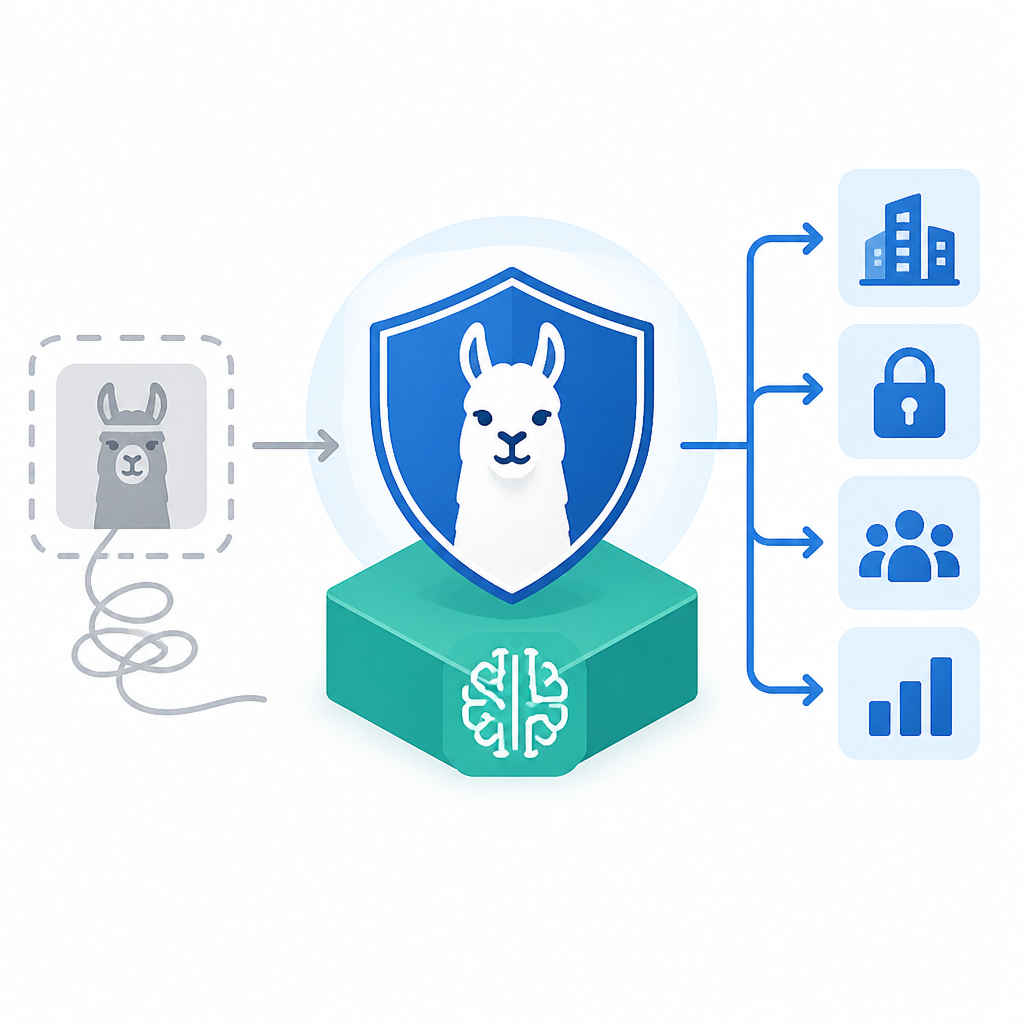
Amazon Bedrock turns Meta’s Llama into a practical enterprise default by removing infrastructure friction and widening deployment options.

Amazon Bedrock turns Meta’s Llama into a practical enterprise default by removing infrastructure friction and widening deployment options.
Meta’s Llama belongs in Amazon Bedrock because it turns model choice into a deployment decision, not an infrastructure project.
AWS is not just hosting a model family here. It is packaging Llama 4, Llama 3.2, and the surrounding tooling into a managed path for teams that want text, vision, code, and multilingual support without building their own serving stack.
Bedrock removes the real bottleneck: operations
Get the latest AI news in your inbox
Weekly picks of model releases, tools, and deep dives — no spam, unsubscribe anytime.
No spam. Unsubscribe at any time.
The strongest case for Llama in Bedrock is that most teams do not fail on model quality. They fail on the work around the model: scaling, patching, routing, security controls, and cost management. AWS says Bedrock is serverless and managed, which means teams can call Llama through an API instead of standing up GPU fleets and inference plumbing. That matters more than another point on a benchmark chart.

Nomura’s use of Llama in Amazon Bedrock shows the operational value clearly. The bank cites faster innovation, transparency, bias guardrails, and strong performance across summarization, code generation, log analysis, and document processing. That is the kind of result enterprises want: not a lab demo, but a repeatable internal platform that can be rolled out across teams.
Llama’s product fit is broader than most model families
Llama 4 in Bedrock is not positioned as a single-purpose assistant. AWS highlights native multimodality, mixture-of-experts architecture, expanded context windows, and efficiency gains. Llama 4 Maverick focuses on image and text understanding with fast responses at low cost, while Scout is aimed at multi-document analysis, codebase reasoning, and data processing. That range makes the family useful for real enterprise workflows, not just chat.
The older Llama 3.2 line strengthens the case further. AWS points to a 128K token context window, multilingual support across eight languages, and on-device or more efficient processing. Those are not vanity features. They are the ingredients for document-heavy tasks, regional products, and workflows where latency and memory limits decide whether the system is usable at all.
Bedrock lowers adoption risk for teams that already live in AWS
Enterprises do not buy AI in a vacuum. They buy it inside an existing stack of IAM, networking, logging, compliance, and procurement. Bedrock matters because it lets teams use Llama without leaving the AWS environment they already trust. That reduces the integration tax and shortens the path from prototype to production.
TaskUs is a good example of why that matters. Its TaskGPT platform uses Amazon Bedrock and Llama to support paraphrasing, content generation, comprehension, and complex task handling. The value is not only model capability. It is the ability to embed that capability into customer experience workflows where cost, reliability, and speed matter every day.
The counter-argument
The best objection is that Bedrock can make Llama too convenient, and convenience can hide dependency. If a company builds deeply around AWS, it may trade flexibility for speed, and it may accept a model roadmap that is partly controlled by a cloud provider. Teams that want maximum portability or direct model-level control will see that as a real cost.
There is also a fair product concern: managed access can encourage shallow experimentation. If a team only wants to test prompts or spin up a proof of concept, Bedrock may look like overkill compared with lighter-weight options. In that sense, some developers will prefer direct model hosting or a more neutral abstraction layer.
That criticism is real, but it does not beat the core argument. Most enterprises are not optimizing for theoretical portability. They are optimizing for time to production, governance, and operational simplicity. Bedrock is the right trade when the goal is to ship Llama into a business system with minimal friction. The dependency is acceptable because the alternative is usually slower delivery, higher ops burden, and more failure points.
What to do with this
If you are an engineer, treat Llama in Bedrock as the default path when your app needs multimodal reasoning, long context, or multilingual support inside AWS. If you are a PM, use it to cut the gap between prototype and deployed workflow, especially in document processing, support, and internal knowledge systems. If you are a founder, build on it when speed matters more than model ownership, because the real advantage is not novelty, it is getting a reliable AI product into customers’ hands faster.
// Related Articles
- [IND]
Rust 661’s best releases for builders this week
- [IND]
Deepwoken’s Second Layer hides Ethiron below Scyphozia
- [IND]
AMD is right to use Anthropic to break CUDA’s grip
- [IND]
AI Weekly: 2026-07-20 ~ 2026-07-27
- [IND]
WAIC 2026 turns AI hype into real work
- [IND]
KPMG’s OpenAI deal turns SaaS into agents