WAIC 2026 turns AI hype into real work
WAIC 2026 shifts AI talk from bigger models to agents, chips, and robots people can actually use.

WAIC 2026 shifts AI talk from bigger models to agents, chips, and robots people can actually use.
I've been around enough AI conferences to know when the script is getting stale. For a while, every stage talk sounded the same: bigger model, more parameters, louder claims, and a demo that looked great until you asked who would actually use it on Monday morning. That gets old fast. I keep coming back to the same frustration: if the whole story ends at model size, then the story is mostly marketing with a GPU budget.
So when I looked at the WAIC 2026 framing from Zhihu, what grabbed me was not the usual model bragging. It was the shift in emphasis: agent productivity, heterogeneous collaboration, photonic computing, and embodied AI. That is a much more honest split. It says the field is moving from "look what the model can say" to "look what the system can do."
Stop treating bigger models like the whole product
Get the latest AI news in your inbox
Weekly picks of model releases, tools, and deep dives — no spam, unsubscribe anytime.
No spam. Unsubscribe at any time.
AI narrative is shifting from model parameter stacking to agent productivity landing.
What this actually means is simple: raw model size is no longer the only thing worth talking about. A model that sounds smart but cannot complete a task inside a real workflow is still just an expensive autocomplete. Agents matter because they connect the model to actions, tools, and state. That is where usefulness starts.
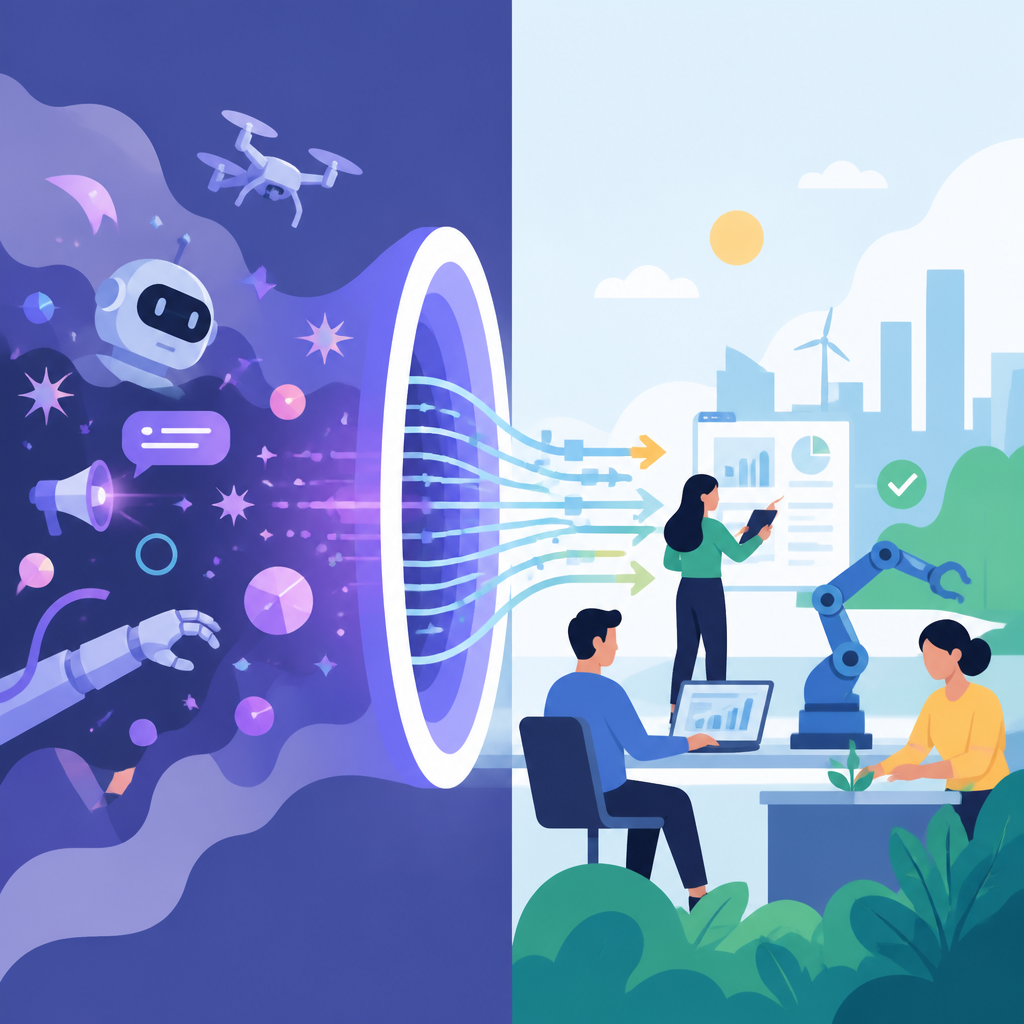
I ran into this exact problem when I tried to use a strong model as the center of a workflow without any agent layer. It could draft, summarize, and suggest. Then it hit a wall the moment I needed it to check a system, call an API, or keep track of a multi-step process. The output was fine. The work was not done. That gap is why the agent conversation matters more than another parameter count.
WAIC 2026, at least in this framing, is telling builders to stop worshiping the base model and start designing the surrounding machinery. That means tool use, memory, routing, planning, retries, and failure handling. If you are building anything users rely on, that surrounding machinery is the actual product.
How to apply it: audit your own AI feature and ask one blunt question, "What task does this finish end to end?" If the answer is "it helps a person write faster," that is fine, but it is not agentic yet. If the answer is "it can gather data, make a decision, and execute the next step," now you are in the right neighborhood.
- Define the task before you define the model.
- Map the tool calls the model needs.
- Decide where the model should stop and the system should take over.
Agents are only useful when they survive contact with workflows
People love saying "agent" like the word itself does the work. It does not. I have seen plenty of demos where an agent looks brilliant in a clean sandbox and then falls apart the second it has to deal with permissions, missing fields, or a user who changes direction halfway through. Real workflows are messy. Agents need to be built for that mess.
The Zhihu piece points to agent productivity as the next headline. I read that as a reminder that the winning agent is not the one with the fanciest reasoning trace. It is the one that fits into how teams already operate. That means being explicit about inputs, outputs, escalation paths, and human override. If you skip those parts, you are not building an agent. You are building a demo with extra steps.
When I review agent systems now, I look for boring details first. Can it recover from a failed tool call? Can it ask a clarifying question instead of guessing? Can it hand off to a human without losing the thread? Those are the things that separate something useful from something that just looks clever on stage.
How to apply it: design your agent around one narrow workflow and write down every failure mode you can think of. Then build the escape hatches before you build the polish. If you do not know how the system behaves when data is missing, the agent is not ready for users.
- Start with one workflow, not five.
- Instrument retries and fallbacks from day one.
- Make human handoff a first-class feature.
Heterogeneous collaboration is the part people skip until it hurts
Heterogeneous collaboration and photonic computing keep pushing the compute ceiling higher.
What this actually means is that the next wave of AI infrastructure will not come from one magic chip or one monolithic stack. It will come from mixing the right compute for the right job. CPUs, GPUs, specialized accelerators, and new interconnect ideas all matter because no single component is great at everything. That is not a sexy message, but it is the real one.
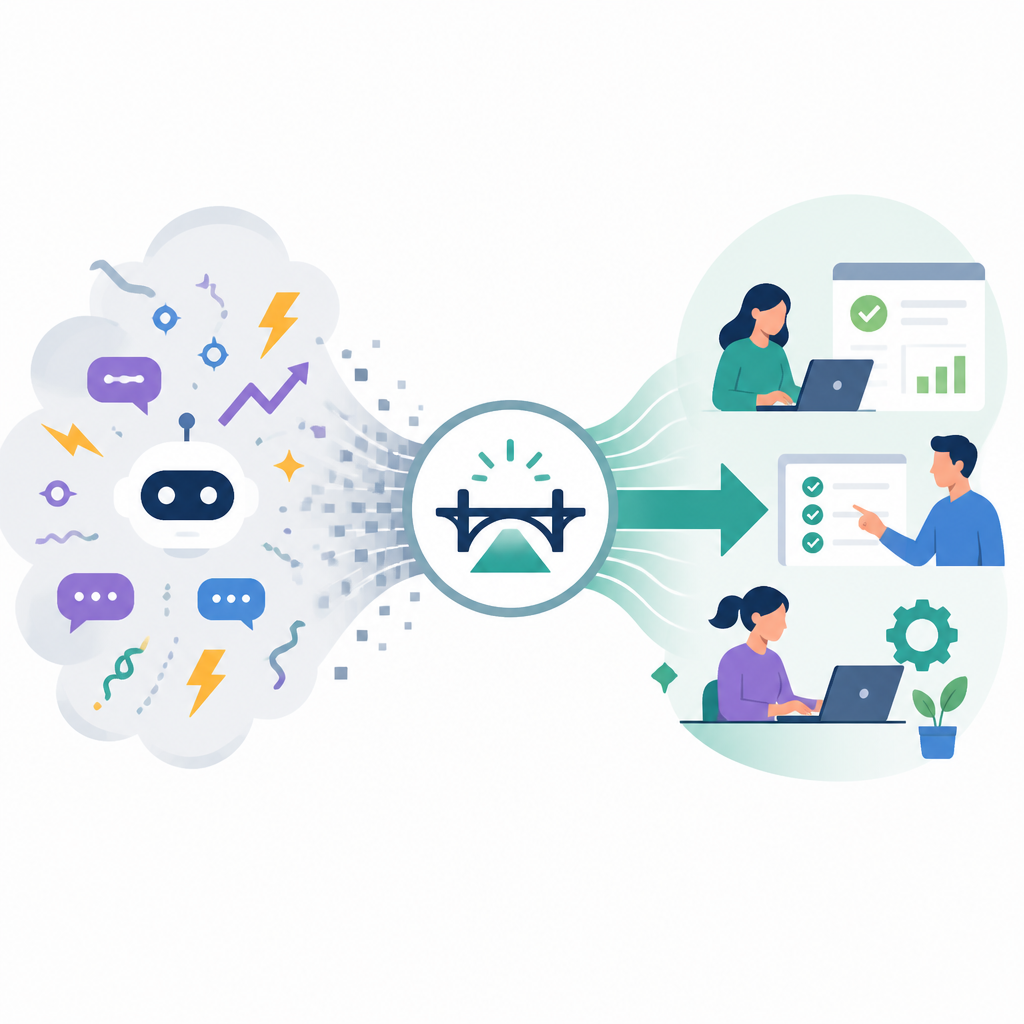
I have watched teams burn months trying to force one architecture to do every job because it looked cleaner on a slide. Then latency shows up, cost shows up, or memory pressure shows up, and the clean slide turns into a very expensive headache. Heterogeneous systems are annoying to design, but they are often the only sane way to scale.
The mention of photonic computing is interesting for the same reason. I would not read it as "this replaces everything tomorrow." I read it as a signal that the compute ceiling is still being pushed from multiple angles. For builders, that means the infrastructure conversation is not over just because the model layer feels mature.
How to apply it: if you are responsible for AI infrastructure, stop asking only whether your stack is fast. Ask whether each workload is on the cheapest acceptable path. Training, inference, retrieval, batching, and storage all have different needs. Treating them like one problem is how budgets get wrecked.
Useful references if you want to go deeper: NVIDIA's CUDA platform at developer.nvidia.com/cuda-zone, Intel's oneAPI at intel.com, and IBM's work on photonics at research.ibm.com/topics/silicon-photonics.
Embodied AI is where the hype finally has to touch dirt
Embodied intelligence is accelerating, with robots moving into homes and factories.
What this actually means is that AI is leaving the screen and entering places where physics has opinions. Homes and factories are not forgiving environments. Objects are inconsistent, lighting changes, people move, and mistakes cost time or safety. That is exactly why embodied AI matters. It forces the field to prove it can operate outside a tidy text box.
I like this part of the WAIC framing because it stops the conversation from floating away into abstraction. A robot that can navigate a warehouse, sort items, or assist with repetitive tasks has to deal with perception, planning, control, and real-world uncertainty all at once. That is a much harder test than generating a polished paragraph.
And frankly, this is where a lot of AI rhetoric gets exposed. If the system cannot handle a dropped object, a blocked path, or a human interrupting the task, then the intelligence is still pretty shallow. Embodied AI is useful because it makes those weaknesses impossible to ignore.
How to apply it: even if you are not building robots, borrow the embodied mindset. Test your AI systems in ugly conditions. Give them bad data, partial context, interruptions, and conflicting instructions. If the product only works in ideal conditions, it is not ready for the real world.
For reference points, I would look at OpenAI robotics research, NVIDIA robotics, and Bosch Research robotics. Different approaches, same basic truth: the physical world is a brutal product manager.
The real story is the shift from demos to systems
That is the thread tying all of this together. Agents, chips, and robots are not separate trends. They are all responses to the same problem: AI is finally being judged by whether it works inside a system, not just whether it impresses someone for 30 seconds on a stage.
When I think about how to build against this shift, I keep coming back to one rule: every AI feature needs an operational story. Who uses it, what it touches, what it depends on, what breaks, and what happens next. If you cannot answer those questions, you are still in demo land.
That is why this WAIC 2026 framing matters. It is less about a single announcement and more about a change in what counts as progress. Bigger models still matter, but they are no longer the whole conversation. The conversation is moving toward reliability, integration, and physical usefulness. About time.
How to apply it: rewrite your AI roadmap so each item names the user outcome, the system dependencies, and the failure path. If a roadmap item cannot survive that rewrite, it probably does not deserve to be on the roadmap.
The template you can copy
# AI product framing template for 2026

## 1) What we are building
- User:
- Task:
- Environment:
- Success metric:

## 2) Model layer
- Base model:
- Why this model:
- What the model is responsible for:
- What the model is not responsible for:

## 3) Agent layer
- Tools available:
- Memory/state:
- Planning steps:
- Retry policy:
- Human handoff rule:

## 4) Infrastructure layer
- Compute split:
- Inference path:
- Retrieval path:
- Storage path:
- Cost guardrails:

## 5) Physical or real-world constraints
- Latency limits:
- Safety limits:
- Interruptions to handle:
- Failure cases:

## 6) Shipping checklist
- One workflow only:
- One fallback path:
- One measurable outcome:
- One rollback plan:

## 7) Plain-English product statement
"This AI feature helps [user] do [task] by [mechanism], and it still works when [failure condition]."
Source attribution: The original idea comes from the Zhihu post at https://zhuanlan.zhihu.com/p/2062605005086003442. I rewrote the framing and expanded it into a builder-focused breakdown; the template and commentary here are my own derivative interpretation.
// Related Articles
- [IND]
KPMG’s OpenAI deal turns SaaS into agents
- [IND]
Trump adviser accuses Moonshot AI of stealing Anthropic
- [IND]
Vector databases will reshape financial search, not replace core syst…
- [IND]
Milvus 3.0 adds lake-native vector search
- [IND]
Google’s Q2 2026 results prove AI spend is now the story
- [IND]
AI regulation in India is now a business risk