This benchmark proves harness quality beats model hype in coding
The repo shows coding benchmark results depend more on harness quality than model branding.

This benchmark shows coding results depend more on harness quality than model branding.
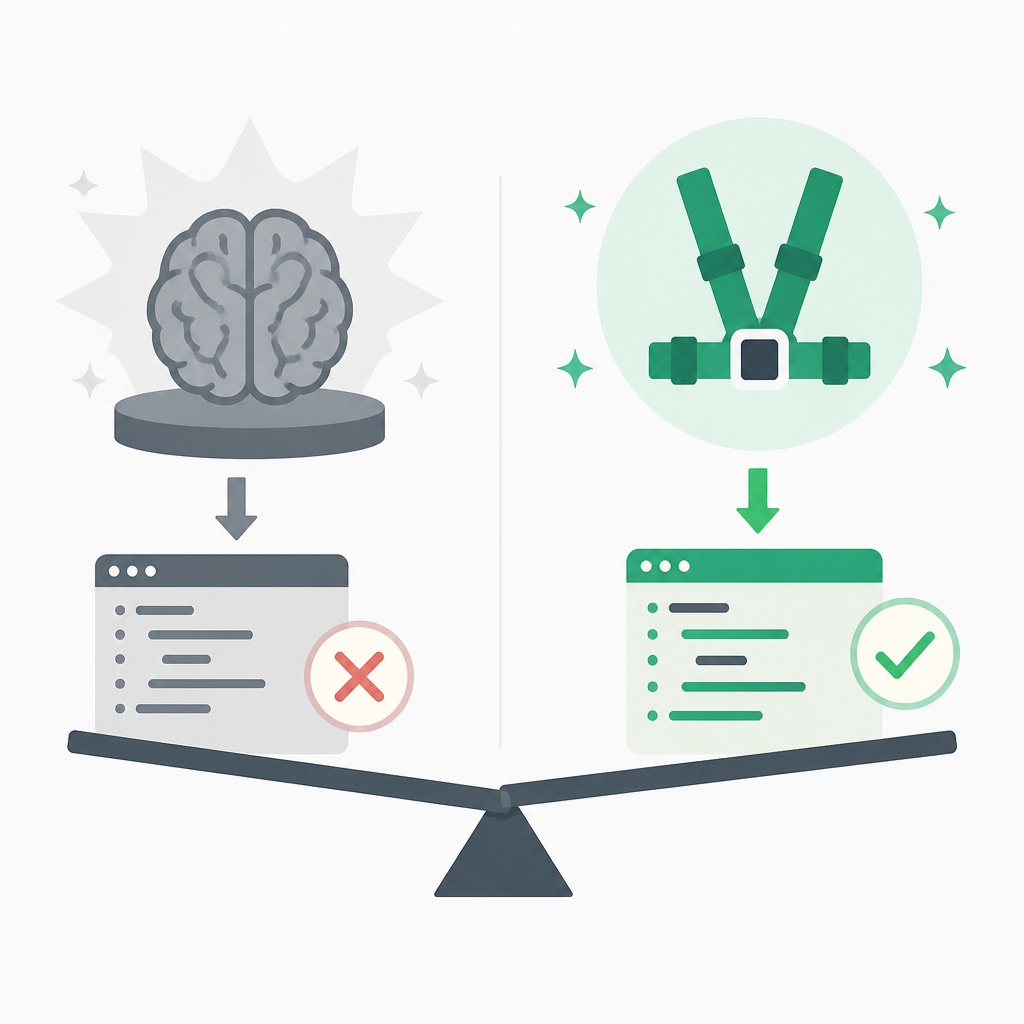
GitHub’s llm-coding-benchmark repo makes a blunt case: if you want to judge coding models, the harness matters more than the logo on the model card. The project compares open source and commercial LLMs against one fixed Rails brief, then scores them with normalized metadata, raw logs, and a 0-100 rubric that rewards deliverables, API correctness, tests, error handling, persistence, Hotwire, architecture, and production readiness. That structure produces a result that is hard to ignore: the same model can look competent in one environment and fail in another, while a cheaper model can outperform a famous one when the workflow is tighter.
The benchmark rewards real shipping behavior, not benchmark theater
Get the latest AI news in your inbox
Weekly picks of model releases, tools, and deep dives — no spam, unsubscribe anytime.
No spam. Unsubscribe at any time.
The strongest argument for this repo is that it measures what breaks in production, not what looks good in a screenshot. A model that writes a lot of files but hallucinates the RubyLLM API gets punished. A model that writes fewer tests but uses the correct signatures, handles errors, and validates boot behavior gets rewarded. That is why the repo’s own notes call out cases where file count and test count were misleading: Kimi K2.5 reportedly wrote 37 tests without mocking RubyLLM correctly, while Gemini 3.1 Pro wrote 11 tests with a correctly signed FakeChat and scored higher on test quality.

The practical lesson is simple. Benchmarks that count output volume are easy to game, while benchmarks that inspect correctness survive contact with reality. This repo’s rubric treats hallucinated APIs as a failure even when tests pass green, because green tests built on fake interfaces are worthless. That is the right standard for coding agents, because the cost of a wrong method call or a fake client class does not show up in a markdown summary. It shows up when the app boots, the compose stack starts, or the first real request hits the code.
Harness design changes the ranking more than model marketing does
The repo’s most important finding is not that one model is always better than another. It is that the same model can produce different quality depending on the orchestration layer. The README says the same Opus 4.7 model produced Tier A code in opencode but only Tier 2 or 3 code in Claude Code because it hallucinated chat.complete there. That is not a subtle difference. It means the surrounding agent loop can either preserve or distort the model’s ability to reason about the task.
The DeepSeek V4 Pro example makes the point even harder. In opencode, the model was initially unmeasurable because of a reasoning_content interop bug. Once routed through Claude Code with the deepclaude env-swap shim and OpenRouter’s Anthropic-compatible endpoint, it landed in Tier A at 84 and 89. Same model, different harness, dramatically different result. That is the clearest evidence in the repo that benchmark operators are not neutral observers. They are part of the experiment, and their implementation choices directly shape the outcome.
Cost efficiency matters, but only after correctness is proven
This benchmark also demolishes the idea that the most expensive model is automatically the best choice. Claude Opus 4.7 and GPT 5.4 xHigh both scored 97, but the repo says Opus cost about $1.10 per run while GPT 5.4 xHigh cost about $16 per run. GPT 5.5 xHigh scored 96 at around $10 per run and 18 minutes, which is still expensive relative to the quality gap. The result is not that price is irrelevant. It is that price only matters after a model has cleared the bar for API correctness, tests, and runtime validation.
The best value story is even more persuasive. Kimi K2.6 is listed as the best value at around $0.30 per run, with correct API usage, real LLM-path tests, and restart-safe persistence. DeepSeek V4 Flash sits even lower on cost at about $0.01 per run, but with a weaker tier. That spread is exactly why this repo is useful to engineers and founders: it separates “cheap and broken” from “cheap and usable,” and it shows where the actual trade-off lives. In coding agents, a model that is 10 times cheaper but fails on boot or API recall is not a bargain. It is a hidden support burden.
The counter-argument
There is a fair objection to this whole approach. A benchmark built around one Rails app, one prompt family, and one agent stack can overfit to the evaluator’s preferences. The 0-100 rubric is rigorous, but it is still a human rubric. Different teams care about different things. A startup shipping a narrow product may value speed and partial correctness over polished architecture. A platform team may care more about maintainability than a benchmark can capture. In that view, the repo risks turning one strong opinion into a universal law.
That critique is strongest when people mistake the benchmark for a full substitute for product evaluation. It is not that. It is a controlled stress test, and controlled stress tests always simplify reality.
Still, the counter-argument does not defeat the repo’s core claim. A benchmark does not need to model every production environment to reveal which models hallucinate APIs, which ones survive boot validation, and which ones keep persistence and tests aligned with the brief. Those are universal failure modes, not niche preferences. The repo’s value is precisely that it reduces the noise enough to expose binary differences in correctness. Once a model fails on a real interface or a live compose check, no amount of benchmark skepticism rescues it for serious coding work.
What to do with this
If you are an engineer, stop trusting leaderboard rank and start demanding harness transparency: inspect the prompt, the validation steps, the runtime checks, and the failure modes. If you are a PM or founder, choose models and agents by the quality of their end-to-end output under your own stack, not by generic hype. The right buying question is not “which model scored highest?” It is “which model can ship correct code in my environment, with my tools, at a cost I can defend?” This repo says that answer depends less on the name of the model than on the discipline of the benchmark around it.
// Related Articles
- [AGENT]
FaithEyes lets you train tool-faithful vision agents
- [AGENT]
Connect Qwen 3.8 Max to CLI Agents
- [AGENT]
Fine-tune a small LLM for legal labeling
- [AGENT]
SALA Boosts Long Context on Edge AI
- [AGENT]
Anthropic’s breach proves AI agents need hard security limits
- [AGENT]
GenAI.mil turns a scary prompt into a report