California’s Claude deal puts AI inside state offices
5 ways California’s Claude deal could change how state workers draft, search, and serve the public.

California is expanding Claude use across government to speed up routine work.
California’s new deal with Anthropic gives state and local agencies cheaper access to Claude, plus training and support. The agreement matters because it moves AI from pilot projects into daily government work for thousands of employees.
| Item | Access | Support | Noted use |
|---|---|---|---|
| California state agencies | 50% discount | Free training and assistance | Drafting, summarizing, analysis |
| California local governments | 50% discount | Free training and assistance | Public service and admin tasks |
| San Francisco city workers | Copilot Chat rollout | Citywide deployment | Nearly 30,000 employees |
1. A cheaper Claude rollout for government
Get the latest AI news in your inbox
Weekly picks of model releases, tools, and deep dives — no spam, unsubscribe anytime.
No spam. Unsubscribe at any time.
The biggest change is simple: California agencies can get Claude at half price. That lowers the cost barrier for departments that want to test AI on paperwork-heavy tasks without buying a separate enterprise system at full price.

Gov. Gavin Newsom said the point is to help workers move faster and solve problems better, not replace staff. The state also said local governments can use the same discount, which widens the reach beyond Sacramento.
- 50% discount for state agencies
- Same discount for local governments
- Free training and other assistance included
2. Routine paperwork is the first target
Claude is being pitched as a helper for the most repetitive parts of public service. That includes drafting memos, summarizing long documents, and sorting information so staff can spend less time on mechanical work.
Those are the kinds of jobs where AI can produce quick time savings, especially in agencies that handle high volumes of forms, emails, and internal reports.
- Draft documents
- Summarize reports
- Analyze information
- Support public-facing workflows
3. California is already using Claude in some agencies
This is not a clean-slate pilot. The governor’s office said California has already started using Claude to build tools that help the public engage with AI policy discussions and to assist state workers.
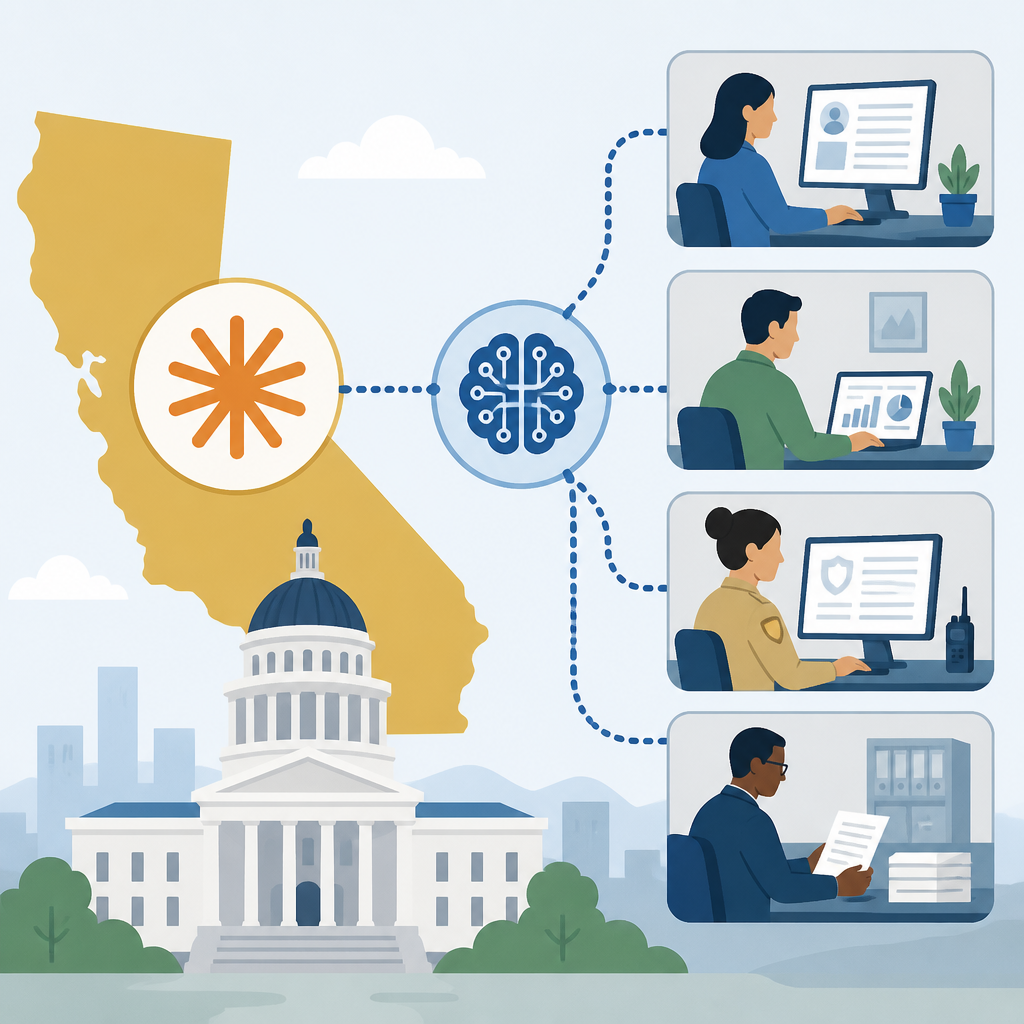
State agencies, including the Department of Motor Vehicles, are also using AI to cut wait times and improve customer service. That suggests the partnership is meant to expand existing use, not merely announce a future plan.
Examples already in motion:
- Public engagement tools for AI policy discussions
- Worker support tools inside state government
- DMV efforts to reduce wait times
- Customer service improvements
4. Security and privacy remain the main concern
Anthropic says its government version of Claude offers more security than the consumer product. That distinction matters because government systems handle sensitive records, and agencies need tighter controls than a normal chatbot account.
Still, the deal arrives with familiar worries about privacy, data handling, and job displacement. Union leaders quickly criticized the partnership, arguing that cheap AI access could push public agencies to hand over private data and outsource work to big tech.
- Government version has stronger security controls
- Privacy risks are still a live concern
- Labor groups fear job loss and data exposure
5. California is betting AI can speed services without replacing staff
The state’s message is that AI should support workers, not take their place. Nick Maduros, secretary of the Government Operations Agency, said employees need access to modern tools if they are going to give Californians better service.
That framing puts California in the middle of a larger trend: governments are trying AI to speed up internal work while also trying to keep human judgment in the loop. The success of this deal will depend on whether agencies use Claude for assistance or let it drift into decision-making it was never meant to handle.
How to decide
If you care most about cost, this deal is a straightforward win for agencies that want to test AI without paying full price. If you care most about risk, the privacy and labor questions will matter more than the discount.
The clearest use case is back-office work, not policy decisions or final judgments. California is betting Claude can make government faster at the edges while people stay responsible for the center.
// Related Articles
- [IND]
Meta一句话引爆AI硬件,华尔街仍看多算力
- [IND]
Cloudflare sets September 15, 2026 crawl defaults
- [IND]
Cloudflare’s new crawler rules shift power to publishers
- [IND]
Midjourney is building a body-scan spa
- [IND]
Midjourney Is Right to Force Hollywood’s AI Cards Onto the Table
- [IND]
Midjourney should stay out of diagnosis and focus on body-composition…