ClinFusion tackles medical MLLMs from the vision side
ClinFusion unifies 2D and 3D medical images in a vision-centric MLLM and improves clinical evaluation with RoI-grounded metrics.

20 of 24 benchmarks show ClinFusion improving medical MLLM performance with fused 2D and 3D vision.
- Research org: Unspecified in arXiv abstract
- Core data: 20 out of 24 benchmarks
- Breakthrough: Cascade Spatial-Aware Locality Fusion for unified 2D/3D vision encoding
ClinFusion: A Vision-Centric Multimodal LLM System for Holistic Medical Understanding argues that the hard part of medical multimodal AI is not just language generation — it is getting the vision side right. That matters because clinical data is messy, image-heavy, and often split across 2D and native 3D formats, while evaluation has to match how radiologists actually judge reports and answers.
The paper is useful to engineers because it frames medical MLLMs as a systems problem: encode the images well, ground the output in the image regions that matter, and evaluate with metrics that reflect clinical practice. It also suggests that stronger medical assistants may need both better multimodal architectures and better evaluation loops, not just larger language models.
What problem this paper is trying to fix
Get the latest AI news in your inbox
Weekly picks of model releases, tools, and deep dives — no spam, unsubscribe anytime.
No spam. Unsubscribe at any time.
ClinFusion starts from a practical complaint: many multimodal large language models are built around language, but medical use cases are dominated by vision. A model has to deal with heterogeneous 2D images and native 3D scans, then produce outputs that are clinically useful, factual, and aligned with radiologists’ workflow.

The abstract says current evaluation is also a problem. If the scoring protocol is not clinically aligned, the model may look good on a generic benchmark while still missing the fine-grained visual evidence that matters in a real report or instruction-following task. So the paper is trying to fix both the model and the measurement problem at the same time.
How the method works in plain English
ClinFusion is described as a vision-centric MLLM for holistic medical understanding. Its core architectural idea is a compositional and cascaded vision encoder that uses a Cascade Spatial-Aware Locality Fusion operator.
In plain English, that means the system is designed to merge information from different medical image sources inside a single fused encoder instead of treating them as isolated inputs. The goal is to unify understanding of both 2D and 3D medical images while preserving spatial locality, which is especially important when small regions in a scan carry the decisive evidence.
The paper also introduces a vision-grounded evaluation framework. One part is MedIF-Bench, which is used for instruction-following assessment. Another part is a region-of-interest-grounded method for report generation evaluation, intended to be more clinically aligned and more factualness-driven than generic automatic metrics.
This is a notable design choice for developers: the paper does not treat evaluation as an afterthought. It builds a measurement layer that tries to score whether the model is actually looking at the right region and grounding its report in the right visual evidence.
What the paper actually shows
The abstract claims ClinFusion sets a new state of the art across a broad suite of 2D and 3D multimodal medical benchmarks. Those benchmarks span visual question answering, report generation, instruction following, and textual medical tasks.
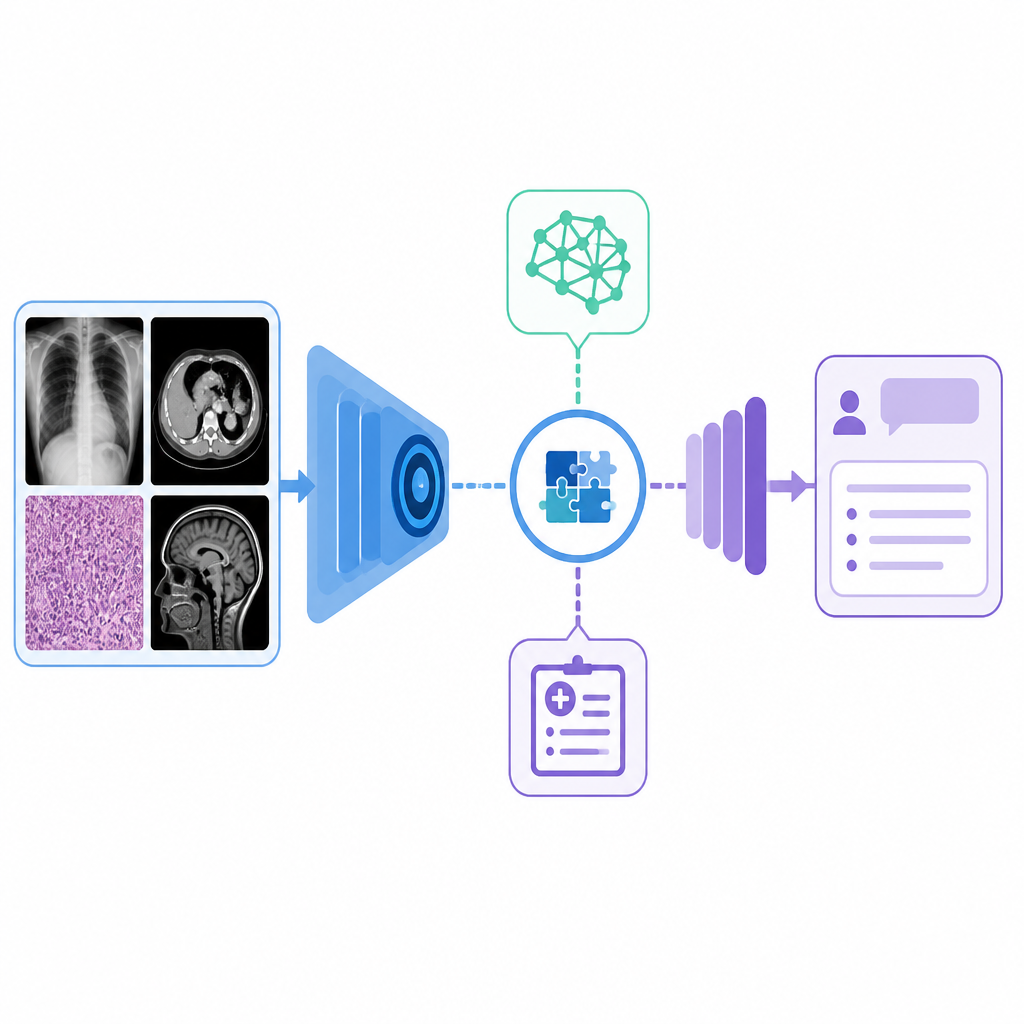
On the numbers that are available in the abstract, ClinFusion outperforms leading open-source medical MLLMs such as Hulu-Med and Lingshu on 20 out of 24 benchmarks. It also beats proprietary systems including GPT-5.2 and Gemini-3-Flash on 13 out of 16 benchmarks. The abstract does not provide the individual benchmark scores, so there is no way to inspect the margin of improvement from the source alone.
The paper also says ClinFusion can be augmented with agentic tool use for retrieval-augmented and tool-assisted clinical workflows. That is interesting for practitioners because it hints at a path from a standalone model to a more operational assistant that can combine generation with external tools.
Another result is evaluation-focused: a blinded assessment by board-certified radiologists found that ClinFusion produces the highest-ranked reports. The same evaluation also validates the RoI-grounded metric as having the strongest correlation with expert judgment among the automatic metrics examined.
Why developers should care
If you are building medical AI, the main takeaway is that architecture and evaluation are tightly coupled. A model that handles 2D and 3D images well is useful, but if the scoring method does not reward image-grounded factuality, you can still end up optimizing for the wrong thing.
ClinFusion’s emphasis on a fused vision encoder is also practical. Medical workflows rarely fit a single-image, single-sentence pattern. A system that can unify heterogeneous image inputs and preserve spatially meaningful detail is closer to the way real clinical data is presented.
The evaluation side may be even more important for teams shipping or auditing models. The paper’s RoI-grounded metric is explicitly designed to correlate with expert judgment, which suggests a possible direction for more trustworthy benchmarking in medical imaging and report generation.
What the abstract does not tell us
The abstract is strong on claims but light on implementation specifics. It does not provide the benchmark scores, dataset names, training recipe, compute cost, latency, or ablation details. It also does not say which institution or lab led the work in the abstract text provided here.
That means practitioners should read the full paper before treating ClinFusion as a drop-in solution. The results look broad and promising, but the source available here does not show how much of the gain comes from the encoder design, the evaluation framework, or the agentic tool-use augmentation.
Still, the paper’s direction is clear: medical multimodal systems need better visual fusion, better grounding, and better evaluation. For engineers, that is a useful reminder that in clinical AI, the model is only half the product; the measurement stack matters just as much.
Bottom line
ClinFusion is a vision-first medical MLLM that tries to make 2D and 3D image understanding, report generation, and evaluation work as one system. The abstract claims strong benchmark coverage and expert validation, but the real contribution for developers is the design pattern: fuse the vision stack, ground the outputs, and measure against clinical judgment.
- ClinFusion targets both 2D and native 3D medical image understanding in one fused encoder.
- The paper pairs model design with RoI-grounded evaluation to better match radiologist judgment.
- Its reported gains span VQA, report generation, instruction following, and textual medical tasks.
// Related Articles
- [RSCH]
Learning from Multiple Data Providers
- [RSCH]
Certified parallel Sinkhorn speeds up dynamic OT
- [RSCH]
Explainable RL for Air Traffic Control
- [RSCH]
Skill Self-Play lets LLMs co-evolve skills
- [RSCH]
SM4RT brings rigid motion into 4D reconstruction
- [RSCH]
Prompt engineering turns codegen into a repeatable workflow