Skill Self-Play lets LLMs co-evolve skills
Skill Self-Play uses co-evolving skills to balance verifiable feedback with open-ended task generation.

Skill Self-Play uses co-evolving skills to balance verifiable feedback with open-ended task generation.
- Research org: Unspecified in arXiv abstract
- Core data: No benchmark numbers in abstract
- Breakthrough: Proposer, solver, and dynamic skill controller co-evolve in RL
When you train an LLM with self-generated data, you usually run into the same tradeoff: either keep the environment tight enough to verify outcomes, or let the model roam freely and risk training on noisy rewards. This paper argues that agent skills are a useful middle layer for escaping that trap.
Skill Self-Play: Pushing the Frontier of LLM Capability with Co-Evolving Skills proposes a framework that lets skills act as both a source of task variety and a way to keep feedback grounded. For engineers building agents, the interesting part is not just that the model improves itself, but that the training loop is organized around verifiable skill execution rather than raw open-ended generation.
What problem this paper is trying to fix
Get the latest AI news in your inbox
Weekly picks of model releases, tools, and deep dives — no spam, unsubscribe anytime.
No spam. Unsubscribe at any time.
The abstract frames a real weakness in current self-evolution approaches. Environment-bound methods can give precise feedback, but they tend to trap learning inside narrow task domains. Open-ended self-generation expands the task space, but without reliable verification it can feed misleading rewards back into training.
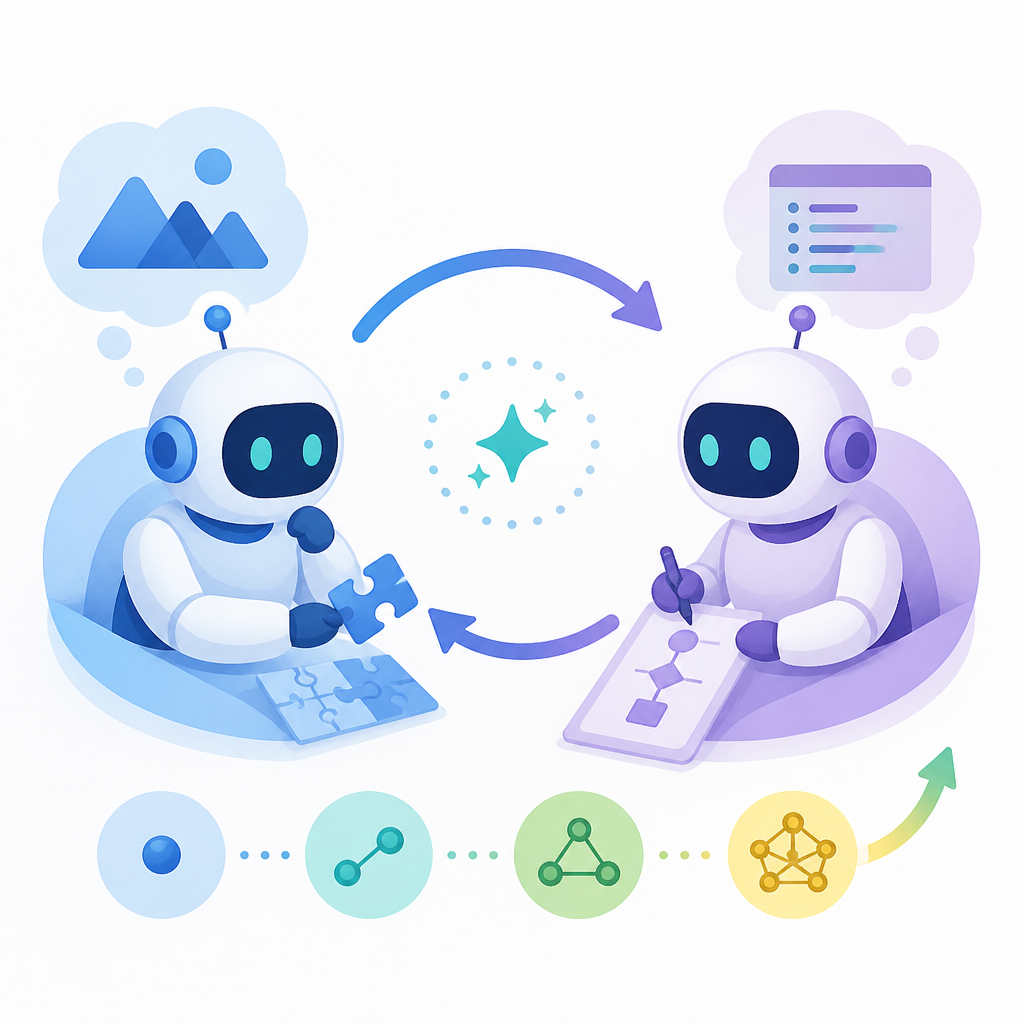
That tension matters because a self-improving system is only as good as its signal. If the model can invent harder tasks but cannot verify them reliably, the loop can drift. If it can verify well but only in a tiny sandbox, capability gains may not transfer.
The authors’ answer is to treat agent skills as a middle ground. Each skill gives the system a specific scenario where execution can be checked deeply, while routing across many skills keeps the overall task distribution broad.
How Skill Self-Play works
Skill-SP is described as a co-evolutionary framework with three parts: a proposer, a solver, and a dynamic skill controller. The proposer creates challenging tasks conditioned on dynamically sampled skills. The solver then tries candidate solutions and explores the edge of its current ability. The skill controller watches execution feedback, then updates and expands the skill library.
In plain English, this is a self-play loop built around skills instead of a fixed benchmark or a single environment. The proposer is not just making random hard problems; it is generating tasks that are tied to the current skill space. The solver is not just answering; it is being pushed to stretch. And the controller is not passive bookkeeping; it actively changes what skills exist next.
The paper says this orchestration happens through a reinforcement learning loop. That matters because the system is not described as a one-shot data generation pipeline. It is an interactive training process where task generation, solving, and skill expansion feed into one another continuously.
For developers, the architecture is interesting because it separates three roles that are often mixed together in agent training. You get a task generator, an executor, and a curriculum-like controller. That separation makes the training logic easier to reason about than a monolithic self-improvement setup where everything is optimized at once.
What the paper actually shows
The abstract does not give benchmark numbers, so there are no reported scores, deltas, or sample-efficient gains to cite here. What it does claim is directional: empirical evaluations on tool-use and reasoning benchmarks show that Skill-SP consistently pushes the performance ceiling of capable backbones.
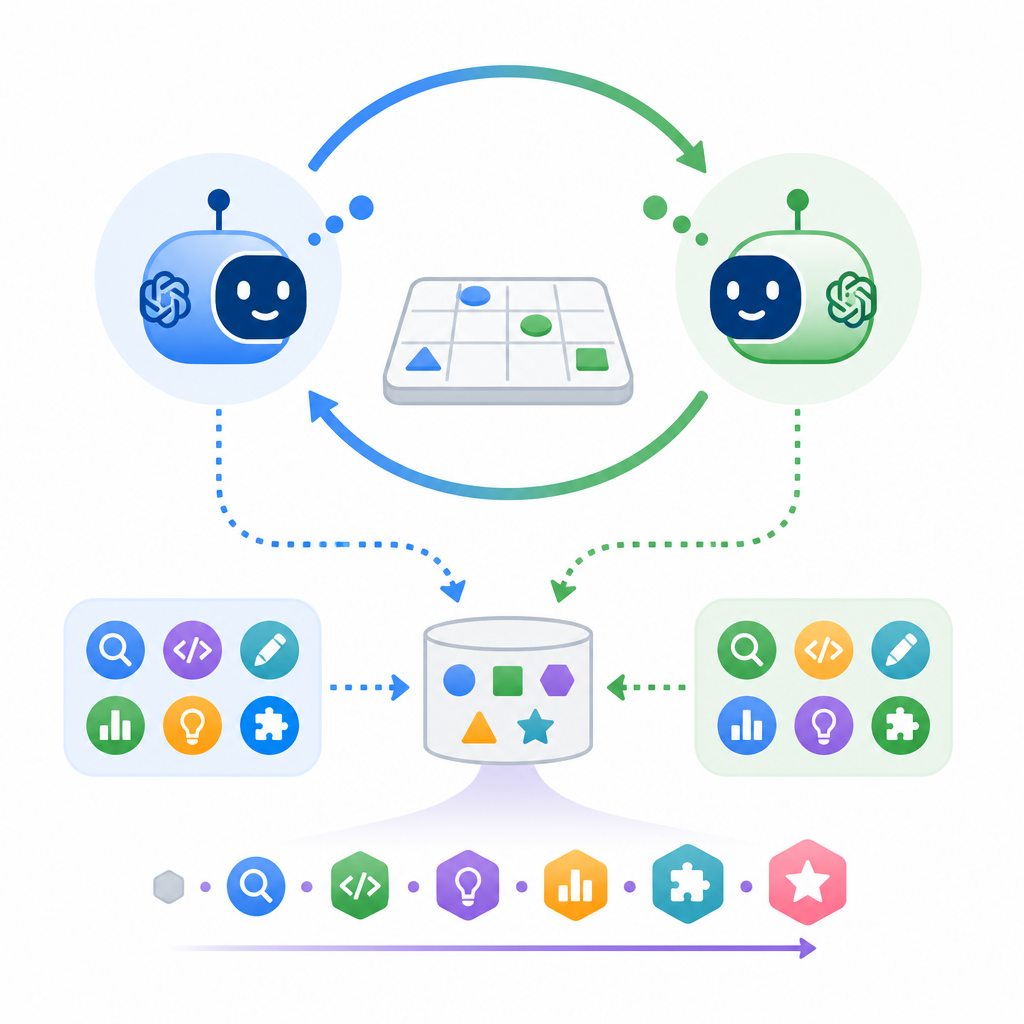
It also says the framework can produce striking turnarounds for initially misaligned models. That is a strong claim, but the abstract does not define the models, the exact tasks, or how large the turnaround was. So the safe reading is that the method appears to help not only strong starting models, but also models that begin in a poor alignment state.
Another important phrase is “robust evolution engine.” That suggests the authors see Skill-SP less as a benchmark trick and more as a reusable training mechanism. In other words, the contribution is the loop itself: a way to keep generating useful training signal while avoiding the worst failure modes of unconstrained self-generation.
- It targets both tool-use and reasoning benchmarks.
- It claims gains for competent backbones and misaligned models.
- It relies on co-evolution between task proposal, solving, and skill expansion.
Why engineers should care
If you are building agents, evaluation is often the bottleneck. You want the model to explore, but you also need a signal you can trust. This paper’s core idea is that skills can provide that signal without collapsing the task space into a tiny environment.
That could matter for any system that needs to improve through interaction: tool-using agents, reasoning agents, or training setups where the model must learn from its own generated tasks. The paper is not claiming a universal fix, but it does point to a practical design principle: keep verification local to a skill, while keeping the overall curriculum dynamic.
There is also a broader systems lesson here. The most useful self-improvement pipelines may not be the ones that maximize task novelty at all costs. They may be the ones that can generate novelty, verify execution, and expand the curriculum in the same loop.
Limitations and open questions
The abstract leaves several things unspecified. It does not give benchmark numbers, does not name the backbone models in the summary, and does not explain how many skills are in the library or how quickly it expands. It also does not describe failure cases, compute cost, or whether the method is stable across very different domains.
There is also a practical question around skill design and controller quality. If the skill library is poorly shaped, the system could still drift into narrowness or noisy feedback. The paper’s promise depends on the controller being able to identify useful skills and route tasks effectively.
That means the main takeaway is architectural, not just performance-oriented. Skill Self-Play sketches a way to make self-evolution less brittle by anchoring exploration in verifiable skill execution. For teams working on agent training, that is a pattern worth watching even before the full implementation details are known.
// Related Articles
- [RSCH]
Explainable RL for Air Traffic Control
- [RSCH]
SM4RT brings rigid motion into 4D reconstruction
- [RSCH]
Prompt engineering turns codegen into a repeatable workflow
- [RSCH]
CLEAR prompts turn AI search into usable answers
- [RSCH]
Prompt engineering in 2026: the cheat sheet
- [RSCH]
GraphVid uses interaction graphs to steer video