Crypto AI Agents Face a Hidden Model Risk
Crypto AI agents can keep running while their model access changes, and that can alter trade behavior overnight.

Crypto AI agents can keep running while their model access changes, and that can alter trade behavior overnight.
A crypto AI agent can stay online, keep the same interface, and still start making different decisions if its model changes. That matters now because Anthropic said on June 12, 2026, that it had to disable two frontier models, Fable 5 and Mythos 5, after a U.S. government export-control directive.
| Fact | Value |
|---|---|
| Anthropic action date | June 12, 2026 |
| Models disabled | Fable 5 and Mythos 5 |
| Government trigger | U.S. export-control directive |
| Global impact | All customers lost access to those two models |
| Policy context | AI Diffusion Rule published in January 2025, rescinded in May 2025 |
The real risk is not downtime
Get the latest AI news in your inbox
Weekly picks of model releases, tools, and deep dives — no spam, unsubscribe anytime.
No spam. Unsubscribe at any time.
The biggest mistake people make with AI agents is assuming the main failure mode is a clean outage. In crypto, the more dangerous failure is partial continuity: the app still loads, the wallet still connects, and the agent still answers, but the model behind it has changed.
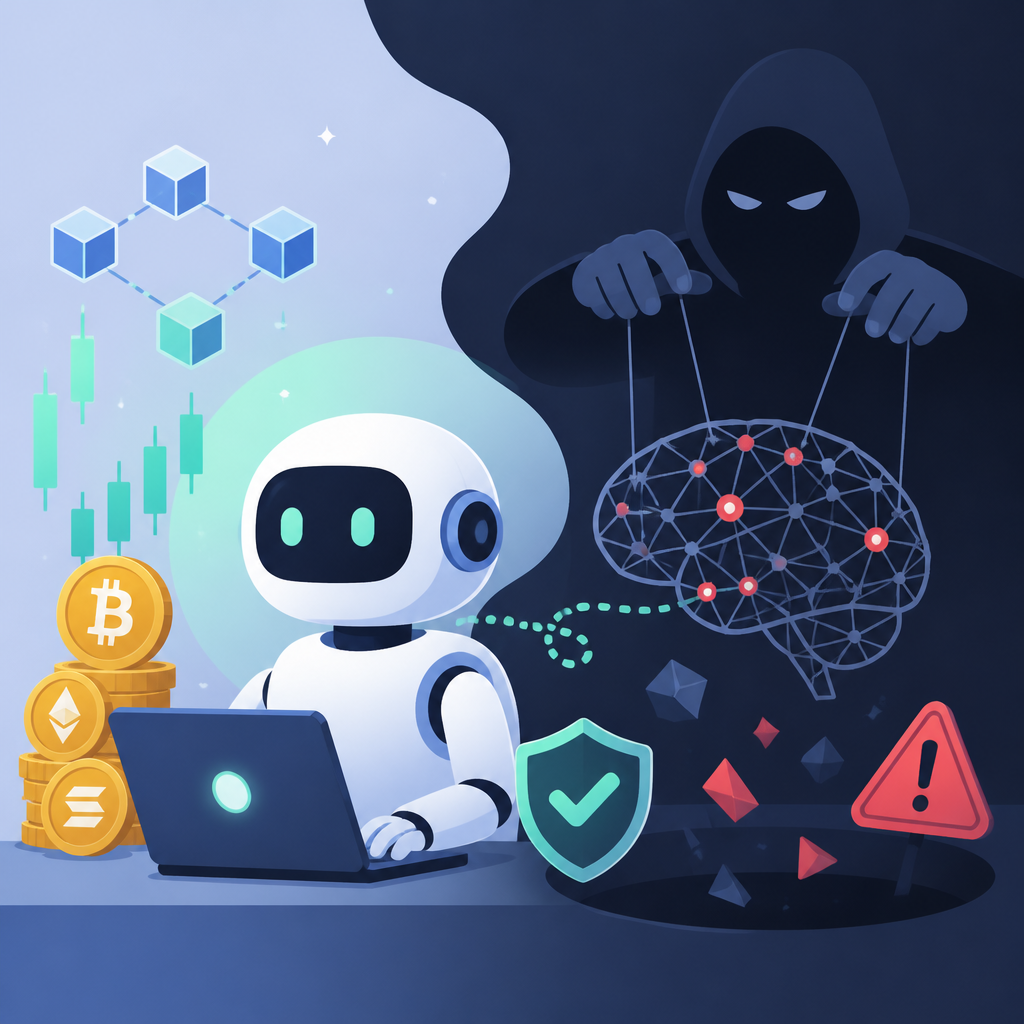
That kind of change can alter risk scoring, tool selection, prompt interpretation, and how the agent reacts to market noise. A strategy bot that used to reject a shaky trade may accept it after a model swap. A wallet assistant may miss a contract detail that the old model flagged. The UI can look identical while the decision layer is no longer the same.
This is why model-access risk deserves its own label. It is the chance that an AI product loses, changes, or downgrades access to the model it depends on. For a chatbot, that is annoying. For a DeFAI tool that can move funds, it can become a money problem.
The off-chain brain problem
Crypto AI agents live in two worlds at once. The on-chain part handles wallet calls, smart contract execution, settlement, and public verification. The off-chain part does the reasoning, and that is where the model lives. The split is functional, but it creates a dependency users often miss.
Blockchains are good at recording actions. They are not built to run large language models inside transactions. So the model usually sits on provider infrastructure, cloud regions, API keys, and external data feeds. If any of those pieces change, the agent can still be technically alive while its behavior shifts.
That makes the stack look safer than it is. Your wallet may still work. The chain may still settle. The agent may still issue commands. But the intelligence layer that chooses those commands is off-chain, centralized, and exposed to policy decisions that have nothing to do with your token.
- User prompt and strategy input happen on your device or the app front end.
- The model runs on provider servers, not inside the blockchain.
- Data feeds and RPC access come from outside providers.
- The final action lands on-chain only after the model decides what to do.
Why the Anthropic cutoff matters
Anthropic’s June 2026 move is important because it shows how quickly access to frontier models can change when governments treat a model as a security issue. The company said the U.S. government issued an export-control directive that forced it to suspend access to Fable 5 and Mythos 5 for any foreign national inside or outside the country. Anthropic then disabled both models worldwide.
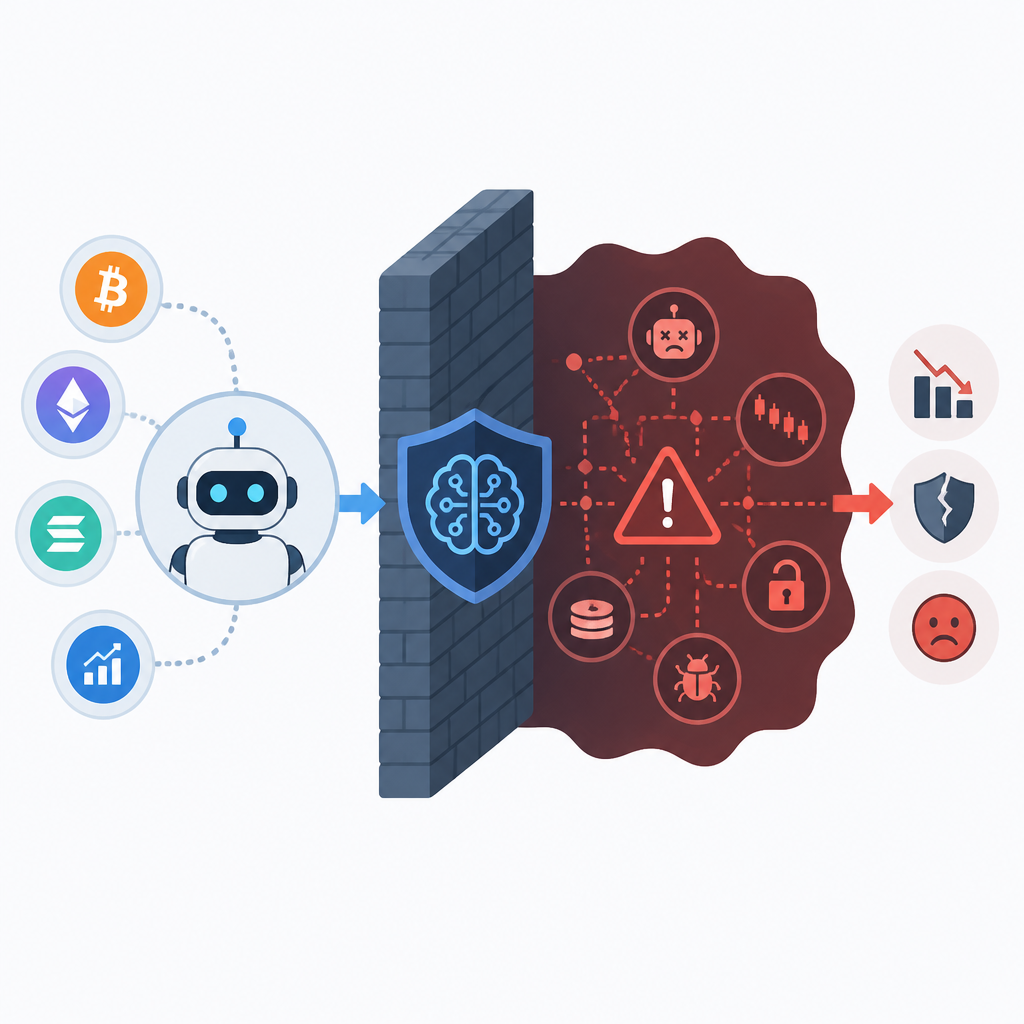
That sequence matters more than the specific dispute around the models. The company said the issue involved a possible jailbreak method, and that the government believed the technique could expose minor software vulnerabilities. Anthropic disagreed with the scope of the response, but the operational result was clear: access changed fast, and every customer felt it.
“There is no such thing as a perfect defense,” said Anthropic co-founder and CEO Dario Amodei in a January 2025 statement on AI safety, a line that fits this story because access control is part of the defense problem too.
For crypto, the lesson is simple. If a trading agent or wallet assistant depends on one controlled model, the model can disappear for reasons that have nothing to do with your app’s code quality. That is a supply-chain risk, not a product bug.
Export controls now reach the model layer
The Anthropic case did not come out of nowhere. In January 2025, the United States published the Bureau of Industry and Security’s AI Diffusion Rule, which treated advanced chips and model weights as items that could fall under export controls. In May 2025, BIS said it would rescind that rule and replace it with new guidance, while also tightening controls on advanced AI chips.
The exact wording changed, but the direction stayed the same: governments now see compute and frontier models as strategic assets. That puts the AI layer inside the same policy machinery that already affects semiconductors, cloud access, and cross-border technology transfers.
For crypto builders, that is a hard reality. A DeFAI app may be global by design, but its model provider may not be able to serve every user in every region. If a provider is forced to narrow access, the app might route to a weaker model, change its behavior, or shut off features without warning.
- Government action can block a model even if the app itself is legal.
- Provider policy changes can force a fallback model with weaker reasoning.
- Region restrictions can split the user base by geography.
- Cloud or API changes can raise costs enough to change product behavior.
Smart contract risk is not the same thing
Crypto already knows how to think about technical risk. Smart contracts can have bugs, bridges can fail, and token incentives can break. Model-access risk belongs to a different bucket because the contract may be fine while the agent’s decision-making changes underneath it.
That difference matters in practice. A smart contract bug is usually visible in code review, audits, or on-chain behavior. Model-access risk can hide behind a working product. The app may still quote prices, sign transactions, and answer questions, but the model may now be a fallback with different guardrails and different blind spots.
That is why decentralization claims need a full-stack check. A token does not make the model decentralized. A DAO does not make the inference layer decentralized. And a smart contract on Ethereum does not protect you from a provider-level cutoff on the off-chain brain.
If you want to judge a crypto AI agent, ask four questions:
- Which model does it use today?
- What happens if that model becomes unavailable?
- Can the app swap models without telling users?
- Does the project disclose where inference, data, and execution actually happen?
What to ask before trusting a crypto AI agent
The safest crypto AI products will treat model access like a dependency report, not a marketing detail. They should say which provider they use, whether they have fallback models, how they handle region blocks, and whether model changes alter execution permissions.
They should also disclose whether the agent can move funds automatically or only after human approval. That distinction matters more than the word “agent” on the homepage. A tool that drafts a trade is very different from one that signs it.
For users, the practical move is to check the stack before you deposit funds or let an agent act on your behalf. Read the docs, inspect the fallback policy, and look for any mention of provider dependence. If a project will not say what happens when the model disappears, that silence is itself a signal.
For builders, the standard should be higher. Publish model dependencies, document fallback behavior, and make model changes visible in the product. If the agent changes its reasoning engine, users should know before it touches their wallet.
Crypto’s AI layer now needs its own risk checklist
Crypto AI agents do useful work, but they do that work on top of infrastructure they do not own. That makes model-access risk a first-order issue, especially as governments treat frontier models like strategic assets.
The next obvious question is whether DeFAI teams will start publishing model dependency disclosures the way exchanges publish custody and security details. If they do, users will finally be able to tell the difference between a true autonomous agent and a product that only looks autonomous until a provider flips a switch.
Until then, the safest assumption is blunt: if an AI agent can move money, the model behind it can move your risk profile just as fast.
// Related Articles
- [AGENT]
SALA Boosts Long Context on Edge AI
- [AGENT]
Anthropic’s breach proves AI agents need hard security limits
- [AGENT]
GenAI.mil turns a scary prompt into a report
- [AGENT]
EPAM’s OpenAI deal turns pilots into production
- [AGENT]
Prompt engineering is overrated for Claude Code
- [AGENT]
Grok Build adds live previews and rewind fixes