Cursor’s real breakthrough came after eight public false starts
Cursor became a breakout product because Michael Truell kept relaunching it until the market finally answered.

Cursor became a breakout product because Michael Truell kept relaunching it until the market finally answered.
Cursor did not become a category-defining startup because its founders got the first version right; it won because Michael Truell kept launching, relaunching, and narrowing the product until the market finally said yes.
The first launch was not a code editor at all
Get the latest AI news in your inbox
Weekly picks of model releases, tools, and deep dives — no spam, unsubscribe anytime.
No spam. Unsubscribe at any time.
The cleanest way to understand Cursor’s rise is to start with the embarrassing part: in January 2022, Truell posted “Cursor – An AI Email Companion” on Hacker News. It was a product from cursor.so, not a code editor, and it landed with 2 points the first time and 4 points the second time, plus 5 comments. That is not a launch story built for mythology. It is a record of a founder testing a weak idea in public and getting a weak response.

That matters because it shows Cursor’s success was not preordained by branding or timing alone. The company did not begin with a perfectly sharp thesis about software development. It began with a broad AI productivity concept, then moved toward “A Copilot for Diffs” in March 2022, which still drew just 1 point and no comments. The market was not confused. It was uninterested. Truell and his team had to learn, in public, that the problem they were chasing was not email or diffs. It was the editor itself.
Real traction came only after the product narrowed
By March 2023, the submission had changed into something much more specific: “Cursor: A code editor built for programming with AI.” That post earned 14 points and 11 comments, which is still modest by internet standards, but it marks the first time the product description matched the thing users would actually care about. This is the pattern founders hate and investors ignore: the breakthrough often arrives only after the category is made narrower, not broader.
The same arc shows up in the later submissions. In January 2023, Truell boosted a co-founder’s post about “Cursor: An AI-Enabled IDE,” which got 8 points. By January 2025, the posts were no longer about concepts at all. They were about internal mechanics like “Character Prefix Conditioning” and “A New Tab Model,” the kind of technical writing a company publishes when it already has a real user base. One of those posts drew 29 points and 15 comments. That is the difference between pretending to have a product and shipping one people depend on.
Iteration beat charisma, and word of mouth did the rest
Cursor’s rise also proves that founder visibility is overrated when the product is good enough. Truell stayed unusually low-profile even as the company scaled fast, and Cursor’s growth came mostly from developer word of mouth rather than a loud public campaign. That is not an accident. It is the result of building a tool that sits inside a developer’s daily workflow, where usefulness compounds faster than marketing ever can.
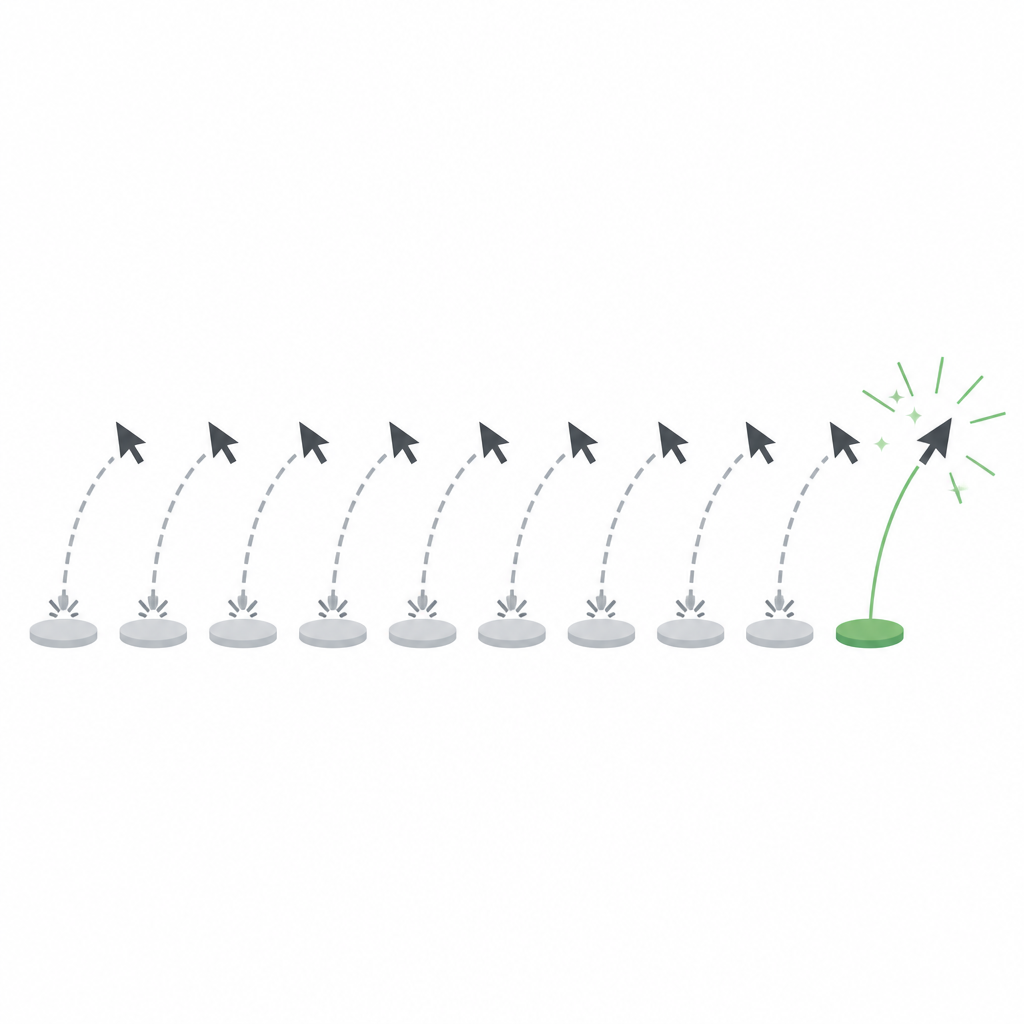
The company’s own numbers show how far that compounding went. Cursor raised a $60 million Series A in June 2024, then added three more rounds by the end of 2025, bringing in $3.3 billion and pushing valuation from $2.5 billion to $30 billion in a single year. By April 2025, Cursor was writing 1 billion lines of code a day, and more than a third of pull requests were being created by autonomous agents. Those figures do not describe a startup that got lucky on one launch. They describe a product that kept getting better until adoption became inevitable.
The counter-argument
The opposing view is straightforward: this was not persistence, it was privilege plus timing. Truell and his co-founders were MIT-trained, deeply technical, and building in the exact window when AI coding tools were becoming mainstream. GitHub Copilot had already educated the market, so Cursor was not creating demand from scratch; it was arriving after the category had been validated. On that reading, the eight launches are a nice anecdote, but the real driver was structural luck.
That objection has force. Timing mattered, and elite technical talent mattered. But it does not explain why Cursor, not one of its many peers, became the breakout. Plenty of teams had access to the same market wave. What separated Cursor was the willingness to abandon dead-end packaging, move from email to diffs to the editor, and then keep refining the core experience until users stayed. Timing opens the door. Iteration decides who walks through it.
What to do with this
If you are a founder, stop treating the first launch as a verdict. Treat it as a diagnostic. If the market ignores your idea, do not polish the pitch deck; change the problem, the workflow, or the product boundary until the response changes. If you are a PM or engineer, look at Cursor’s history as a reminder that shipping is not the same as finishing. The right move is often to keep the team close to the user, keep the surface area small, and keep relaunching until the product earns its place in someone’s daily habit.
Cursor’s eight launches are the point, not the footnote
Cursor’s story is not that Michael Truell had one brilliant idea from the start. It is that he had the discipline to keep trying versions of the idea until one of them matched the market. That is the part most startup stories flatten away, because it is less glamorous than genius. But it is the more useful lesson: big companies are usually built by founders who survive their own bad first drafts.
// Related Articles