ELSA3D Makes 3D Models Reason in Scales
ELSA3D uses sparse anchors and scale-aware geometry to unify 3D generation and language reasoning.

ELSA3D unifies 3D generation and language reasoning with sparse, scale-aware cross-modal anchors.
- Research org: Unspecified in arXiv abstract
- Core data: Roughly halving FLOPs and inference latency
- Breakthrough: Anchor Tokens route semantic cues to matched 3D abstraction scales
ELSA3D: Elastic Semantic Anchoring for Unified 3D Understanding and Generation is trying to fix a familiar problem in unified 3D models: text and geometry are often mixed into one flat token stream, so the model has to sort out coarse structure and fine detail with the same undifferentiated attention machinery. That works in principle, but it makes cross-modal reasoning implicit, expensive, and easy to blur.
For developers, the important idea is not just that ELSA3D generates 3D assets and captions them. It is that the model tries to make the text-to-3D connection explicit and selective, so the system can spend capacity where alignment actually matters instead of letting every token talk to every other token all the time.
What problem this paper is trying to fix
Get the latest AI news in your inbox
Weekly picks of model releases, tools, and deep dives — no spam, unsubscribe anytime.
No spam. Unsubscribe at any time.
Unified 3D foundation models aim to do two jobs in one backbone: create 3D content and reason about it in language. That is attractive because it reduces fragmentation across specialized models, but it also creates a design problem. If you simply concatenate text tokens and 3D tokens into a single sequence, the model has no built-in sense of which language cue should affect which geometric detail.

The abstract says existing methods collapse coarse structural cues and fine geometric details into one representation. In practice, that means the model has to infer too much from a single self-attention pool. The result is a system that can be flexible, but not necessarily precise. ELSA3D is presented as a way to keep the interaction sparse while still making it targeted.
This matters because 3D data is naturally hierarchical. Large-scale structure, object parts, and local surface details do not all live at the same level of abstraction. A model that treats them all the same is leaving structure on the table. ELSA3D’s core claim is that the model should reason along matched abstraction scales instead of flattening everything into one sequence.
How the method works in plain English
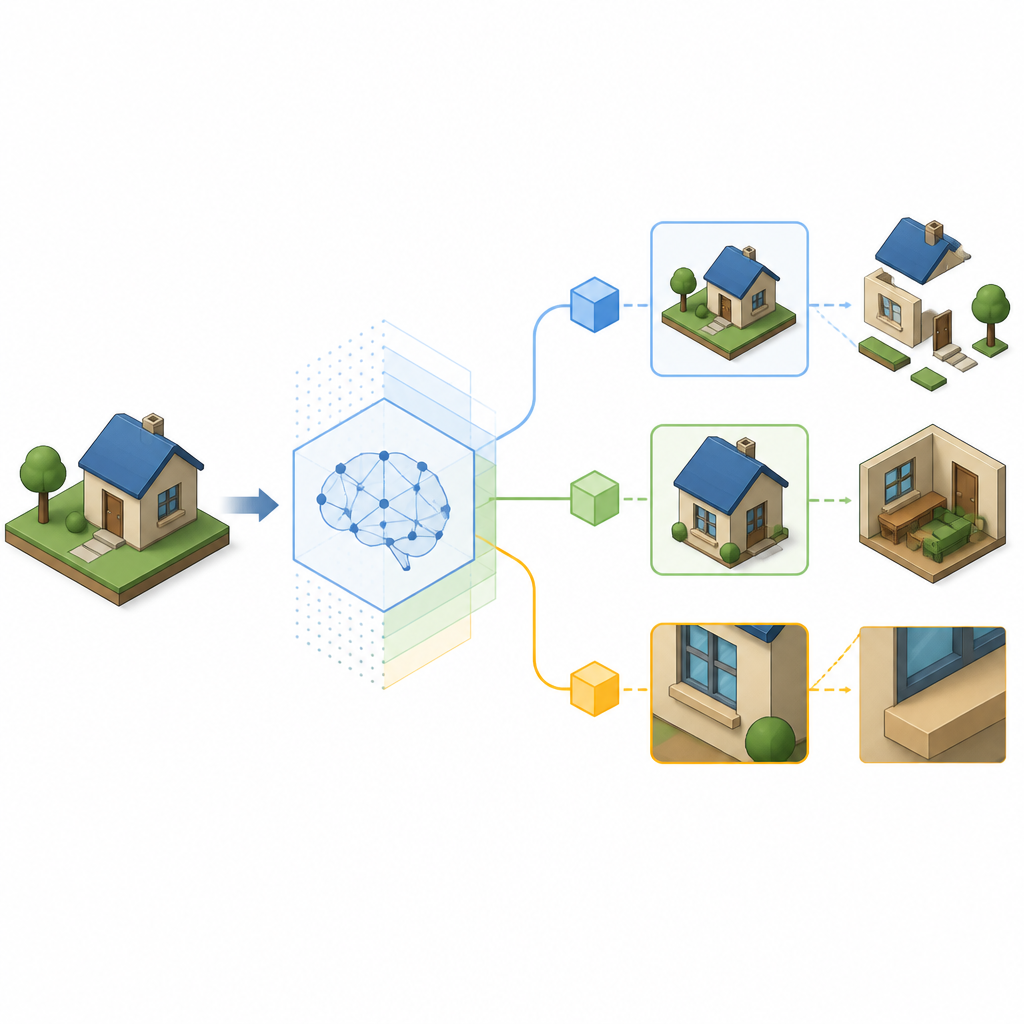
ELSA3D introduces what the authors call elastic semantic anchoring. The basic idea is simple: instead of letting every language token interact with every geometry token, the model creates sparse cross-modal units called Anchor Tokens. These anchors pick out semantic cues from text, route them to the most relevant 3D scale, retrieve geometric evidence at that scale, and then write the fused result back into the shared representation.
That “elastic” part is doing a lot of work. The model is not forced to use the same cross-modal path for every example or every token. A lightweight per-block router chooses which text tokens should become anchors and at what geometric scale they should operate. So the model can concentrate cross-modal capacity where alignment is most needed.
The 3D side is also scale-aware. ELSA3D represents geometry with a scale-aware octree tokenizer, which suggests the model is not encoding 3D space as one flat blob. Instead, it can work across different levels of spatial resolution, which is a better fit for the way 3D scenes and objects are actually structured.
In plain terms, ELSA3D is trying to make the language side ask the right question at the right level of detail, and the geometry side answer with evidence from the right part of the shape hierarchy. That is a more disciplined design than generic self-attention over mixed tokens.
What the paper actually shows
The abstract claims state-of-the-art performance across three tasks: image-to-3D generation, text-to-3D generation, and 3D captioning. It also says ELSA3D outperforms the strongest unified baseline. Those are the headline results, but the abstract does not provide the exact benchmark names or task-specific scores, so this summary cannot fill those in.
What the abstract does give us is a concrete efficiency result. Compared with the non-elastic version of the same model, ELSA3D roughly halves FLOPs and inference latency. That is the most actionable number in the note, because it suggests the method is not only about better alignment but also about making unified 3D reasoning cheaper to run.
That tradeoff is important. In many foundation-model settings, adding more cross-modal capability usually means more compute. Here, the design is explicitly trying to avoid that by making the interaction sparse and routed. If the reported savings hold in practice, the architecture could be appealing for teams that care about both quality and throughput.
Still, the abstract leaves out several things engineers would want to inspect before treating this as a drop-in design: exact datasets, the size of the backbone, how the router is trained, and whether the gains hold across different 3D domains. Those details may be in the full paper, but they are not in the source text here.
Why developers should care
If you build systems around 3D generation, scene understanding, or multimodal assistants that need to talk about 3D assets, the architecture idea here is practical. It suggests a way to avoid brute-force token mixing and instead align language and geometry through explicit sparse pathways. That can make unified models easier to reason about, easier to scale, and potentially cheaper to serve.
The scale-aware octree tokenizer is also a useful signal. It reinforces a broader lesson for 3D ML: representation matters as much as model size. When the input format preserves hierarchy, the model has a better chance of learning the right abstractions without wasting capacity on irrelevant detail.
At the same time, the paper is not claiming to solve all of unified 3D. The abstract does not say anything about failure cases, robustness under noisy prompts, or behavior on out-of-distribution geometry. It also does not provide benchmark numbers in the summary we have, so the performance story is directional rather than fully quantified here.
What to watch next
The most interesting question is whether elastic anchoring generalizes beyond the reported tasks. If the same routing idea works for other 3D reasoning settings, it could become a pattern for future multimodal backbones: keep the shared representation unified, but make cross-modal communication selective and scale-aware.
For now, the key takeaway is straightforward. ELSA3D argues that unified 3D models do not need to choose between generation and understanding, but they do need a better interface between language and geometry. Its answer is sparse anchors, hierarchical 3D tokens, and a router that decides when and where to spend cross-modal compute.
- ELSA3D targets the common failure mode of flat text-plus-3D token mixing.
- Its main technical move is sparse Anchor Tokens routed to matched 3D scales.
- It reports better quality plus roughly 2x lower FLOPs and latency than the non-elastic version.
// Related Articles
- [RSCH]
Rethinking Indic AI Through Cultural Heritage
- [RSCH]
Graph Convolutional Attention fixes graph denoising
- [RSCH]
Leanstral 1.5 proves open-source math models are now useful
- [RSCH]
Label-free real-bogus classification with calibrated uncertainty
- [RSCH]
Direct-OPD reuses weak-model RL gains for stronger models
- [RSCH]
CamVLA makes robot policies view-robust