Rethinking Indic AI Through Cultural Heritage
This paper reframes Indic AI as a cultural-preservation problem and proposes Culture Sensing for more meaningful outputs.

Earlier Indic AI focused on access; this paper argues it must also preserve cultural meaning.
- Research org: Unspecified in arXiv abstract
- Core data: No benchmark numbers in abstract
- Breakthrough: Introduces “Culture Sensing” using hermeneutic reasoning
Rethinking Indic AI from a Lens of Cultural Heritage Preservation is not a typical model paper. It is a framing paper that asks a bigger question: if AI is spreading across the Indian subcontinent, how do we make sure it does not flatten the languages, practices, and worldviews it is supposed to serve?
That matters for engineers because the usual “just scale up the model” approach does not automatically solve representation. In a setting with rich morphology, complex scripts, diglossia, and wide dialect variation, a system can look fluent while still missing the cultural meaning behind the words.
What problem the paper is trying to fix
Get the latest AI news in your inbox
Weekly picks of model releases, tools, and deep dives — no spam, unsubscribe anytime.
No spam. Unsubscribe at any time.
The paper starts from a tension that is easy to miss in product work. AI can expand access for large populations, but it can also homogenize worldviews and leave underrepresented languages behind. The authors treat that as a core design problem, not a side effect.

Instead of looking at Indic AI only as a language-coverage issue, they connect it to cultural heritage preservation. That shift changes the goalposts: success is not just whether a model can answer in an Indic language, but whether it can do so in a way that is culturally meaningful.
The paper also emphasizes that Indian languages are not a uniform bucket. Their linguistic structure is tied closely to cultural practice and worldview, and that creates unique challenges for AI foundation models. Rich morphology, complex scripts, grammar rules, diglossia, and dialectal variation all make the problem harder than a straightforward translation or tokenization task.
How the paper approaches the problem
This is a survey-and-position paper, so the method is conceptual and historical rather than experimental. The authors perform a longitudinal survey of how NLP techniques have evolved in Indic settings, tracing milestones, methodological shifts, and resource-creation efforts over time.
That historical view is useful because it shows how the field moved from early resource building to newer foundation-model efforts. The paper then examines how current Indic foundation models try to address long-standing gaps in resources and representation.
In practical terms, the paper is mapping the space for developers: what has been tried, what kinds of language-specific obstacles keep recurring, and where the next step should go. It is less about a new architecture and more about a new lens for evaluating future systems.
What “Culture Sensing” means
The paper’s main proposal is a research direction called Culture Sensing. The idea is to re-imagine AI through hermeneutic reasoning, which in plain English means interpreting language in context rather than treating it as a purely statistical pattern-matching problem.
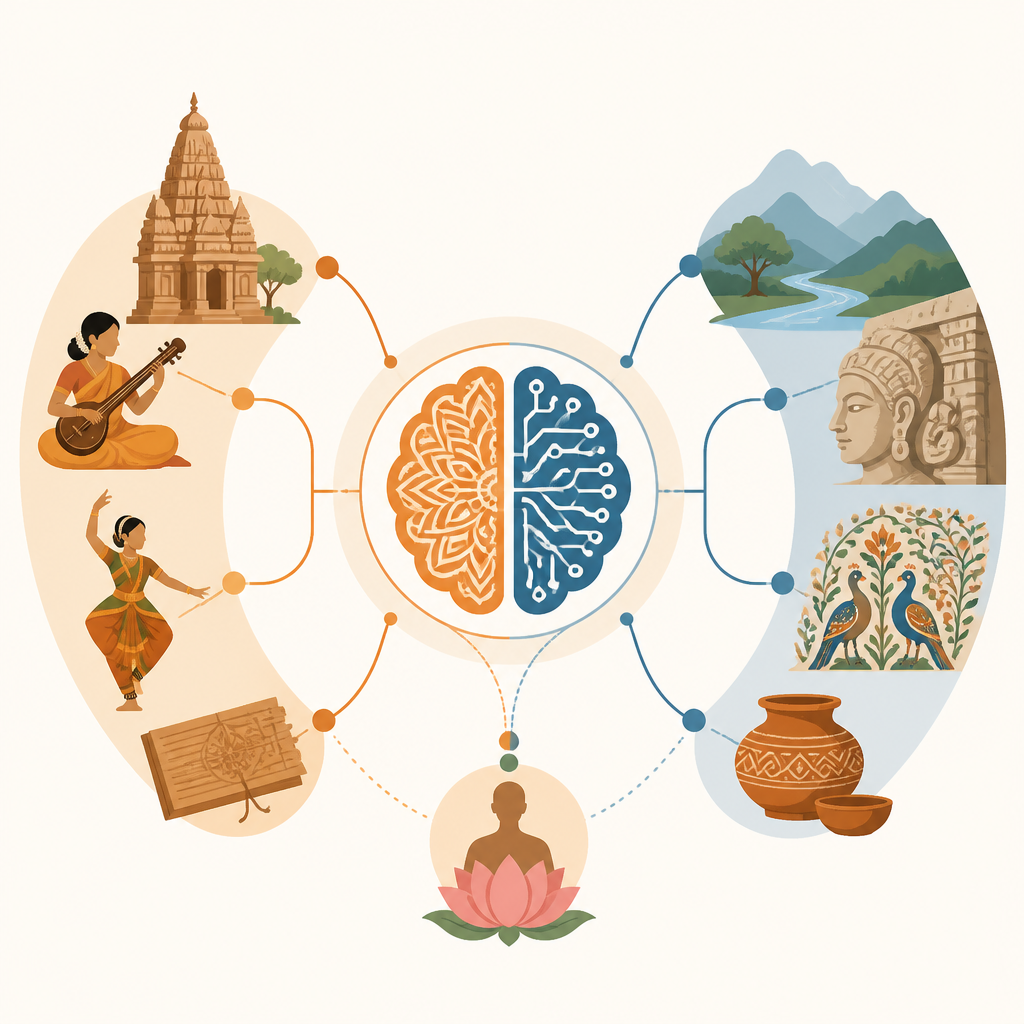
Culture Sensing is meant to tackle two open problems the authors call out explicitly: equitable performance across low-resource languages and outputs that are culturally meaningful. That is a stronger bar than standard accuracy, because it asks whether the model respects the social and interpretive context of the language it is generating.
The paper does not present Culture Sensing as a finished system with benchmark results. It is a direction for research, not a shipped method. That is important: the contribution here is the framing, the taxonomy of challenges, and the argument for why future Indic AI should be evaluated differently.
What the paper actually shows
Because this is an abstract-level summary of a survey and position paper, there are no benchmark numbers in the source material. There are also no reported wins on a standard benchmark, no ablation table, and no quantified comparison against prior models.
What it does show is a structured case for why Indic NLP needs to be treated as both a technical and cultural problem. The paper ties together past work, current techniques, and emerging trends to argue that the next phase of the field should prioritize robustness, inclusion, and cultural meaning at the same time.
For teams building multilingual systems, that is a useful reminder that “supporting a language” is not the same as “supporting the people who use it.” The paper’s lens pushes developers to think about representation gaps, dialect diversity, and whether model outputs preserve the worldview embedded in the language.
Why developers should care
If you work on search, assistants, translation, moderation, or foundation models for Indian languages, this paper offers a design checklist more than a benchmark suite. It says the hard part is not only coverage, but fidelity to cultural context.
That has direct implications for data collection, evaluation, and product decisions. A model trained on more text can still fail if it erases dialects, collapses diglossic usage, or produces text that is grammatical but socially off-target.
The paper also suggests that future Indic AI work may need new evaluation criteria. If cultural meaning matters, then standard metrics alone will not capture the full picture. Developers may need human-centered review, language-community input, and task definitions that reflect real linguistic practice.
Limitations and open questions
The biggest limitation is that the paper is primarily a synthesis and proposal. It does not claim a new model architecture, and it does not provide experimental evidence that Culture Sensing works yet.
That leaves several open questions. How do you operationalize hermeneutic reasoning in a model pipeline? What data sources best represent cultural context without overfitting to elite or urban usage? How should success be measured across languages with very different writing systems and dialect continua?
Those are not small questions, but they are the right ones to ask if the goal is a more inclusive Indic AI stack. The value of this paper is that it makes the problem legible in engineering terms while refusing to reduce it to a simple benchmark chase.
In short, the paper argues that the next wave of Indic NLP should not just be bigger or broader. It should be more culturally aware, more linguistically grounded, and more honest about what it means for AI to serve a multilingual civilization.
// Related Articles
- [RSCH]
Graph Convolutional Attention fixes graph denoising
- [RSCH]
ELSA3D Makes 3D Models Reason in Scales
- [RSCH]
Leanstral 1.5 proves open-source math models are now useful
- [RSCH]
Label-free real-bogus classification with calibrated uncertainty
- [RSCH]
Direct-OPD reuses weak-model RL gains for stronger models
- [RSCH]
CamVLA makes robot policies view-robust