Graph Convolutional Attention fixes graph denoising
A new graph attention method uses spectrum-aware filtering to improve denoising and diffusion without expensive structural features.

Graph Convolutional Attention uses graph spectrum information to improve denoising and diffusion.
- Research org: Unspecified in arXiv abstract
- Core data: No benchmark numbers in abstract
- Breakthrough: Graph-filtered queries and keys for spectral denoising
Graph denoising is one of those unglamorous problems that sits underneath a lot of graph learning work. If the input graph is noisy, then downstream models can waste capacity learning around the noise instead of learning the structure that matters. This paper argues that standard linear attention is not the right tool for that job, and it replaces it with a spectrum-aware alternative called Graph Convolutional Attention, or GCA.
For engineers building graph transformers or graph diffusion systems, the practical question is simple: how do you denoise graphs without paying a big compute bill or relying on brittle structural features? The paper’s answer is to use the graph’s spectrum directly, then implement that idea in a permutation-equivariant way that can be dropped into attention-based architectures.
What problem this paper is trying to fix
Get the latest AI news in your inbox
Weekly picks of model releases, tools, and deep dives — no spam, unsubscribe anytime.
No spam. Unsubscribe at any time.
The paper focuses on graph denoising, which it describes as a fundamental problem in graph learning and the core operation in graph diffusion models. In plain terms, the model needs to recover useful structure from a graph that has been corrupted or blurred by noise. That matters both for training and for generation, because a diffusion model that cannot denoise well will struggle to produce clean graph structure.

The authors say attention-based architectures such as graph transformers have recently shown promise here, but the underlying mechanism has not been well understood. That gap matters because if you do not know what attention is actually learning, it is hard to know whether the mechanism is aligned with the task or just working by accident on a narrow set of graphs.
The paper’s main critique is specific: under a denoising objective, linear attention is suboptimal. According to the abstract, it can only learn an average spectral denoising filter over the training distribution. That creates a limitation when graphs in the dataset vary spectrally, because a single average filter cannot adapt to the diversity of graph structures it sees.
How the method works in plain English
Instead of treating attention as a generic content-matching mechanism, the paper reframes denoising as a spectral problem. It introduces Spectral Attention, which directly uses the input graph spectrum. The claim is not just that this is a nicer interpretation; the paper says this mechanism provably outperforms linear attention by an amount governed by the spectral diversity of the distribution.
The practical version of that idea is Graph Convolutional Attention. GCA is described as a permutation-equivariant realization of spectral attention that implements spectral denoising through graph-filtered queries and keys. That is the key design move: rather than using attention on raw node features alone, the model first filters queries and keys through the graph structure so the attention computation is already informed by the spectrum.
The abstract also adds an important detail about the softmax step that follows attention. According to the authors, softmax provides additional denoising by approximately projecting noisy eigenvectors onto the clean eigenspace. In other words, the attention block is not just scoring interactions; it is also helping clean up spectral components that were corrupted by noise.
What the paper actually shows
The paper makes both theoretical and empirical claims. On the theory side, it says Spectral Attention provably beats linear attention, and that the size of the gain depends on the spectral diversity of the graph distribution. That is a useful framing because it suggests when the method should help most: not on uniform graph families, but on datasets where spectral structure changes a lot from sample to sample.
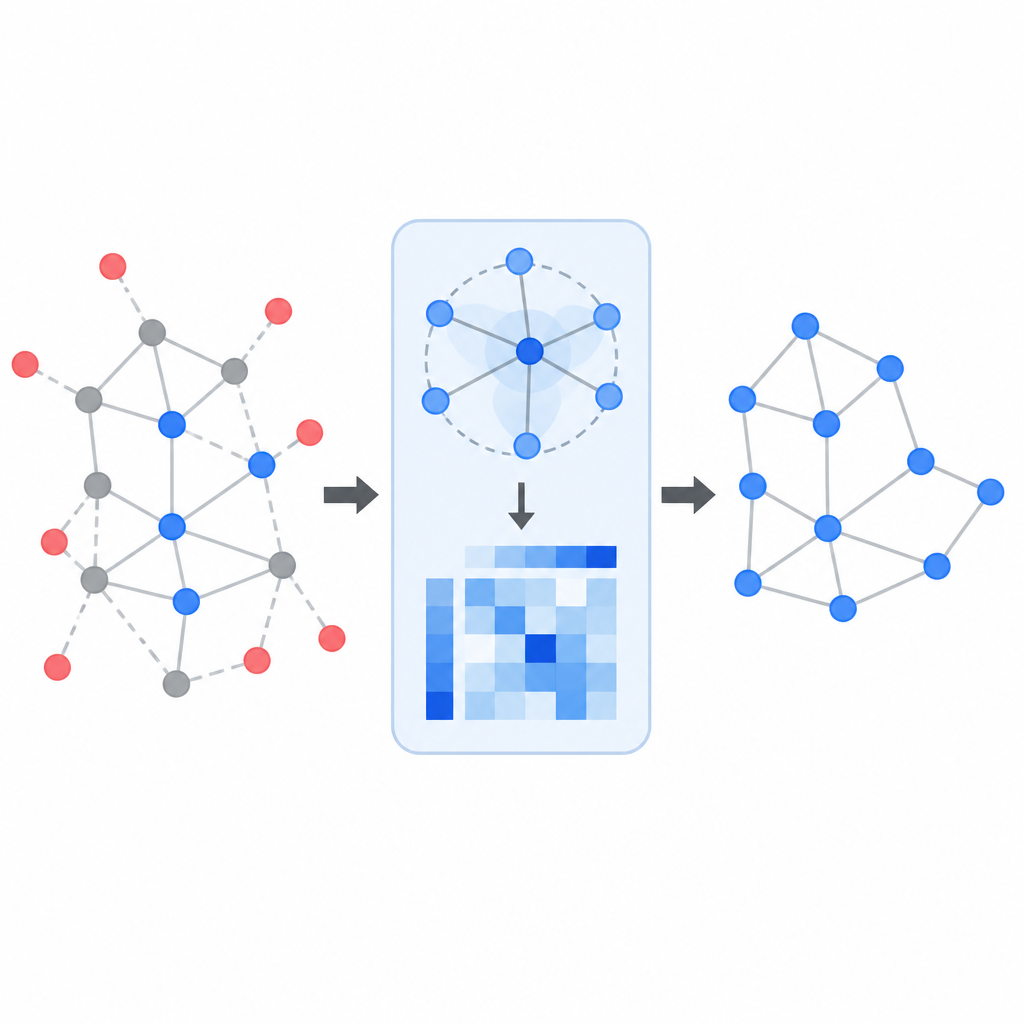
For stochastic block models, the paper says GCA provably matches the idealized Spectral Attention mechanism. That is a strong result because stochastic block models are a standard setting for testing whether a graph method can recover community structure under noise. Matching the idealized mechanism suggests the practical implementation is not just a heuristic approximation.
On the empirical side, the abstract says replacing linear attention with GCA consistently improves graph denoising and diffusion on synthetic and real datasets, and that the gains are strongly correlated with spectral diversity. The abstract does not provide benchmark tables or specific numeric scores, so there are no exact improvements to report here. What it does make clear is that the improvement is not uniform across all datasets; it tracks how spectrally varied the data is.
There is also a very practical systems angle. In DiGress, GCA matches standard graph-transformer performance without computing expensive structural features. And when combined with the recently proposed PEARL positional encodings, it avoids explicit eigendecomposition computations, which leads to faster inference without degrading quality. For developers, that combination is the real value proposition: better denoising behavior without forcing an expensive spectral decomposition step into every run.
Why developers should care
If you are building graph generation, graph diffusion, or graph transformer pipelines, this paper gives you a concrete warning: standard linear attention may be averaging away exactly the structure you need to preserve. If your graphs vary a lot in spectral terms, a one-size-fits-all attention rule may leave performance on the table.
GCA is interesting because it tries to make attention behave more like a graph filter than a generic sequence operator. That is a useful design pattern for graph ML in general: bake the structure of the problem into the attention computation instead of hoping the model learns it indirectly. The paper’s implementation choice, graph-filtered queries and keys, is the part engineers would actually look at when deciding whether to prototype the method.
There is also a deployment angle. The abstract explicitly mentions avoiding expensive structural features and, with PEARL positional encodings, avoiding explicit eigendecomposition. That matters because spectral methods are often attractive in theory but awkward in practice when they require costly preprocessing or per-graph linear algebra.
Limitations and open questions
The abstract is strong on theory, but it leaves some practical questions unanswered. It does not give benchmark numbers, dataset names beyond DiGress and the mention of synthetic and real datasets, or runtime figures for the faster inference claim. So while the direction is clear, the abstract alone does not tell you how large the gains are in absolute terms.
Another open question is how broadly the spectral-diversity story transfers across graph domains. The paper says the gains are strongly correlated with spectral diversity, which is helpful guidance, but that also implies the method may matter less on datasets where graphs are spectrally similar. That makes dataset characterization important before adoption.
Even so, the paper’s central message is easy to act on: if your graph learning stack depends on denoising, and especially if it uses attention, you should think about whether the model is actually using graph spectrum information or just averaging over it. GCA is presented as a way to make that spectral information part of the attention mechanism itself, while keeping the implementation permutation-equivariant and practical.
Bottom line
Graph Convolutional Attention is a spectrum-aware attention design for graph denoising and diffusion. The paper argues that linear attention is fundamentally limited for this task, then shows how to replace it with a graph-filtered mechanism that is both theoretically grounded and practical enough to slot into existing graph transformer systems.
- Linear attention can only learn an average spectral filter over the training distribution.
- GCA uses graph-filtered queries and keys to make attention spectrum-aware.
- The method aims to improve denoising without requiring expensive structural features or explicit eigendecomposition.
// Related Articles
- [RSCH]
Rethinking Indic AI Through Cultural Heritage
- [RSCH]
ELSA3D Makes 3D Models Reason in Scales
- [RSCH]
Leanstral 1.5 proves open-source math models are now useful
- [RSCH]
Label-free real-bogus classification with calibrated uncertainty
- [RSCH]
Direct-OPD reuses weak-model RL gains for stronger models
- [RSCH]
CamVLA makes robot policies view-robust