Equilibrium thermodynamic computing, made trainable
A blueprint for hardware-native thermodynamic computing uses Langevin dynamics and probabilistic graphical models.

This paper outlines a trainable thermodynamic computing stack built on stochastic analog hardware.
- Research org: Unspecified in arXiv abstract
- Core data: No benchmark numbers in abstract
- Breakthrough: Uses Langevin-driven energy potentials in physical hardware
Machine-learning systems are expensive to run, and the paper is aimed squarely at that problem: energy and latency. The authors argue that one way around those costs is to move part of the computation into stochastic analog physical hardware, where the hardware itself helps generate and sample from energy-based models.
That is a very different angle from the usual digital-first approach. Instead of treating randomness as a nuisance to be simulated, the paper treats stochastic dynamics as the core primitive. For engineers, the interesting part is not just the physics; it is the idea that model construction, sampling, and training can be organized around hardware-native energy-based models.
What problem this paper is trying to fix
Get the latest AI news in your inbox
Weekly picks of model releases, tools, and deep dives — no spam, unsubscribe anytime.
No spam. Unsubscribe at any time.
The abstract frames the core issue plainly: machine-learning workloads keep pushing up energy use and latency. That matters whether you are building inference systems, probabilistic models, or research hardware, because the cost of sampling and repeated computation can quickly dominate the practical deployment story.

The paper’s answer is a thermodynamic computing stack that is both energy-efficient and fast in principle. Rather than relying on conventional digital execution alone, it leverages stochastic analog processes in physical hardware. The goal is to make the physics do useful work for probabilistic machine learning.
This is especially relevant for developers working near the boundary of ML systems and hardware. If a model class can be mapped onto a physical process that naturally samples from the right distribution, then some of the expensive machinery of digital simulation may be reduced or reshaped. The paper is not claiming that this is already a drop-in replacement for today’s ML stack; it is proposing a blueprint for getting there.
How the method works in plain English
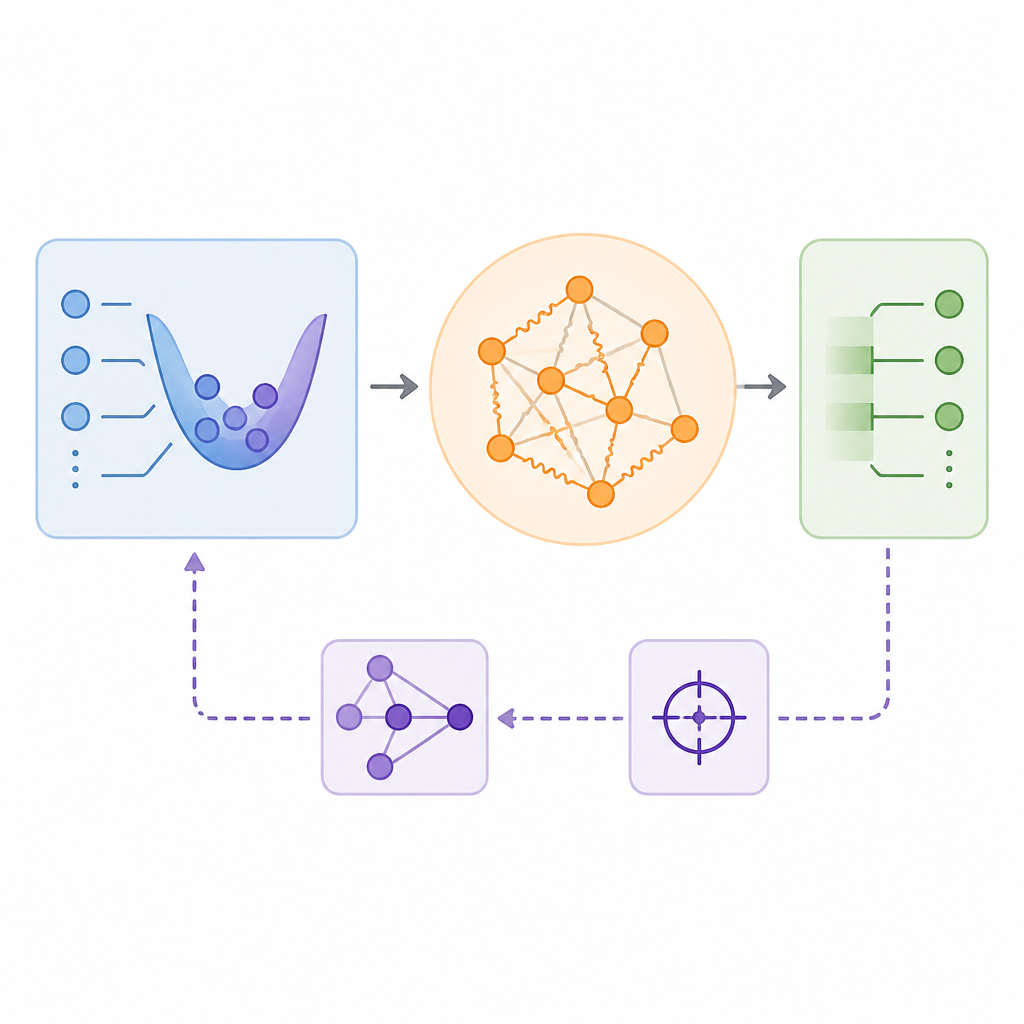
The technical center of the paper is energy-based thermodynamic computing, with stochastic processes described by Langevin dynamics. In simple terms, Langevin dynamics is a way to model noisy motion in a potential landscape. Here, the “landscape” is an energy potential that can be tuned.
Those tunable potentials are implemented in physical hardware. Once that hardware exists, it can generate and sample from basic parameterized energy-based models. That is the key hardware-native idea: the model is not merely simulated by the machine; the machine is built to embody the model’s dynamics.
The authors then use probabilistic graphical models as the framework for building and training popular classes of machine learning models on top of those hardware-native energy-based models. That matters because graphical models give a structured way to represent dependencies and perform inference, which makes the proposal more than a physics demo. It is positioned as a general modeling and training approach.
In other words, the paper is stitching together three layers: stochastic analog hardware, energy-based modeling, and probabilistic graphical models. The blueprint is about making those layers line up so that the hardware can support training and sampling workflows rather than just isolated physical experiments.
What the paper actually shows
The abstract says the authors analyze runtime and energy consumption for different models in this thermodynamic paradigm using theoretical considerations and numerical studies. That is useful, but the abstract does not give benchmark numbers, so there are no concrete speedups, watt savings, or accuracy metrics to report here.
That omission is important for readers who want to judge maturity. The paper is presenting an architecture and an analysis, not a full performance leaderboard. So the right takeaway is that the work outlines how such a stack could be evaluated, and indicates that runtime and energy are part of the analysis, but it does not provide abstract-level quantitative proof of superiority.
The most tangible experimental piece mentioned is a preliminary realization: stochastic analog superconducting circuits driven by thermal noise. That suggests the authors are not only writing theory; they are also pointing to a physical implementation path. Still, the abstract carefully labels it as preliminary, which means this is best read as an early hardware proof-of-concept rather than a finished platform.
- Hardware-native energy-based models are generated and sampled in physical hardware.
- Training is framed through probabilistic graphical models.
- Runtime and energy are studied theoretically and numerically, but no abstract-level metrics are given.
Why developers should care
If you build ML systems, the headline lesson is that there may be another route to sampling-heavy workloads besides ever-larger digital accelerators. This paper explores a path where stochastic analog physics becomes part of the compute stack, especially for probabilistic machine learning.
For developers, that could matter in a few practical ways. First, it reframes model design around what hardware can do natively. Second, it suggests that training and inference for certain energy-based models might eventually be co-designed with physical dynamics rather than forced through purely digital emulation. Third, it gives a vocabulary for thinking about thermodynamic hardware as a platform, not just a lab curiosity.
But the limitations are just as important. The abstract does not show benchmark numbers, so you cannot yet compare this approach against standard ML hardware on throughput, accuracy, energy, or cost. It also does not claim a production-ready system. The superconducting circuits are explicitly preliminary, which means there is still a lot of work between a blueprint and a deployable stack.
The other open question is scope. The paper focuses on energy-based thermodynamic computing and probabilistic graphical models, so it is not claiming that every ML workload should move to analog hardware. The likely sweet spot is narrower: workloads where sampling and stochastic dynamics are central, and where the physics can be matched to the model structure.
What to watch next
The most interesting next step would be to see how this blueprint performs once the hardware and models are pushed harder. That would mean concrete measurements, clearer comparisons to digital baselines, and evidence that the training workflow scales beyond a preliminary circuit demonstration.
For now, the value of the paper is architectural. It gives a plausible route from stochastic physical hardware to trainable probabilistic models, and it does so without pretending that the hard engineering problems are already solved. If you care about low-energy ML, hardware-aware model design, or non-CMOS compute, this is the kind of paper that sketches the map before the road exists.
// Related Articles
- [RSCH]
LLM Inference Hardware Needs Memory, Not More FLOPs
- [RSCH]
Agent Skills: the next layer for LLM agents
- [RSCH]
Offline-First LLMs for Low-Connectivity Learning
- [RSCH]
How LLMs are changing US research funding
- [RSCH]
Aligning LLMs with selective prediction
- [RSCH]
Implicit Reasoning for LLM Recommendation