Aligning LLMs with selective prediction
This paper studies how to make LLMs answer only when they’re likely correct.

This paper studies how to make LLMs answer only when they’re likely correct.
- Research org: Unspecified in arXiv abstract
- Core data: No benchmark numbers in abstract
- Breakthrough: Align language models with selective prediction
High-stakes systems do not just need fluent answers; they need answers that are trustworthy enough to use. That is the core problem this paper targets: large language models are being deployed as decision-making components, but reliability is still a major concern.
The practical idea behind selective prediction is simple: a model should not be forced to respond to every input with equal confidence. Instead, it should learn when to answer and when to abstain, so downstream systems can treat uncertain cases differently. For engineers building AI into products, that matters because the cost of a wrong answer can be much higher than the cost of no answer at all.
What problem the paper is trying to fix
Get the latest AI news in your inbox
Weekly picks of model releases, tools, and deep dives — no spam, unsubscribe anytime.
No spam. Unsubscribe at any time.
The abstract frames LLMs as critical parts of high-stakes real-world AI systems, which means their mistakes are not just annoying; they can affect decisions. In that setting, raw capability is not enough. A model that sounds convincing but is wrong can be worse than a system that knows when it does not know.

That is why alignment with selective prediction is relevant. The paper is not about squeezing out a few more points on a benchmark from the abstract alone; it is about making model behavior better match the reality of deployment, where uncertainty handling is part of the product requirement.
In practice, this kind of capability is useful anywhere a system needs a confidence-aware policy: support workflows, decision assistance, safety-sensitive triage, or any pipeline where a model’s output can trigger an action. The abstract does not spell out a specific application, so that list is general context rather than a claim about the paper’s experiments.
How selective prediction works in plain English
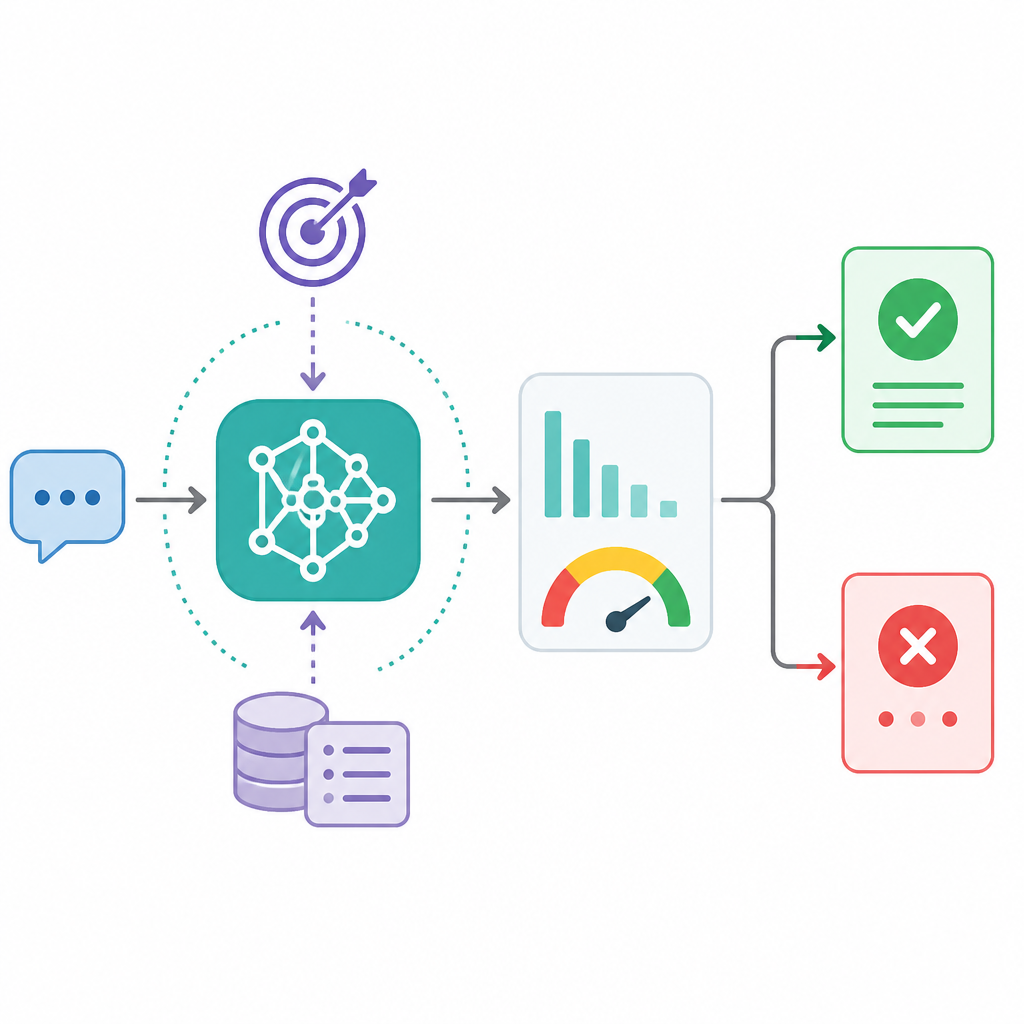
Selective prediction means the model is trained or evaluated not only on what it answers, but also on whether it should answer at all. The point is to create a system that can defer on inputs it finds too uncertain, rather than pretending every prompt deserves a full-confidence response.
For an LLM, that changes the alignment problem. You are no longer optimizing only for helpfulness or accuracy in the usual sense. You are also asking the model to expose uncertainty in a way that a downstream application can use. That can be especially important when the model is embedded in a larger workflow that already has fallback logic, human review, or escalation paths.
The abstract does not provide the paper’s exact training recipe, loss design, or selection rule, so those details should be treated as unknown from the source provided. What is clear is the direction: align LLM behavior with selective prediction rather than unconditional answering.
What the paper actually shows
From the abstract and notes available here, there are no benchmark numbers, no named datasets, and no reported percentage gains to cite. That means we should be careful not to overstate the evidence. The source establishes the research problem and the proposed framing, but it does not expose the quantitative results in the material provided.
That absence matters for readers trying to evaluate whether this is ready for production. Without metrics, you cannot tell from the abstract alone how much the approach improves coverage, calibration, abstention quality, or downstream task performance. Those are exactly the numbers engineers would want before changing a system design.
So the honest read is: the paper proposes aligning LLMs with selective prediction, but the raw abstract excerpt does not let us verify the scale of the improvement. If you need hard adoption criteria, you would need the full paper.
Why developers should care
Even without benchmark figures, the idea maps directly onto deployment pain points. Most teams eventually hit the same issue: a model that answers everything can create more risk than value when the domain is sensitive. Selective prediction gives you a framework for asking the model to be selective instead of overconfident.
That can simplify product design. Instead of treating every output as equally actionable, you can route low-confidence cases to a human, a safer fallback model, or a narrower rules-based system. In other words, the model becomes one component in a reliability stack rather than the sole source of truth.
For model builders, this also changes what “good” looks like. You may care less about raw answer rate and more about how well the model separates safe-to-answer cases from cases where abstention is the right behavior. That is a different optimization target, and it can reshape evaluation, logging, and UX.
Limitations and open questions
The biggest limitation here is the source itself: the abstract excerpt is thin. It does not include benchmark details, so there is no way to assess performance tradeoffs from the provided text alone. It also does not specify the research org, so attribution is unavailable in the source.
There are also open engineering questions the abstract does not answer. How is abstention calibrated? Does the method generalize across tasks or only in specific settings? What happens to coverage when the model becomes more conservative? And how easy is it to integrate selective prediction into existing LLM pipelines without hurting usability?
Those are the right questions for practitioners to ask before adopting the idea. The paper’s value, based on the abstract, is not that it proves a finished product; it is that it pushes LLM alignment toward a more operational definition of reliability.
Bottom line
This paper argues for a more deployment-aware kind of alignment: one where an LLM is not only accurate, but also selective about when it should speak. For engineers building high-stakes systems, that is a useful shift because reliability is often about knowing when to defer, not just about getting more answers right.
- Selective prediction is about answering only when confidence is high enough.
- The abstract provides no benchmark numbers, so quantitative impact is unknown here.
- The main engineering value is safer deployment through abstention and fallback routing.
// Related Articles