Genpact’s growth story is built on BPO scale
5 milestones explain how Genpact grew from a GE unit into a 125,000-person services firm.

Genpact grew from a GE back-office unit into a global services company with 125,000 employees.
Genpact’s history is a useful case study in how a captive back-office team became a public company with global reach. Read these 5 items to see the moves that shaped its scale, leadership, acquisitions, and product push.
| Item | Founded | Employees | Revenue |
|---|---|---|---|
| Genpact | 1997 | 125,000 (2023) | $4.48 billion (2023) |
1. GE back-office unit
Get the latest AI news in your inbox
Weekly picks of model releases, tools, and deep dives — no spam, unsubscribe anytime.
No spam. Unsubscribe at any time.
Genpact began in 1997 as GE Capital International Services, or GECIS, in Gurgaon, India. It started with 20 employees and a narrow mission: handle back-office work for GE Capital, including car loans and credit card transactions.

That origin matters because it shows the company helped shape the early business process outsourcing model before “outsourcing” became a standard corporate strategy. By 2001, the unit had grown to about 12,000 employees and was managing work across GE’s financial services and manufacturing businesses.
- Original name: GE Capital International Services
- Launch year: 1997
- Starting headcount: 20
- Early work: loans, card processing, back-office operations
2. Break from GE and rename
In 2003, GE sold most of its stake, and in January 2005 the company became independent and began serving clients outside GE. The new name, Genpact, was built around the idea of “generating business impact.”
This was the turning point from captive service arm to standalone vendor. Revenue in 2005 reached $493 million, and 15% of that came from new global clients rather than GE, which signaled that the business could sell outside its original parent.
- Independence year: 2005
- New name meaning: generating business impact
- 2005 revenue: $493 million
- New-client share of revenue: 15%
3. Public listing and global expansion
Genpact listed on the NYSE in August 2007 under the ticker G, then widened its footprint across India, the Philippines, Mexico, China, Europe, and the US. By 2008, it had crossed $1 billion in revenue, with more than half coming from clients other than GE.
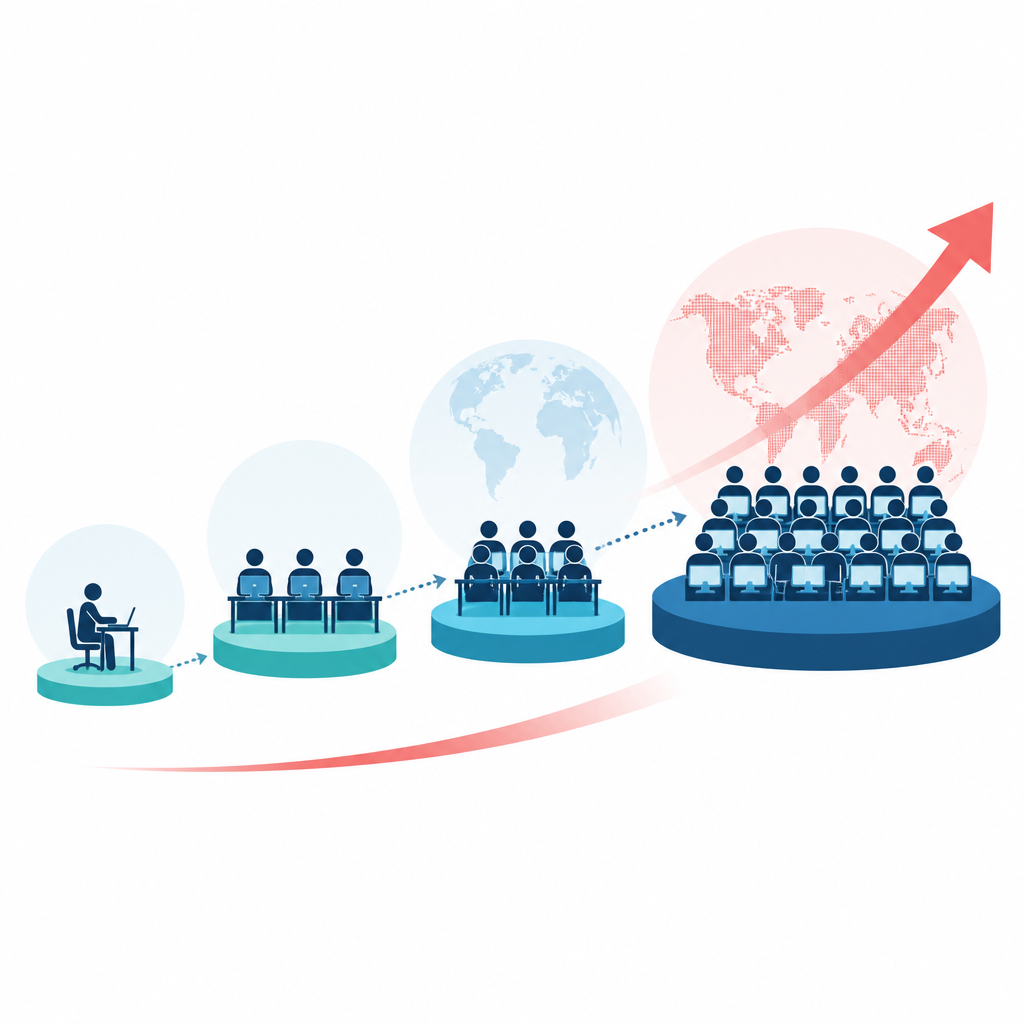
That shift shows how quickly the company moved from one-client dependence to a broader services portfolio. It also explains why Genpact later relocated its headquarters to New York as it leaned more heavily into Western markets.
- NYSE listing: 2007
- Ticker: G
- 2008 revenue: over $1 billion
- Client mix in 2008: 53% non-GE
4. Leadership changes and ownership shifts
Pramod Bhasin, the founding CEO, stepped aside in 2011, and NV “Tiger” Tyagarajan took over the same year. Tyagarajan had already helped guide the company through its GE-era growth phase, then returned after the spinout to lead sales, business development, operations, and later the CEO role.
Ownership also changed. Bain Capital became the largest shareholder in 2012, showing how private equity continued to shape the company even after the GE breakup. In 2024, Balkrishan “BK” Kalra became president and CEO after Tyagarajan retired.
- 2011 CEO change: Bhasin to Tyagarajan
- 2012 ownership shift: Bain Capital became largest shareholder
- 2024 CEO: Balkrishan Kalra
- Current leadership model: Genpact Leadership Council
5. Acquisitions and product bets
Genpact used acquisitions to move beyond classic outsourcing into software, analytics, design, and consulting. Deals included Headstrong, Endeavour Software Technologies, PNMsoft, TandemSeven, Rightpoint, and Enquero, each adding a different capability to the stack.
The company also pushed its own product layer. In 2017 it announced Genpact Cora, an AI-based enterprise platform with API design and open architecture. The stated goal was to improve data handling, customer service, financial reporting, and speed to market.
- Headstrong: software services
- Rightpoint: digital consultancy
- Enquero: data engineering and analytics
- Genpact Cora: AI-based enterprise platform
How to decide
If you want the origin story, start with the GE unit and independence sections. If you care about public-market scale, the listing and expansion phase matters more. If your focus is strategy, the acquisition list and Cora product bet show how Genpact tried to move from labor-heavy services into higher-value offerings.
For a quick read, the most useful lens is simple: Genpact is a company that grew by turning internal process work into a global services business, then layering acquisitions and software on top.
// Related Articles
- [IND]
80% of Q1 2026 VC Went to AI, But Blockchain Is Next
- [IND]
Seed’s anti-distillation rule turns open models into policy
- [IND]
Windows Codex and Claude Code fixes that work
- [IND]
Rust 1.97.1 fixes a compiler bug stable users felt
- [IND]
OpenAI Astra turns math proofs into a workflow
- [IND]
OpenCode Go makes open coding models affordable